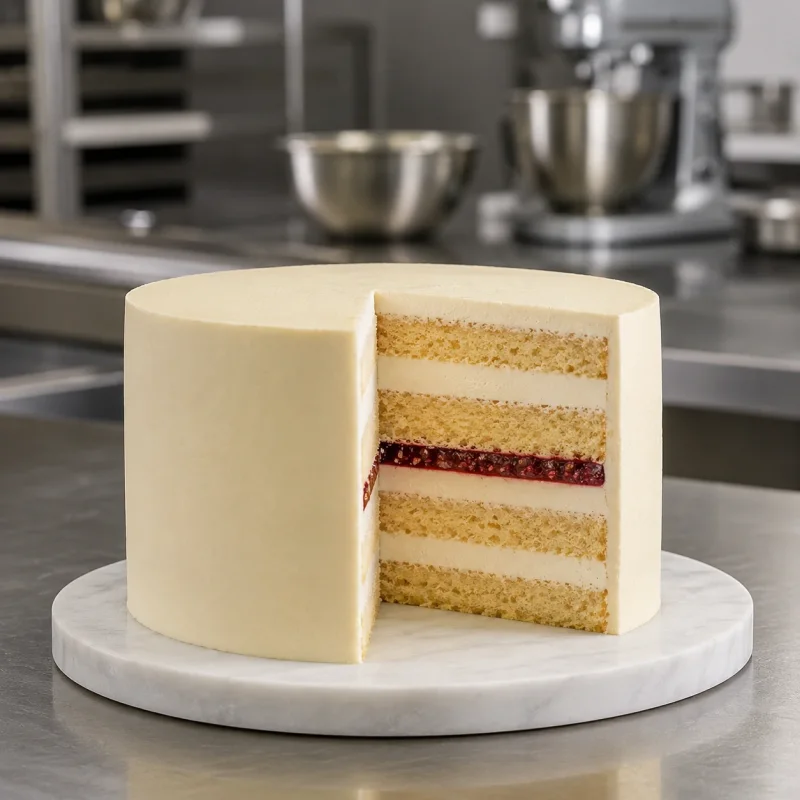
A stable layer cake is a system, not just a firm filling
A cake stays level when every layer does its job and can carry the load above it. The cake layers must hold their shape, the cream or filling must bind the layers without being squeezed out, fruit inserts must not create a slippery or overly wet plane, and the interfaces between layers must keep enough grip after chilling. If a cake slides, bulges or starts closing in after a slice is removed, first identify which layer failed. Only then change the formula or technique.
The most useful rule is simple: the weakest layer determines the slice.
For the wider science of how air, water, proteins, starch, fat and temperature build dessert structure, see the guide to dessert structure and stability. If a cream is already losing shape in the bowl or on the spatula, the problem is more likely the cream itself than the assembly; in that case, first check stable creams and mousses.
First identify what is actually moving
The same final appearance can come from very different causes. A filling that squeezes out at the edge is not necessarily just “too soft”. The layer may be too thick, the cake may not be level, a fruit insert may be sliding underneath, or the cake may not yet be evenly chilled through the centre.
| What you see | Check first | What to do |
|---|---|---|
| Filling squeezes out as soon as the next cake layer is added | filling strength and thickness, level cake layers | reduce the filling thickness or use it at the correct degree of firmness; place the next layer level without pressing hard |
| Layers start level but slide later | wet insert, grip between layers, temperature | reduce free liquid, contain the insert with a firmer cream dam and chill the cake evenly |
| Cake layer compresses into a wet band under the filling | doneness and load-bearing strength of the cake, moisture migration | use a fully cooled, adequately baked cake layer and check the amount of free liquid in the filling |
| Cake leans to one side | levelness of trimmed layers and even filling height | level the cake layers and keep the filling the same height around the full circumference |
| Slice spreads after lifting even though the whole cake stands | serving temperature and the softest internal layer | chill the cake further or redesign the softest layer so it carries the intended load |
That order matters. If you thicken the cream, reduce the fruit insert and extend chilling all at once, the cake may improve, but you still will not know what caused the failure.
Cake layers must carry weight without collapsing
A layer cake base should be tender enough to eat pleasantly but strong enough not to lose height under the filling. After a light press, the surface should spring back and the crumb should not be wet or compressed. A fully cooled cake is more reliable for assembly than a warm one: residual heat and steam can soften the interface with the cream and increase condensation.
In batters whose structure depends on eggs and incorporated air, both emulsion quality and foam stability matter. If the mixture splits during preparation, review the method for adding eggs to cake batters. For foam-based sponges, check the guide to common egg-white whipping mistakes.
The thickness of the cake and filling is not a quality measure by itself. A thicker soft filling creates more lateral pressure than a thinner layer of the same cream. A firmer filling can tolerate more depth, while a light whipped-cream or mousse layer at the same height needs more precise support and chilling. Set layer thickness according to the load-bearing capacity of the actual system, not one universal number.
Cream is the bond between layers, not a structural fix for every problem
A supporting cream should stay where you spread or pipe it, but it should not be so hard that it cracks during slicing or separates from the cake. With buttercream, a stable emulsion matters; a grainy surface, released liquid or an unusually greasy sheen suggests the system is no longer uniform. Correct the buttercream emulsion before using it as a structural layer.
Temperature strongly changes the flow behaviour of whipped-cream and mousse fillings. That is why no single chilling temperature or time works for every formula. A better control point is the state of the cream: before adding the next cake layer, it should hold the shape you gave it and should not start flowing toward the edge under the added weight.
If you want to build a cake without gelatin, choose the filling according to its actual load-bearing capacity, not only how firm it feels in the bowl. The guide to cake fillings without gelatin compares whipped-cream and mascarpone fillings, ganache, buttercream and cooked starch-based creams, and shows how to check stability before the cake is assembled.
If the cream is already soft before assembly and a spatula groove closes quickly, the cake structure will not fix it. But if the cream stands on its own and only squeezes out once the cake is loaded, check filling thickness, levelness of the cake layer and the interface with any fruit insert.
A wet insert can create a slip plane
In multi-component desserts, water redistributes over time between components with different moisture states. That can soften the cake, change the texture of an insert and weaken adhesion between layers. Do not judge a fruit filling only by how thick it looks in the saucepan. What matters is how it behaves when chilled and under the pressure of the next layer.
Cool fruit inserts completely before assembly. Keep them inside a dam of the more stable cream so lateral pressure does not act directly on the outer edge of the cake. If the filling spreads readily when slightly tilted or pressed, it is not ready to act as a load-bearing layer. See the detailed guide to fruit filling that stays inside the cake.
With a very wet filling, a thin fat-rich layer such as a suitably formulated ganache or chocolate layer can slow water transfer between components. It is not a perfect moisture barrier for every cake, and it must not be so thick or hard that it behaves like a brittle plate when sliced.
If a filling separates from its base, thickness may not be the only issue. Different shrinkage, a very smooth surface or an unsuitable interface between wet and dry phases can create a separation line. For that problem, also check why a filling separates from the crust.
Level layers are a mechanical requirement, not just a cosmetic detail
A sloping cake layer transfers more weight to one side. The soft filling compresses more there, the layer above tilts, and every additional layer magnifies the error. Level each cake layer before assembly, then check the cake at eye level after every new layer, not only from above.
Assemble softer cakes inside a straight cake ring. Acetate should be smooth and wrinkle-free because soft fillings conform to the wall as they chill. Spread the filling evenly and lower the cake layer straight down. Press only enough to establish full contact; force is not a levelling technique.
If filling immediately escapes over the edge, stop assembling. Adding more layers only increases the load and makes diagnosis harder.
For tiered cakes, structural support is a separate issue from cream firmness. The upper tier should not load the soft layers of the cake below directly; each tier needs a suitable board and support system for its weight and construction. In a normal single-tier layer cake, however, dowels are not a substitute for a weak cake layer or unstable filling.
Chilling is a structural step
Chilling is not just waiting before decoration. It firms fat phases, lets gels reach working strength, equalises temperature through the cross-section and makes the whole structure less sensitive to movement.
Set chilling time from the thickness, composition and temperature of the entire cake, not one universal number of hours. A tall cake with several thick layers needs longer than a low cake with thin filling. The outer edge can feel firm while the centre is still soft.
A useful control check is to remove the ring and observe the cake briefly on a level surface. The sides should stay vertical, upper layers should not shift, and filling should not begin creeping toward the open space. See the detailed method for chilling a cake for level, stable layers.
If the cake moves during assembly, chill it before adding more weight. Freezing, however, is not a permanent fix for a filling that lacks sufficient strength at serving temperature.
Cheesecake is a different structural system
In cheesecake, load-bearing strength does not come from alternating cake and cream layers but from a gelled or coagulated interior. Do not evaluate it by exactly the same rules as a tall layer cake.
Near the end of baking, the edge should be visibly more set than the centre, while the middle should wobble as one connected mass rather than move like liquid. A baked cheesecake continues to stabilise while cooling. Baking until the centre is completely rigid increases the risk of a dry, overbaked texture and greater shrinkage.
For specific troubleshooting, use the guide to cheesecake without cracks.
A clean slice tests the entire structure
Before slicing, the cake should be cool enough for the softest layer to hold its shape, but not so hard that butter-based or chocolate layers fracture under the knife. The state of the cake therefore matters more than one fixed serving temperature for every style.
Use a long, straight, sharp knife. If useful, warm the blade in hot water, wipe it completely dry, and make one calm vertical cut. With a very soft mousse, keep the blade only mildly warm; an overheated knife can melt and smear the surface.
Clean the blade after every cut. Support as much of the slice as possible when lifting it and avoid twisting it; a narrow server under only one edge can break the lower cake layer.
Checklist before assembly and slicing
Before the next cake, check these points in order:
- Cake layer: is it completely cool, level and strong enough?
- Cream or filling: does it hold its shape before assembly?
- Insert: is it chilled and free from excess unbound liquid?
- Interface: do layers grip without sliding or a hard brittle barrier?
- Geometry: are all layers level and similarly loaded?
- Chilling: is the centre stabilised as well as the outside?
- Slice: do the exposed edges remain vertical after a piece is removed?
If you can answer those seven questions, most problems do not need more gelatin, starch or a much firmer cream. Identify the weakest link first and change only the element that failed. That produces a cake that is not merely firm in the refrigerator but stays neat when served and sliced.
Diagnostics
Common problems and solutions
Cream squeezes out at the edge as soon as the next cake layer is added.
Cause: The filling layer is too thick for its strength, the cream is too soft, or the cake layer is not level.
Solution: Stop assembly. Check whether the cream holds a spatula groove, reduce layer thickness or stabilise it according to its formula, and place the cake layer level without heavy pressure.
The cake is level during assembly, but the layers slide after chilling.
Cause: A moist insert or poor adhesion creates a slip plane; the centre may also be unevenly stabilised.
Solution: Check free liquid in the insert, use a supporting cream dam and, when appropriate, a thin compatible barrier; judge the next batch by the state of the centre, not only the edge.
The cake layer compresses under the filling and becomes wet.
Cause: The cake is not strong enough, or moisture migrates from the filling faster than the structure can tolerate.
Solution: Use a fully cooled, adequately baked cake layer, reduce free liquid in the filling and assess whether a suitable intermediate barrier is needed.
Upper layers lean only to one side.
Cause: A sloping cake layer or uneven filling height redirects the load.
Solution: Level every cake layer, check horizontal alignment at eye level after each layer, and do not use extra pressure to force the cake level.
A slice spreads when lifted even though the cake looks firm inside the ring.
Cause: The softest internal layer is not yet stable at slicing temperature, or it is too thick for its load-bearing capacity.
Solution: Chill the cake more evenly and, next time, adjust the thickness or formula of the softest layer instead of hardening every layer.
Technical terms
Terms worth understanding
- Load-bearing capacity of a layer
- The ability of a cake layer, cream or insert to keep its shape under load without excessive compression, sliding or squeezing out.
- Moisture migration
- Movement of water between components with different water activity, which can change the texture of cake, filling or cream over time.
- Slip plane
- An interface with low adhesion or excess free liquid along which layers move more easily under load.
- Cross-section stabilisation
- Equalising and firming the structure through the whole cake during chilling so the centre also holds its shape when sliced.
Frequently asked questions
Answers to common questions
How long should a layer cake chill before slicing?
There is no single correct number of hours for every cake. Time depends on height, layer thickness and the type of cream or gel. Slice only when the centre is stable too: after removing the ring, the sides do not bulge and the layers do not shift.
Why does cream squeeze out when I add the next cake layer?
The cream may be too soft, the layer too thick or the cake layer uneven. If the cream holds its shape on its own, check thickness and assembly geometry first; stronger pressure usually only squeezes out more filling.
How do I stop fruit filling from making cake layers soggy?
Cool the filling completely, limit free liquid and keep it inside a supporting cream dam. With very moist inserts, a thin compatible fat-rich layer can slow water transfer, but it is not a universal perfect barrier.
Does every tall single-tier cake need dowels?
Not simply because it is tall. For a single-tier cake, strong cake layers, stable filling and a level base are the key factors. Structural support becomes essential in tiered cakes or other designs with substantial point loads.
How do I get clean slices without smearing the cream?
Chill the cake until the softest layer holds its shape, use a long sharp knife, warm the blade gently if useful and wipe it completely dry. Make one calm vertical cut and clean the knife before the next slice.