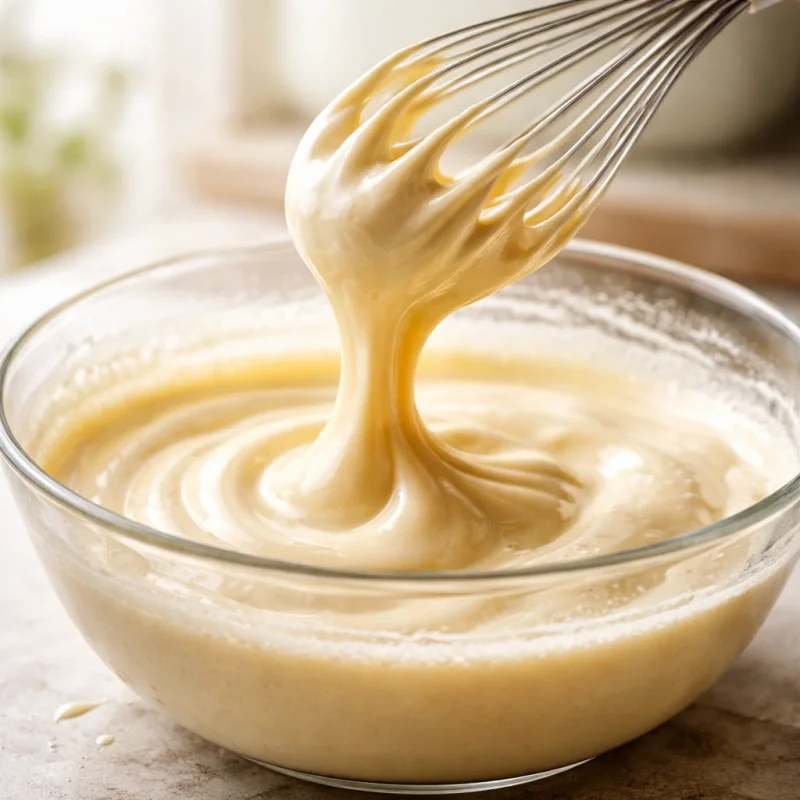
How to tell when eggs and sugar are whipped enough for sponge cake
For a sponge made with whole eggs and sugar, you are not looking for stiff peaks. You are looking for a pale, clearly increased, thick foam that falls from the whisk in a broad ribbon and leaves a visible trail on the surface for a few seconds.
That ribbon test is more dependable than “whip for 8 minutes.” Batch size, sugar ratio, egg temperature and mixer power can change the time substantially.
Whole-egg foam is not the same as whipped egg whites
A common source of bad advice is applying egg-white rules to whole eggs. Egg whites are judged by soft, medium or stiff peaks. Whole eggs with sugar stay pourable, but become much thicker, paler and more aerated.
So “whip until just before the foam breaks” is not a useful endpoint for whole eggs. The better controls are volume, fine bubbles, viscosity and the ribbon left by the whisk.
What changes as you whip
The whisk disperses air through the egg mixture. Egg proteins help stabilize the air bubbles while sugar changes the viscosity of the liquid phase and affects how quickly the foam develops.
You will usually see three broad stages. First the mixture is yellow, thin and coarsely foamy. Then it becomes paler and noticeably larger. Finally it becomes thick and fine enough to fall from the whisk in a broad ribbon.
That final stage is the key checkpoint in many foam-leavened sponge cakes.
The ribbon test: a better endpoint than the clock
Stop the mixer and lift the whisk roughly 10 to 15 cm above the bowl. Let the mixture fall back onto itself.
A well-developed whole-egg foam should fall in a broad, continuous ribbon, leave a clear trail for a few seconds, look much paler than it did at the start, and show fine rather than watery bubbles. You can also draw a figure eight with the falling batter. If part of the line is still visible briefly, you are at or very close to ribbon stage.
If the trail disappears instantly into a thin mixture, keep whipping. If it sits a little longer, that does not automatically mean the eggs are overwhipped.
How to whip whole eggs and sugar with control
Room-temperature eggs generally whip faster than refrigerator-cold eggs. Some classic génoise methods gently warm the eggs and sugar over a water bath before or during whipping. That can help dissolve the sugar and speed volume development, but it is not mandatory unless the formula calls for it.
Use medium to medium-high speed until the mixture is pale and thick. Maximum speed from the first second to the last is not a requirement. With a powerful stand mixer, a short finish at a lower speed can help even out the bubble structure.
Sugar does not have to be added in one universal way either. Some methods start with eggs and sugar together; others add sugar gradually. Both can work. Follow the formula and judge the final foam rather than treating one sequence as a law.
Most of the lost air may disappear when you add flour
A perfect ribbon-stage foam can still be ruined in seconds by rough folding. Sift the flour, add it in two or three additions, and fold from the bottom of the bowl up and over while rotating the bowl.
The goal is not to fold as slowly as possible. The goal is to use the fewest effective strokes needed to remove dry flour pockets.
If the batter remains visibly airy and thick after the flour is incorporated, you have protected the foam. If it quickly turns loose and loses a large amount of volume, the folding was too aggressive or too long.
For the broader sponge process, see PEK’s guide to a fluffy, stable sponge cake.
What common symptoms mean
The mixture is thin and the ribbon disappears immediately. Keep whipping. Very cold eggs can simply take longer.
The mixture has volume but the bubbles still look coarse. Continue until the foam becomes finer; with a strong mixer, a brief lower-speed finish can help.
The foam collapses when flour goes in. Next time sift the flour, add it in stages and reduce the number of folding strokes. Also check whether the egg mixture really reached ribbon stage first.
The sponge is still low even though the ribbon looked right. The egg foam is not the only possible cause. Formula balance, doneness, pan dimensions and later handling also matter.
Frequently asked questions
Answers to common questions
How do I know when eggs and sugar are whipped enough?
Lift the whisk. The mixture should fall in a broad, thick ribbon that stays visible on the surface for a few seconds. It should also be much paler and noticeably increased in volume.
Do I need to whip for an exact number of minutes?
No. Time is only a guide because batch size, egg temperature and mixer power vary. Judge the foam by color, volume, bubble size and the ribbon test.
Can you overwhip whole eggs and sugar?
There is little benefit in whipping for a long time after a clear ribbon is reached, but a few extra seconds do not automatically destroy the foam. Folding technique is often the bigger risk.
Do I always need to add sugar gradually?
No. Some sponge methods whip whole eggs and sugar together from the start, while others add sugar gradually. Follow the formula and judge the final foam.
Why does the foam collapse when I add flour?
Usually because the flour is mixed too aggressively or for too long, or because the egg foam was underdeveloped. Sift the flour, add it in stages and fold only until no dry pockets remain.
Are room-temperature eggs better for whipping?
They usually whip faster and can reach greater volume more easily. Cold eggs can still be whipped successfully, but often take longer.
Is this the same as whipping egg whites?
No. Whole eggs with sugar are judged by viscosity and ribbon stage, not by soft, medium or stiff peaks.