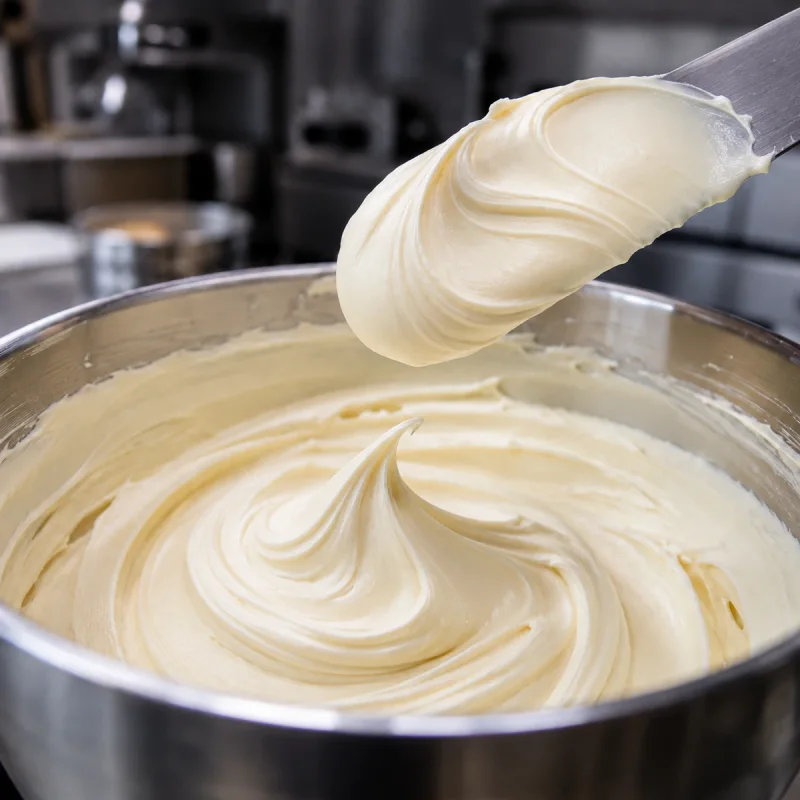
Buttercream that looks curdled and buttercream that flows out of the bowl can need opposite fixes. Before you add sugar or turn up the mixer, identify the type of cream and check whether it is cold and firm or warm and loose.
First identify what is in the bowl
American buttercream is mainly butter and icing sugar, sometimes with milk or cream. Its firmness depends strongly on the recipe’s proportions. A soft batch is not necessarily a broken emulsion.
Swiss and Italian meringue buttercreams incorporate butter into a whipped egg-white-and-sugar base. Water, fat and air must form a uniform texture. During the addition of butter, a briefly curdled appearance can be part of the process; assess the finished addition and the recipe’s mixing stage before declaring the batch a failure.
For the wider question of fillings and layers holding their shape, see stable cake layers and clean slices.
Cold and lumpy: warm gently
If meringue buttercream contains firm butter pieces and the bowl feels cold, the butter may be too stiff to blend evenly. Mix slowly and gently warm the outside of the bowl, or warm a small portion and mix it back into the batch.
Stop adding heat once the texture starts to smooth. The aim is workable butter, not melting the whole batch. If the cream becomes flowing and oily, do not keep warming it.
Warm and flowing: chill before mixing again
A cream that loses its peak and whose spatula ridge immediately closes may be too warm. Briefly chill it, then mix and assess the response. For a smaller batch, 5–10 minutes can be a first checkpoint, but the bowl, room and amount all change the cooling time.
Do not keep chilling until the whole batch becomes hard. The useful endpoint is a smooth cream that spreads while retaining a ridge.
American buttercream needs a formula check too
If cooling improves the cream, temperature was part of the problem. If it is still too soft at a suitable working consistency, check the milk or cream against the butter and icing sugar in the recipe.
Extra icing sugar can thicken American buttercream, but it also changes sweetness and proportions. Adding it to meringue buttercream does not automatically solve a temperature fault. More beating is likewise not a universal answer: mixing a warm batch can add heat.
Read firmness as well as shine
Butter contains water dispersed in a fat phase and a network of fat crystals. The balance of solid and liquid fat influences how easily it spreads. This helps explain why the same recipe can behave differently in a cold room and a warm kitchen.
A satiny surface, smooth spatula stroke, defined ridge and soft peak are useful working signals. A greasy feel or shine alone is not a diagnosis: cold, dense buttercream and warm, flowing buttercream require different assessments. Check separated liquid as well.
Temperature differences can also matter when adding eggs to butter-based cake batter; the method there concerns cake batter, so do not apply its instructions wholesale to frosting.
Test the correction before frosting the cake
Change one variable, mix and spread a small amount. If the ridge holds and the texture is uniform, test the intended piping or coating. If the same symptom remains, check the recipe and ingredient additions before repeating the same correction indefinitely.
Texture repair is not a food safety treatment
Gentle warming of the bowl does not pasteurize egg whites. If a recipe would leave eggs raw or undercooked, use a suitable pasteurized egg product. Follow the recipe’s safe storage instructions. Do not try to rescue cream whose safe handling or storage cannot be confirmed by chilling or beating it; a smooth surface is not proof of safety.
Diagnostics
Common problems and solutions
Cold, curdled meringue buttercream with firm butter lumps
Cause: The mixture may be too cold or uneven in temperature.
Solution: Check that the pieces are firm and the cream is cold. Gently warm the outside of the bowl while mixing slowly; stop warming as the texture smooths.
Very soft, flowing meringue buttercream
Cause: The butter may be too warm to hold its structure.
Solution: Check whether a ridge disappears and a peak slumps. Chill briefly, mix again and reassess.
Soft American buttercream without curds
Cause: Temperature or too much liquid relative to butter and sugar may be responsible.
Solution: Correct temperature first. If the cream remains soft at a suitable working consistency, check the recipe’s balance rather than only extending mixing.
A greasy film on the cream
Cause: A greasy sensation alone does not distinguish cold, dense cream from warm, flowing cream.
Solution: Check firmness, temperature and any separated liquid. Gently warm cold, dense meringue buttercream; briefly chill a warm, flowing batch. For American buttercream, also check the formula.
Frequently asked questions
Answers to common questions
Can I add icing sugar to meringue buttercream?
It changes sweetness and ingredient proportions. It is not the first correction for a temperature-related fault; assess the texture first.
Are hard pieces always sugar?
No. Firm butter pieces differ from the sandy feel of undissolved sugar. Check the recipe and the particles before adjusting the cream.
How do I check that the cream is ready to spread?
Spread a small amount with a spatula and test a ridge or soft peak. Flowing edges or separated liquid mean it is not ready for an even finish.
Does gentle warming make egg whites safe?
No. Warming to repair texture is not pasteurization. Use a suitable pasteurized product when eggs would otherwise remain raw or undercooked, and follow preparation and storage instructions.