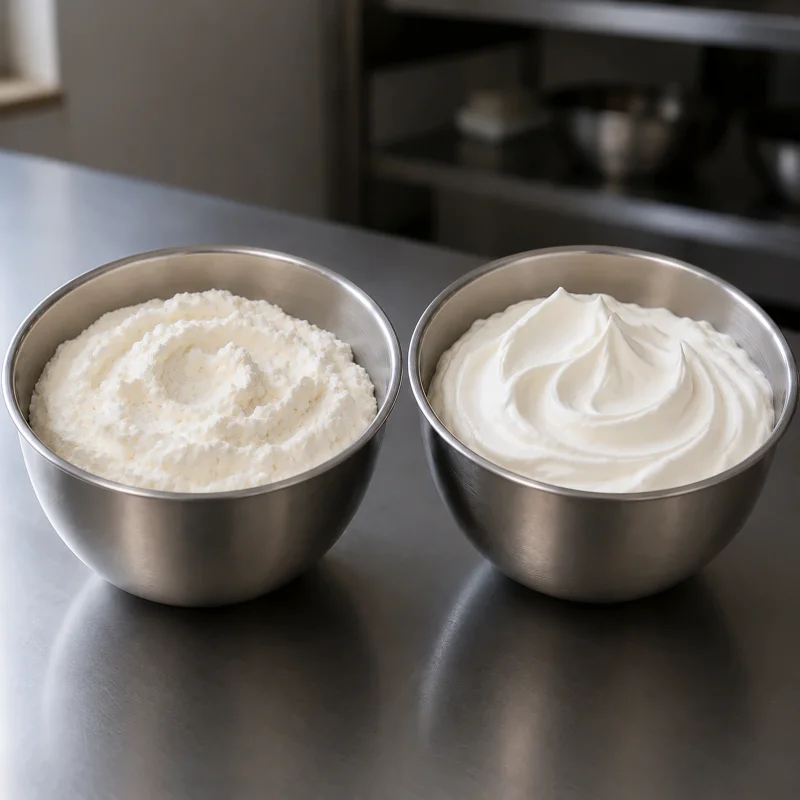
Whipping cream: identify the stage before you try to fix it
The whisk suddenly stops leaving broad, smooth trails. The surface turns dull, the folds look rough, and tiny white grains appear. That is the point where a rescue may still work. In the wider system of stable creams and mousses, whipped cream needs enough structure to hold air, but the fat network must not be pushed so far that liquid starts separating.
This guide applies to dairy whipping cream. Plant-based whipping products can use different fats, emulsifiers and stabilizers, so the same rescue method is not automatically transferable.
If the cream is only slightly overwhipped, stop the machine and gently work in a small amount of cold, unwhipped cream. The fresh liquid phase loosens an overly tight fat network and can bring back a smooth texture. The rescue has worked when the cream is evenly white, slightly glossy and leaves continuous whisk trails without visible grains.
Once liquid is collecting in the bowl or yellowish fat particles appear, the problem is no longer just overwhipping. Butter formation has begun.
Quick visual check
| Stage | What you see | What to do |
|---|---|---|
| Underwhipped | Liquid or very soft foam; whisk trails disappear quickly | Keep whipping and check the peaks often |
| Soft to medium peaks | Smooth, glossy surface; peak holds with a slightly bending tip | For most fillings and folding, stop here |
| Slightly overwhipped | Dull surface, tiny white grains, no separate liquid yet | Stop immediately and gently add a little cold liquid cream |
| Beginning of butter | Yellowish fat particles and separated liquid | Do not try to return it to load-bearing whipped cream |
This visual sequence matters more than a fixed number of minutes. Batch size, cream composition, temperature, bowl geometry and mixer power can all change how fast one stage becomes the next.
If the cream will not whip at all
This is a different problem from overwhipping. First check whether the product is actually intended for whipping, whether it is well chilled, and whether the whisk reaches a deep enough layer of liquid. A very small amount in a broad bowl can stay apparently loose simply because the whisk cannot incorporate air efficiently.
Do not add mascarpone or gelatin just to force a liquid cream to become firm. A stabilizer is designed to support a foam that has already formed; it cannot replace the formation of that foam. For longer holding, transport or sharp piping, use the separate guide to stabilizing whipped cream after the whipping stage itself is correct.
Why smooth whipped cream becomes grainy
Whipping cream is an emulsion: fat droplets are dispersed through a watery phase. Whisking incorporates air while partly crystallized fat droplets begin to connect. This controlled partial coalescence builds a network around the air bubbles, turning liquid cream first into a soft foam and then into a structure that can hold a filling or topping.
If you keep whipping after the useful peak stage, the fat droplets continue to aggregate. More membranes are disrupted, fat clusters become larger, the surface loses its gloss and the foam becomes coarse. Keep going and the network stops behaving like whipped cream: fat and liquid begin to separate.
The speed of that transition is not fixed. It changes with fat content, temperature, batch depth, bowl size and mixer power. A small batch in a large bowl can move from firm peaks to graininess in only a short time, especially at high speed.
Sugar does not stop this process. Mascarpone, gelatin and other stabilizers cannot repair a batch in which the fat has already clearly separated.
How to add liquid cream without making the foam runny
Use cold, unsweetened liquid whipping cream. Milk or water is a poor substitute here because it lowers the fat concentration and changes the foam structure. There is also no single “magic” temperature that works for every cream: research shows that even within a chilled range, temperature affects whipping time, overrun and firmness. In practice, start with refrigerator-cold cream and judge the texture.
For about 250 ml of the original cream, roughly 15 ml of cold liquid cream is a conservative first test when the graininess has only just appeared. It is not a universal ratio. A barely rough batch may need less; a more damaged foam may need several small additions and may never regain the volume of a correctly whipped fresh batch.
Rescue method for slightly grainy whipped cream
- Stop the electric mixer immediately.
- Add about 15 ml cold liquid cream for roughly 250 ml of the original batch.
- Use a hand whisk for a few slow strokes, or fold gently two to four times with a broad spatula.
- Check the surface and the trail left by the tool.
- If fine grains remain, add another 5–10 ml and repeat gently.
The most important measurement is the visible texture. Stop as soon as the grains disappear and the cream becomes cohesive again. Rescued cream may be a little denser and less voluminous than a batch that was stopped correctly; that is a normal limitation of the repair.
Do not pour in a large amount of fresh cream at once. The outside of the mass can become loose before the dense fat clusters inside are evenly dispersed, producing a cream that looks smooth for a moment but releases liquid later.
How firm should rescued cream be?
Do not automatically whip rescued cream back to very stiff peaks. For fillings, mousses and folding, a smooth medium peak is often the safer endpoint. The peak should hold its basic shape while the tip still has some flexibility.
Remember that the cream will be worked again when you fold it into another filling, spread it, smooth a cake or pipe it. If you already take it to the limit in the bowl, that later handling can push it grainy again.
A successfully rescued cream should show these signs:
- an even, slightly glossy surface;
- smooth continuous tool marks;
- no tiny grains;
- no liquid collecting at the bowl edge;
- peaks that form without crumbling or cracking.
If the cream is going into mascarpone, smooth the whipped cream first. Then combine it with a correctly prepared mascarpone cream without lumps. Mascarpone should not be used to hide damaged whipped cream, because the graininess can remain visible in the final filling.
When extra cream cannot help anymore
The line between overwhipped cream and butter formation is visible. In the irreversible stage, the white grains grow larger, the mass separates into firmer fat particles and thinner liquid, and the fat can look slightly yellow. The sound of the mixer may change because the whisk is no longer moving through a uniform foam.
At that point, adding more liquid cream does not reliably rebuild the original whipped-cream structure. You may briefly disguise some roughness, but the damaged fat network tends to show itself again as the mixture sits.
Soft cream can still be whipped further. Butter grains cannot be turned back into the original foam.
If the liquid has clearly separated, the practical choice is to continue until butter and liquid are fully separated and use them appropriately elsewhere. Do not use that mass as a load-bearing cake cream; it can leak and create greasy, uneven layers.
How to keep the mistake from happening again
Begin at a moderate speed. Once the cream thickens and the whisk leaves clear trails, reduce speed and check frequently. Finish the last part slowly or by hand. A timer is a weak control because the final transition can happen very quickly in a small batch.
Choose a bowl that gives the whisk enough depth. The bowl should allow movement, but it should not be so wide that a small amount forms only a thin film on the bottom.
If the cream needs to hold for longer, stabilize it only after the foam itself is correct. A method for making firm cream without gelatin cannot compensate for a batch that has already been overwhipped; it can only support cream that was whipped properly in the first place.
The safest stopping point is usually just before maximum stiffness. Switch the mixer off, lift the whisk and look at the peak. If the cream is smooth, the peak is stable and the tip still has a little flexibility, it is ready for the next step.
Diagnostics
Common problems and solutions
The cream stays liquid and the whisk leaves no lasting trail.
Cause: The product may not be suitable for whipping, may be too warm, or the whisk may be working in a layer that is too shallow.
Solution: Use properly chilled dairy whipping cream and, for small amounts, a narrower bowl so the whisk can incorporate air effectively.
The foam is smooth and glossy; a peak holds but its tip bends slightly.
Cause: The cream has reached a useful medium-peak stage rather than a failure point.
Solution: Stop whipping. This is a safe working firmness for many fillings, folding jobs and desserts.
The surface is dull with tiny white grains but there is no separated liquid.
Cause: The fat network has been mechanically tightened past the ideal peak stage, but the foam has not yet separated into butterfat and liquid.
Solution: Stop the mixer, add a small amount of cold unwhipped cream and gently whisk or fold by hand until the texture becomes smooth.
Yellowish fat clumps and separated liquid are visible.
Cause: The fat phase has aggregated far enough that butter formation has begun.
Solution: Do not try to restore it as load-bearing whipped cream; continue toward butter or repurpose the batch.
Technical terms
Terms worth understanding
- partial coalescence
- Controlled joining of partly crystallized fat globules during whipping; it helps build the network that supports air bubbles.
- medium peaks
- A peak that keeps its shape while the tip still bends slightly; a useful working stage for many fillings and creams.
- overwhipping
- Continuing mechanical action after the desired peak stage, causing larger fat aggregates, loss of smoothness and eventually phase separation.
Frequently asked questions
Answers to common questions
How do I know when whipped cream is done?
Look for a smooth, slightly glossy surface, visible whisk trails and peaks that hold. For many uses, stop at medium peaks before the cream becomes dull or grainy.
How do I fix overwhipped cream?
If it is still white and only slightly grainy with no separated liquid, gently add a little cold unwhipped cream. Stop as soon as the foam becomes smooth again.
Can I fix whipped cream that is already separating into butter?
Not reliably. Yellowish fat particles and distinct liquid separation mean the system has moved into butter formation.
Why won't my whipping cream whip?
Check that the product is intended for whipping, that it is well chilled and that the whisk reaches a deep enough layer of cream. Stabilizer cannot replace formation of a proper foam.
Can rescued whipped cream still be piped?
Sometimes, if it is smooth and firm enough again, but it may be denser and less airy. For very precise decoration, a fresh batch stopped at the correct stage is more reliable.
Can plant-based whipping cream be rescued the same way?
Not necessarily. Plant-based products can use different fats, emulsifiers and stabilizers, so follow the instructions for the specific product.