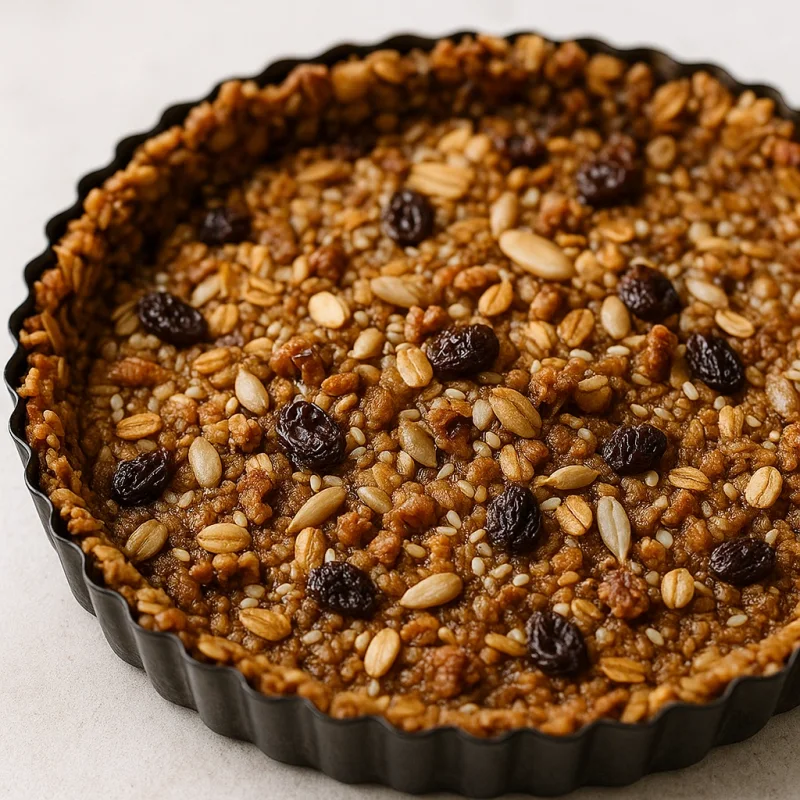
Granola for cake: sugar 'melting' is not the real problem
For cake granola, the goal is not to keep sugar unchanged. Honey, maple syrup and other sweeteners concentrate and brown during baking, helping oats, nuts and seeds bind together. The structure firms further as it cools.
Two questions matter more: Is the granola crisp but still pleasant to cut? And how long will it stay crisp next to a moist cream?
Decide what the granola is doing
As a topping, keep it separate and add it near serving.
As an internal crunch layer, it needs enough cohesion to stay in the slice but should not become a hard slab.
As a pressed crust, it needs more binding because it supports the whole slice.
Building larger clusters
Coat the dry ingredients evenly with sweetener and fat without leaving syrup puddles. Press the mixture lightly on the tray, disturb it as little as practical during baking, and let it cool completely before breaking.
A large part of the final crisp structure develops during cooling.
Why a layer becomes rock-hard
Too much sweetener, a thick layer, overbaking or an excessive amount of chocolate can create a slab that cuts like hard candy.
A cake crunch layer should have controlled fracture. Your knife should pass through it without forcing mousse or soft cream out of the slice.
Why granola softens next to cream
Granola is dry. Mousse, yogurt, whipped cream and fruit gels contain far more available water. When they touch, moisture moves into the dry component and crispness gradually disappears.
Simply baking the granola longer cannot permanently solve that.
Topping: the simplest solution
If granola does not need to be structural, add it shortly before serving. This gives the strongest crunchy contrast.
Internal crunch: chocolate or praline
For a cake that must chill for hours or overnight, lightly bind completely cooled granola with chocolate or praline.
Use only enough to coat and connect the pieces, and keep the layer thin. The fat phase reduces direct contact with water and slows softening, but it is not a permanent waterproof barrier.
Cool completely before storing or coating
Do not seal warm granola in a container. Trapped steam quickly destroys crispness.
Let it cool fully before breaking, storing or adding chocolate.
For topping: bake → cool fully → store dry → add late. For an internal layer: bake → cool fully → lightly bind → spread thin → chill → assemble.
Diagnostics
Common problems and solutions
Granola is soft and sticky.
Cause: It was under-dried or sealed while warm.
Solution: Cool completely before storing and dry further if needed.
The layer is hard like a slab.
Cause: Too much binder or too thick a layer.
Solution: Reduce binder and thickness.
Granola softens quickly next to cream.
Cause: Moisture is migrating from the cream.
Solution: Add later or lightly bind with chocolate/praline.
Frequently asked questions
Answers to common questions
Do I need to stop sugar from melting in granola?
No. That is the wrong target. Sweeteners help bind and brown the mixture. Problems come from excess binder, overbaking or moisture absorbed after baking.
How do I get larger crunchy granola clusters?
Coat the dry mix evenly, press it lightly on the tray, stir as little as practical and let it cool completely before breaking it into clusters.
How do I keep granola crisp between cake layers?
Reduce direct water contact. A thin granola layer lightly bound with chocolate or praline slows softening, especially when it is separated from very wet fruit gels.
Can I make cake granola ahead?
Yes. Cool it completely and store it airtight in a dry place. Use it while it still smells fresh, tastes clean and has a crisp texture.
Can I re-crisp granola before assembling the cake?
Plain granola can be briefly dried again at moderate heat and then cooled completely. There is no universal time and temperature for every formula, and this method is not suitable once chocolate or cream has been added.