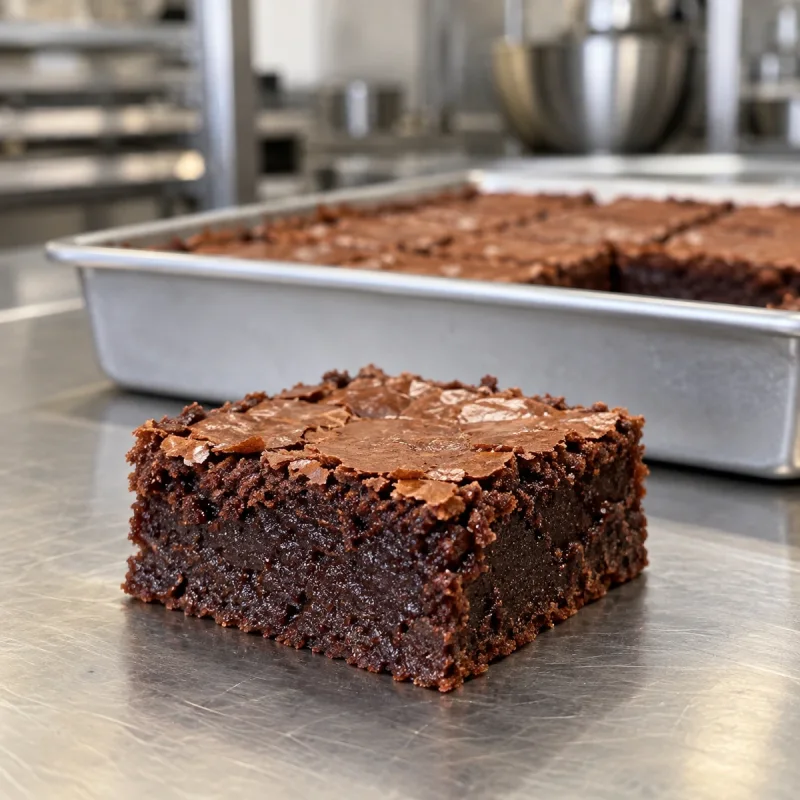
If the edges are dry but the center is still raw, do not just bake longer
One of the most common brownie mistakes is misreading a soft center. A fudgy center is not the same as raw batter. A properly baked dense brownie already has a stable edge while the middle stays moist and soft. Insert a thin knife or toothpick near the center: it may come out with moist crumbs, but it should not be coated in a layer of liquid, glossy batter.
If the edges are already dry while the middle is clearly raw, another ten minutes often increases the difference between edge and center. First check batter depth, pan size and material, and the oven's actual temperature.
Judge the brownie only after it has cooled. A warm brownie is softer, its fat is more fluid, and the center has not yet reached its final structure. A cut straight from the oven is therefore a poor test of whether the formula is truly too wet or greasy.
First decide which texture you actually want
There is no single "correct" brownie texture. Fudgy, chewy and cakey brownies use similar ingredients, but different ratios and methods move the result in different directions.
| Goal | What usually supports it | What quickly moves it away from the goal |
|---|---|---|
| Fudgy | less flour relative to the rest of the batter, plenty of fat, little or no leavener, no unnecessary extra liquid | more flour, more leavener, overbaking |
| Chewy | enough sugar, oil or a combination of oil and melted butter, moderate structure | very little sugar, too much flour, drying out |
| Cakey | more flour and egg structure, added liquid or leavener depending on the formula | very high fat and very little flour |
These are directions, not a universal formula. Brownie recipes differ, so do not change several variables at once. If you want to identify the cause, change only one thing in the next batch.
More flour does not simply mean a "firmer" brownie
Flour contributes starch and proteins that build structure during baking. As its proportion rises, the brownie generally moves more easily from a dense fudgy texture toward a lighter, more cake-like crumb.
If your brownie is too dry, bake time is therefore not the only thing to check. Confirm that the flour was weighed, that the original formula was written in grams, and that a volume conversion did not accidentally add extra flour.
The opposite mistake is cutting flour without understanding the whole formula. Remove too much dry structure and the middle may stay greasy, fragile or so soft that it is difficult to slice cleanly even after cooling.
Fat controls more than moisture
Butter and oil are not fully interchangeable. Butter also contains water and milk solids and firms as it cools, so it gives a different texture and flavor. Oil stays liquid at room temperature and often supports lasting softness and chewiness.
That does not mean oil is always better for a fudgy brownie, or that butter automatically makes a cakey result. The balance of the whole formula matters more than any single ingredient. A one-for-one fat substitution can change the texture even when the total weight of the recipe barely changes.
If you want stronger chocolate flavor, do not try to fix texture by adding cocoa blindly. Cocoa binds liquid and can change the perception of dryness. For chocolate and cocoa selection and ways to deepen flavor without extra sugar, use How to intensify chocolate flavor without adding more sugar.
A shiny crackly crust is not a doneness test
A thin shiny brownie crust is mainly a result of formula and method, not proof that the center is fully baked.
Partly dissolving the sugar before baking can help create a thin glossy layer. In some formulas, added chocolate also contributes. But the crust is not a reliable thermometer: a brownie can have a beautiful crackly top and still be underbaked in the middle, or be perfectly baked without a strong shine.
Do not use gloss as the final test. Judge the edge, the appearance of the center, the mark left on the tester and the texture after cooling.
The pan can change the result even when the recipe stays the same
With the same amount of batter, pan geometry directly changes brownie depth. If the same batter goes into a 20 × 20 cm pan instead of a 23 × 23 cm pan, the surface area is smaller and the batter layer is about 32% thicker. That does not mean you simply increase baking time by 32%. It means the original baking time is no longer directly transferable.
A thicker center needs longer to heat while the edges are already receiving heat through the pan walls. That is exactly how you can end up with "dry edges, raw center."
Material matters too. A light-colored metal pan is generally the most predictable choice for repeatable baking. Glass warms more slowly but retains heat longer, so the edges can keep heating strongly after the pan leaves the oven. A dark metal pan can brown the bottom and edges faster.
If you change shape or material, first read Baking pans and cake tins: which material and size should you choose? and do not transfer timing blindly from a different pan.
How to tell a fudgy center from raw batter
Look at the structure under the crust, not just the color.
Fudgy but baked: the edge is set, the center is not liquid, moist crumbs remain on the tester, and the crumb under the crust looks dense and matte to slightly moist.
Still raw: the tester pulls up liquid or smooth glossy batter without crumb structure, and the center behaves like a fluid mass when the pan moves.
Overbaked: the tester is almost dry, the edges are hard, and after cooling the center crumbles or resembles dry chocolate cake.
In very chocolate-heavy formulas, a melted chocolate piece can mislead the toothpick test. If you hit a chunk directly, test again a few centimeters away.
Why the edges dry out before the center
A brownie edge receives heat from two directions: hot oven air and direct conduction through the pan wall. The center heats more slowly. The greater the mismatch between batter depth, oven temperature and the pan's thermal response, the greater the risk of uneven baking.
If this keeps happening, run a controlled test:
- use the same recipe without changing ingredients;
- weigh the ingredients;
- use the same light-colored metal pan;
- verify the oven's actual temperature;
- start checking before the edges are already dry.
If set temperature and actual temperature are not the same, further formula changes will not tell you much. Use the guide to checking and calibrating oven temperature.
Why a brownie turns cakey when you wanted fudgy
Check the formula first. More flour, more egg structure, added liquid and leavener generally increase the chance of a lighter, more cake-like texture.
Then check the method. Mixing affects the amount of air too, but a blanket rule such as "never whip the eggs" is not useful here. Some successful dense brownie formulas intentionally whip eggs and sugar strongly. What matters is whether the method matches that particular formula.
So if the recipe tells you to whip, do not shorten the step just because you want a fudgier result. First compare the balance of flour, fat, sugar, eggs, added liquid and leavener.
Why a brownie looks greasy or collapses when sliced
Let it cool completely first. Warm fat and a still-soft starch-and-egg structure can make the brownie look greasier and less stable than it will later.
If it is still greasy after complete cooling, check the ratio of fat to dry structure and any butter-to-oil substitution. If the center is also smooth, wet and without crumb structure, the brownie may simply be underbaked.
Do not fix the next batch by adding flour, cutting fat and extending baking time all at once. You will not know which change actually solved the problem.
The most useful record for the next batch
A timer is a poor brownie log. Record instead:
- the internal dimensions and material of the pan;
- the batter weight or exact formula;
- the set temperature and, if known, actual oven temperature;
- the point when the edges became stable;
- what remained on the tester in the middle;
- the texture only after complete cooling.
With that record, you can change one variable next time and identify the cause. That is more reliable than the blind rule "bake five minutes longer."
PEKI recommend: control geometry and doneness first
If you want a fudgy brownie, first keep a proven formula and control pan size, batter depth, actual oven temperature and the point when the center is no longer raw. Only then change flour, fat or eggs.
The key distinction is simple: moist crumbs can be the goal; liquid, glossy batter is not. Give the brownie its final assessment only after it has cooled.