Fruit filling that stays where you put it
A fruit filling does not stay put simply because it is “very thick.” It stays controlled when free water is managed, the thickener is activated correctly, the filling is cooled, and the amount is appropriate for the pastry. A layer cake needs different behavior from a pie or a sealed hand pie, so there is no single cornstarch ratio that works for every fruit.
Start with the application. In a layer cake, the filling should hold a defined layer after chilling without pushing through the cream. In a pie, it needs to bind fruit juices during baking without turning rubbery. In turnovers, croissants, and other sealed pastries, the filling should already be thick and spreadable before baking, while the dough edges must stay clean enough to seal.
Why fruit filling leaks
The cause is not always just “too much juice.” Several factors often overlap:
- the fruit releases more water than the formula can bind;
- starch never gets hot enough to develop full thickening power;
- the pectin type does not match the sugar, acidity, or application;
- warm filling softens the surrounding cream;
- the layer is overfilled and pressure pushes filling toward the edge;
- filling gets onto pastry seams and weakens the seal.
Berries and thawed fruit often release more liquid than firmer, more naturally pectin-rich fruit. It is safer to judge the behavior of the finished filling than to use one fixed thickener amount for everything.
Cornstarch, pectin, or reduction
Cornstarch and other starches are practical for cooked compotes, pies, and many classic fruit fillings. The starch needs to be dispersed evenly and heated enough to thicken properly. A mixture that is only warm and slightly thickened may still fail after assembly.
Pectin is useful for fruit confits and inserts when you want a clean slice and strong fruit flavor. Pectins are not interchangeable. NH pectin, high-methoxyl pectin, and other types have different requirements for sugar, acidity, and heat, so follow the specification for the product you are using. Pectin is commonly mixed thoroughly with sugar before it is whisked into fruit to reduce clumping.
Reduction removes water and concentrates flavor, but it is not always enough by itself. With very juicy fruit, long cooking may flatten the fresh flavor before the filling becomes stable enough.
Test the filling cold
Hot filling almost always looks looser than it will after cooling. Put a small spoonful on a cold plate and let it cool. Drag a spoon through the center. For a cake layer, the track should not immediately flow closed and there should be no puddle of free liquid around the filling. The filling should be spreadable and hold a layer, but it should not be runny.
If it is still runny when cold, do not dump dry cornstarch straight into hot fruit. Disperse the thickener correctly and re-cook according to the formula.
For layer cakes: cold filling plus a cream dam
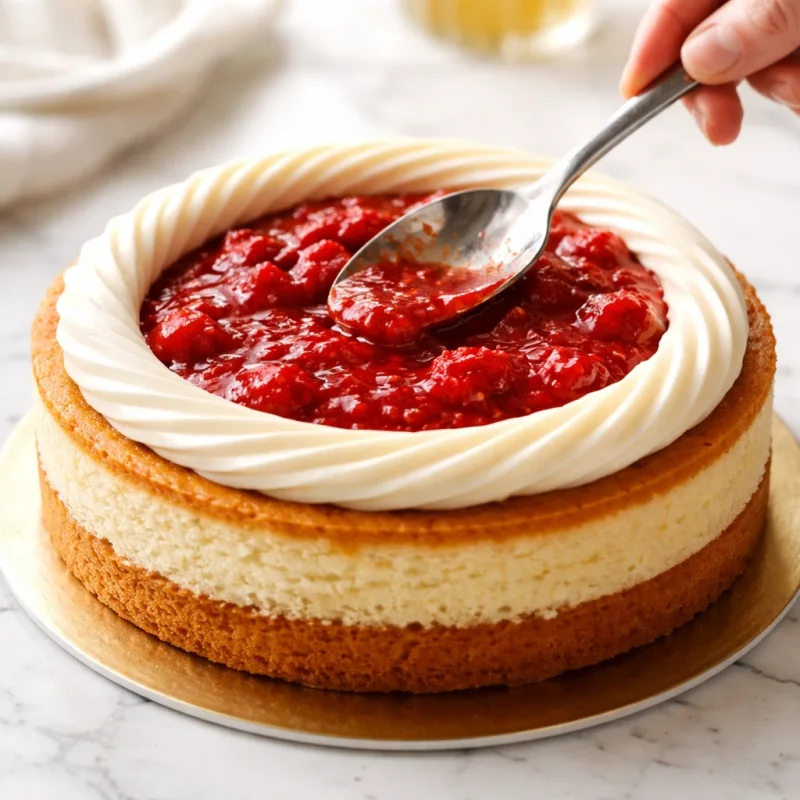
Use the fruit filling completely cold. Pipe a firm ring of cream around the outside of the layer, then keep the fruit filling inside that ring and slightly below its top. The cream dam takes the mechanical pressure and keeps the fruit away from the outer edge.
This is part of a broader system for stable layer-cake structure: stability comes from the cake layer, cream, fruit filling, and chilling working together.
Warm filling can soften buttercream or whipped-cream-based fillings and make layers slide. In cakes, temperature matters just as much as viscosity.
For pies and sealed pastries
Adjust the thickener to the fruit. Juicier fruit generally needs more help than apples and other fruit with more natural pectin. A pie must bake long enough for the starch system to develop, then cool long enough for the filling to finish setting before slicing.
For turnovers and other sealed pastries, use a cold, spreadable filling and leave a clean border of dough. Do not overfill. Filling on the seam acts like a lubricant and prevents dough-to-dough contact; where appropriate, give steam a controlled way to escape.
The PEK rule for stable fruit filling
Do not start with “How much cornstarch do I need?” Start with three questions:
- Which fruit am I using, and how much water does it release?
- Will the filling be baked, frozen, or used cold in a layer cake?
- Do I want a spreadable compote, a clean slice, or a firm insert?
Only then choose starch, pectin, or another suitable binding system. That keeps the filling juicy and fruit-forward without letting it run across the plate when sliced.
Diagnostics
Common problems and solutions
The filling is still runny after cooling.
Cause: Too much free water, too little binder, or incomplete activation.
Solution: Check the formula, disperse the binder correctly, and re-cook as appropriate.
Filling pushes toward the edge of a cake.
Cause: The filling is too warm, too loose, or the layer is overfilled.
Solution: Cool completely, reduce the amount, and use a firm cream dam.
The filling has lumps.
Cause: Starch or pectin was added without proper dispersion.
Solution: Slurry starch in cold liquid first; pre-mix pectin with sugar when the product instructions call for it.
A sealed pastry leaks during baking.
Cause: The seam is contaminated with filling, the pastry is overfilled, or steam has no controlled exit.
Solution: Leave a clean border, use less cold filling, seal firmly, and vent where appropriate.
Frequently asked questions
Answers to common questions
How do I thicken fruit filling so it does not leak?
First judge how much moisture the fruit releases and how the filling will be used. Starch is practical for many cooked fillings and pies; pectin is useful for structured fruit inserts. Activate the binder correctly and cool fully.
Is cornstarch or pectin better for fruit filling?
Neither is universally better. Cornstarch is straightforward for cooked fillings, while pectin is useful for confits and inserts that need a clean slice. Choose the pectin type for the formula.
Why is my fruit filling still runny after cooking?
It may contain too much free water, too little binder, or the starch or pectin may not have been activated correctly. Reassess the texture after cooling.
Should fruit filling be cold before assembling a cake?
Yes. Warm filling can soften cream, encourage layers to slide, and gives a misleading impression of final thickness.
How do I stop fruit filling soaking into cake layers?
Use a stable, fully cooled filling in a controlled amount and pipe a firm cream dam around the outside of the layer.
Why does fruit filling leak from turnovers or pastries?
The filling is often too loose or over-portioned, or it contaminates the dough seam. Use cold spreadable filling, keep a clean border, and seal firmly.