Short answer
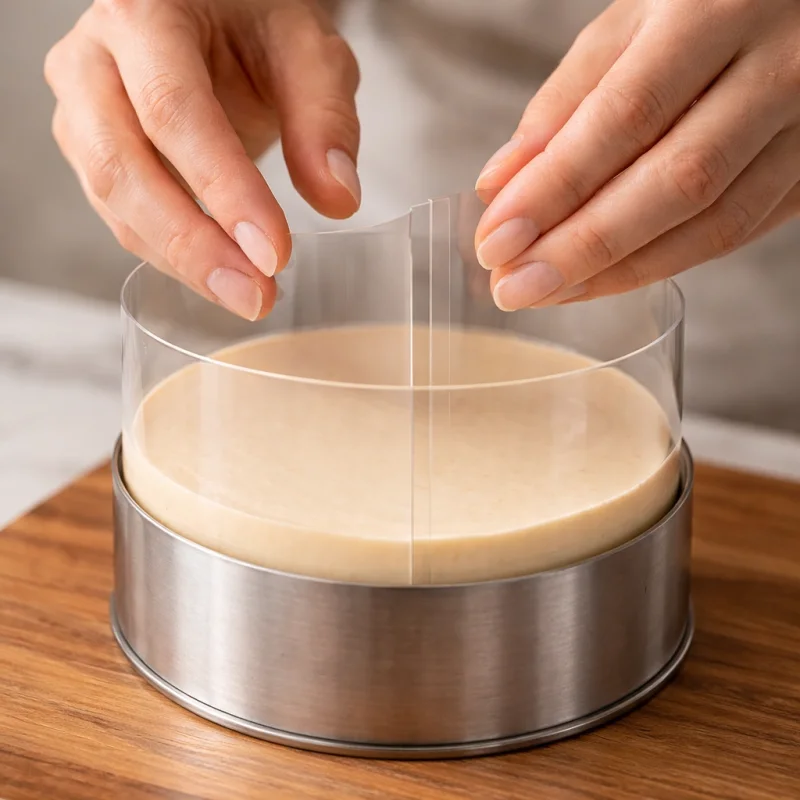
There is no single acetate-collar seam that is best for every cake. For the least visible vertical line, the strip ends need a square cut, accurate alignment, and no raised edge. A butt joint keeps the contact surface to a single thickness, but the ring must hold both ends securely so the seam cannot open. A small, completely flat overlap is mechanically safer when the strip springs outward or the filling is very fluid, but the double thickness can leave a fine ridge in the mousse.
The goal is not maximum overlap. It is a stable seam with no wrinkle or lip that you can feel from the inside. Place the seam where a later slice will be cut, or on the least visible side.
For the basic choice and installation of the strip, see acetate cake collars.
Dry-fit the collar before filling
Cut the strip square and cleanly. Fit it inside the ring without mousse and inspect the full circumference. The collar should stay against the metal wall without waves. Run a fingertip over the inside of the seam. If you can clearly feel a step, a soft filling can reproduce that step as it sets.
If the strip strongly springs outward, the issue may be stiffness rather than the seam itself. A tighter diameter often needs a more flexible collar; see stiff or flexible acetate cake collar.
Butt joint or small overlap?
A butt joint gives the thinnest transition because there is no double layer. Use it when the ring reliably keeps both ends against the wall and the filling is not so fluid that it can force its way through a small gap. The edges must align over the full height.
A small flat overlap gives more mechanical security if the strip wants to open or the filling is very soft. The trade-off is double thickness. A long, folded, or lifted overlap can create a vertical line in the finished side.
If extra fastening is needed, keep it away from direct contact with the filling and follow the instructions for the specific food-contact product. Ordinary adhesive tape should not automatically be treated as suitable for direct food contact.
Avoid loading the seam while filling
Add mousse or cream toward the centre and let it spread outward rather than directing a strong stream at the join. Check the seam before adding the next layer. With very fluid filling, preventing the seam from opening matters more; with a thicker filling and a presentation-focused cake, minimising seam thickness matters more.
Stiffness and strip thickness also change seam behaviour. A stiff strip can spring open on a small ring, while a very flexible strip can wave above the unsupported rim.
Once the mousse is stable, peel the collar slowly and close to the surface. Removal cannot erase a ridge that was already moulded into the mousse. See how to remove acetate from a mousse cake.
Quick decision
If the dry-fitted ends stay calmly together, start with a butt joint for the thinnest seam. If the joint opens or the filling is very fluid, use only enough flat overlap to keep the seam stable. In both cases, the inside surface should be free of folds, lifted edges, and a pronounced step.
Diagnostics
Common problems and solutions
Problem
Problem
Problem
Technical terms
Terms worth understanding
- Butt joint
- A seam where the two cut ends meet without overlapping.
- Overlap
- A seam where one end lies over the other, creating double material thickness.
- Collar stiffness
- Resistance to bending, which affects how the strip follows the ring and whether the seam springs open.
- Seam imprint
- A vertical line or ridge transferred from the collar seam to the set mousse surface.
Frequently asked questions
Answers to common questions
Do acetate collar ends always need to overlap?
No. A butt joint can leave a thinner mark when the ring holds both ends securely. A small overlap is useful when the seam opens or the filling is very fluid.
How much should the collar overlap?
There is no universal length. Use only enough flat overlap to keep the seam stable and closed in the actual ring.
Why is there a vertical line on my mousse cake?
The seam is often too thick, raised, or misaligned and the soft filling moulds itself around that shape.
Is thicker acetate always better for the seam?
No. A stiffer collar can spring outward more strongly on a small diameter. What matters is how the strip behaves in the actual ring.
Where should I place the seam?
When possible, place it at a future cut or on the least visible side of the cake.
Can I fix the seam line while removing the collar?
Not reliably. Gentle removal protects the surface but cannot erase a ridge already moulded into the mousse.