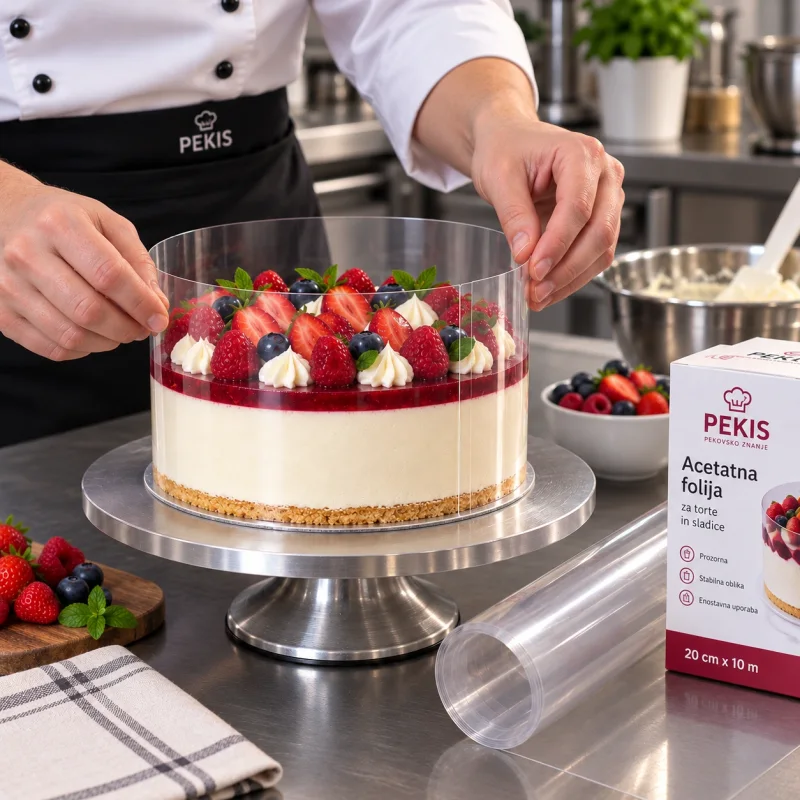
Acetate cake collars create smooth sides — they do not stabilize mousse
An acetate cake collar is a smooth, transparent, food-contact strip placed against the inside of a cake ring when assembling mousse cakes, entremets, no-bake cheesecakes, and other chilled desserts. Its job is straightforward: it gives the filling a flat surface to set against and allows the collar to peel away cleanly once the dessert is firm.
That is different from structural stability. A collar can contain a soft mixture while it is inside the ring, but it does not create a stable mousse. Stability comes from the formula, emulsion, gelatin or another gelling system, chocolate, fat structure, incorporated air, temperature, and sufficient chilling. If the mousse cannot support itself, using a thicker strip does not fix the recipe.
The name can also be misleading. Products sold as acetate, cake collar, cake film, or mousse collar are not necessarily made from exactly the same polymer; PET products are common too. For direct food contact, use only a strip that is specifically declared suitable for food contact and for the way you intend to use it.
Quick decision: when is a cake collar the right tool?
| Situation | Use a collar? | What matters |
|---|---|---|
| Mousse cake or entremet in a ring | Yes | Smooth inner surface and clean release |
| No-bake cheesecake or chilled cake | Yes | Less sticking and cleaner sides |
| Tall layered cake with soft filling | Yes, during assembly | Height and stiffness must suit the cake |
| Baking sponge in the oven | Usually no | Many cake-collar films are not oven-safe; check the manufacturer |
| Chocolate bands and decorations | Yes | Use a smooth food-contact film intended for the purpose |
| Substitute for mousse stabilization | No | The recipe must create the structure |
If you remember one rule, make it this: a cake collar shapes and separates; it is not automatically heat-safe and it is not a cream stabilizer.
Why acetate gives mousse cakes smoother sides
Mousse, cream, and other soft fillings take on the geometry of the surface they touch while they set. A metal ring is straight, but delicate fillings can adhere to it. When the ring is lifted, the edge may smear, tear, or pull away.
A cake collar creates a very smooth intermediate surface. Once the dessert is stable, remove the metal ring first and then peel the collar slowly from the mousse. The edge stays cleaner mainly because it is not dragged against metal during unmolding.
The old explanation that mousse necessarily “reacts” with a metal ring is too simplistic. In normal pastry work, adhesion, pressure, geometry, and mechanical damage are the more useful factors to control.
Choose collar height from the finished dessert, not a generic number
A collar that is too short cannot guide filling above its top edge. A collar that is much taller than the dessert usually causes less trouble, although it can make pouring and smoothing less convenient.
For a chilled assembled cake, choose a strip that reaches at least the final height of the dessert. If you are pouring a fluid mousse or building above the metal ring, leave some practical extra height. There is no single collar height that is correct for every cake.
For very tall desserts, also check the stiffness of the unsupported section above the ring. A collar that is too flexible can start to wave under pressure.
Stiffness matters more than a simple “thick” or “thin” label
On a small-diameter ring, the strip must follow a tight curve without excessive force. A very stiff collar may try to straighten and pull away from the ring. On a tall build, a very soft collar can lose its vertical line once it extends beyond the support of the metal ring.
Evaluate the combination of:
- film stiffness;
- ring diameter;
- dessert height;
- how fluid the filling is when poured;
- how much collar extends unsupported above the ring.
A more flexible strip is often easier for individual portions and small rings. Taller mousse cakes can benefit from more stiffness, provided the film still follows the curve smoothly without creasing.
Most acetate cake collars are not for the oven
This is one of the most important safety boundaries.
Many cake-collar products are intended for cold assembly, chilling, freezing, and chocolate work, not baking. Professional suppliers explicitly state that many acetate collar products are not oven-safe.
The practical sequence is simple: bake the sponge in an appropriate pan, cool it, then line the ring with a food-contact collar during assembly. If the manufacturer does not provide a heat-use specification, transparency and rigidity are not evidence that the material is safe to bake.
The instructions for the specific product take priority over general advice.
The collar must be flat before the mousse goes in
Every wrinkle, sharp crease, and raised seam can print onto the finished cake. Mousse does not “iron out” a badly fitted strip as it chills; it conforms to the surface against which it sets.
Before filling, check three things:
- the collar sits against the ring all the way around;
- there are no sharp folds or creases;
- the join does not create a ledge or open gap that the filling can push into.
If a chilled cake has wavy sides, inspect the collar geometry and its contact with the ring before blaming the mousse formula.
A small seam can become a very visible line
With a collar roll, cut enough length for the ends to meet securely. If there is a gap, mousse can push into it. If the overlap is uneven, it leaves a vertical line or step.
The goal is not the largest possible overlap. It is a flat, quiet join without a wrinkle or pronounced ledge. On a very smooth cake, position the seam where it will be less visible or where the cake will later be cut.
Remove the collar only when the dessert can support its own edge
If the mousse does not yet have enough strength, the side can bulge, slump, or pull with the film when the collar is removed. That does not automatically mean the collar is poor quality. It means the dessert structure is not ready to stand unsupported.
On frozen entremets, collars often release most cleanly from a well-frozen surface. On chilled but unfrozen cakes, the filling needs to be sufficiently firm. Peel the strip slowly, close to the surface, rather than pulling sharply outward.
Read the edge to diagnose the problem
| What you see | Most likely cause | What to check next |
|---|---|---|
| Thin vertical line | collar seam | alignment and overlap |
| Wavy side | wrinkle, gap from ring, or unsuitable stiffness | collar fit and material condition |
| Mousse sticks to the collar | mousse not firm enough or collar removed too early | chilling, formula, and peeling technique |
| Side bulges after removal | mousse lacks its own structural strength | stabilization and dessert temperature |
| Collar springs outward on a small ring | strip too stiff or poorly secured | more flexible film and fitting method |
| A crease is visible on the side | film was damaged before filling | use a fresh, perfectly flat section |
Not every failure is an “acetate problem.” Some come from geometry, some from mousse structure, and some from the removal step.
Can you reuse an acetate cake collar?
Do not rely on a universal rule such as “twice” or “until it looks worn.” Products differ. Some are sold as disposable, while others may be reusable according to the manufacturer.
For another direct food-contact use, prioritize the manufacturer's instructions, hygiene, and the condition of the surface. A strip with deep scratches, permanent creases, cloudy damage, or residues that cannot be reliably removed is a poor choice for another cake.
Acetate collars for chocolate work
Smooth film is also useful for chocolate collars, bands, and thin decorations. Properly tempered chocolate is spread onto a clean smooth surface, shaped, allowed to crystallize, and then released from the film.
The acetate itself does not create shine. Gloss comes mainly from correct tempering and a smooth contact surface. Poorly tempered chocolate can look dull or streaky even on excellent film.
What can you use if you do not have acetate?
Parchment paper, plastic wrap, and random clear plastic are not equivalent substitutes. Parchment is less rigid and has a different surface. Plastic wrap wrinkles easily. Unknown clear plastic may not be declared for direct food contact at all.
If you need truly smooth mousse-cake sides, a purpose-made food-safe cake collar is the most reliable tool. If you do not have one, it is safer to adapt the dessert or assembly method than to use an unidentified material simply because it is clear.
PEKI recommend
Do not look for a magical universal thickness. First decide what the collar has to do: follow a small ring, guide a tall edge while the dessert chills, create a smooth surface, or act as a substrate for chocolate.
Then verify three things: food-contact suitability, appropriate height and stiffness, and the conditions of use allowed by the manufacturer.
When those three are right, an acetate cake collar does exactly what it should: it does not rescue a weak recipe, but it gives a good one a clean, straight, repeatable edge.
Diagnostics
Common problems and solutions
A thin vertical line on the side
Cause: The collar seam is uneven or creates a ledge.
Solution: Make a flatter, quieter join and avoid a pronounced step.
Wavy cake side
Cause: A wrinkle, gap from the ring, or unsuitable film stiffness.
Solution: Replace damaged film, refit it, or choose stiffness better suited to the ring.
Mousse pulls with the film
Cause: The dessert is not firm enough or the collar is being removed too quickly.
Solution: Stabilize longer and peel the film slowly, close to the surface.
The side bulges after removal
Cause: The mousse lacks sufficient self-supporting structure.
Solution: Correct the mousse structure; a thicker collar will not solve it.
Film springs outward on a small ring
Cause: The strip is too stiff for the diameter or is poorly secured.
Solution: Use a more flexible collar or improve the fitting method.
Technical terms
Terms worth understanding
- Cake collar
- A transparent food-contact strip placed against the inside of a cake ring to create smooth sides on chilled desserts.
- Film stiffness
- Resistance to bending; it affects how easily the strip follows a small ring and how well it stands above the ring.
- Entremet
- A modern layered dessert often built from mousse, sponge, inserts, and other textures that set in a ring or mold.
- PET
- Polyethylene terephthalate, one of the clear polymers used for some food-contact cake-collar products.
Frequently asked questions
Answers to common questions
What is an acetate cake collar?
It is a smooth transparent food-contact strip placed inside a ring for mousse cakes, entremets, and other chilled desserts. It gives the filling a flat surface and makes clean release easier.
Can acetate cake collars go in the oven?
Usually not. Use a collar in the oven only when the manufacturer of that specific product explicitly states a permitted baking temperature. For normal baking, use an oven-rated lining material.
How tall should a cake collar be?
It should reach at least the finished height of the chilled dessert. Extra height can be useful when pouring fluid mousse or building above the ring, but there is no universal size.
Does a thicker acetate strip always give a smoother edge?
No. Stiffness matters more than thickness alone. A very stiff strip may spring away from a small ring, while a very soft one may wave above a tall ring.
Does acetate stabilize mousse?
No. The collar guides the mousse while it sets. Structural strength comes from the recipe, emulsion, gelling system, chocolate, air, temperature, and setting time.
What can I use instead of acetate?
Parchment or plastic wrap can work in limited situations but do not give the same smooth, rigid surface. Do not use unidentified clear plastic for direct food contact.
Can acetate cake collars be reused?
It depends on the product. Follow the manufacturer’s instructions and reject film that is deeply scratched, permanently creased, cloudy, or difficult to clean reliably.