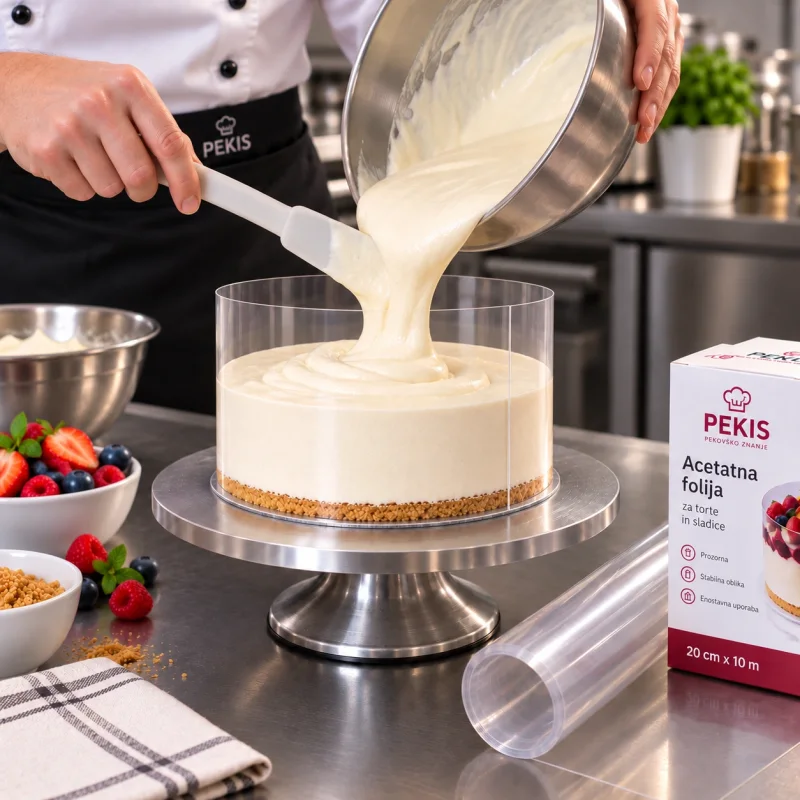
A more flexible collar is usually easier on smaller diameters because it follows a tight curve with less spring-back. A stiffer collar is useful when a larger section extends above the metal ring and needs to stay upright. Neither is universally better, and thickness alone does not fully describe stiffness.
Choose by geometry: a smaller diameter needs more flexibility, while greater unsupported height needs more stiffness. The metal ring provides most of the lateral support; the collar creates a smooth contact surface. If the mousse loses shape after removal, a thicker collar does not solve the structural problem.
Start with ring diameter and unsupported height
Choose collar stiffness by ring diameter and unsupported height, not by the rule 'thicker is always better'.
- A more flexible collar follows the tight curve of a small cake ring more easily.
- A stiffer collar is more useful when a large section extends above the metal ring.
- Thickness and stiffness are not the same property; material and strip geometry also affect behaviour.
When a more flexible collar is better
A more flexible collar follows the tight curve of a small cake ring more easily.
- the collar sits against the full inside circumference without force
- the unsupported section stays upright without broad waves
When a stiffer collar is better
A stiffer collar is more useful when a large section extends above the metal ring.
- the seam has no pronounced step
- there are no open gaps between the collar and metal ring
Thickness is not the same as stiffness
'Stiff' and 'flexible' are not standardised technical classes.
Thickness alone cannot reliably predict stiffness without information about material and strip geometry.
Compare the options
| Option | Best for | Trade-off |
|---|---|---|
| More flexible collar | Small diameters, individual portions and builds where the metal ring supports most of the height. | With a large unsupported height it may wave or bulge. |
| Stiffer collar | Tall builds where the collar extends above the ring and the unsupported section needs to stay straight. | On a small diameter it may spring outward and resist a tight curve. |
| Taller metal ring | Very tall or demanding builds that need more reliable mechanical support. | Requires the right equipment but reduces the need for the collar itself to act as a structural element. |
Five common problems and fixes
1. The collar keeps springing outward on a small cake ring.
Likely cause: The strip is too stiff for the required radius or is fitted incorrectly.
Solution: Use a more flexible collar that follows the ring without strong spring-back.
Prevention: Before filling, dry-fit the collar and check that it stays against the metal wall around the full circumference.
2. The collar is flat inside the ring but starts to wave above the rim.
Likely cause: The unsupported section is too high for that collar's stiffness.
Solution: Use a stiffer strip, reduce unsupported height or use a taller metal ring.
Prevention: Plan collar height together with ring height and the final dessert height.
3. A vertical ridge or pronounced line remains on the cake side.
Likely cause: The collar seam is too thick, raised or misaligned.
Solution: Flatten and align the seam so the ends do not create an edge for mousse to press against.
Prevention: Before filling, run a finger over the inside seam along the full height.
4. After the collar is removed, the mousse edge begins to bulge.
Likely cause: The dessert does not have enough structural stability of its own; the collar only constrained it while chilling.
Solution: Check the formula, temperature and degree of setting; a thicker collar cannot support the mousse after removal.
Prevention: Remove the collar only when the dessert is stable, and correct the formula or process if the problem repeats.
5. Broad waves appear on the cake even though the collar has no visible wrinkles.
Likely cause: The collar is too soft in the unsupported section or has locally pulled away from the ring.
Solution: Check contact with the ring and choose more stiffness for the tall section if needed.
Prevention: Judge the collar at its real installed height, not only as a flat strip on the bench.
Food contact and temperature
Use the collar only within the temperature conditions specified by the manufacturer for that product; transparency or stiffness is not proof that it is oven-safe.
For direct food contact, use a product intended for that purpose and within the manufacturer's stated conditions.
Frequently asked questions
Is a thicker acetate cake collar always better?
No. Extra stiffness can help when a tall unsupported section needs to stay straight, but on a small ring a collar that is too stiff may spring outward. Choose by diameter and height, not thickness alone.
Which collar is better for a small cake ring?
Usually a more flexible one because it follows the tight curve with less spring-back. Dry-fit it and make sure it sits wrinkle-free around the full circumference.
Which collar is better for a tall mousse cake?
If the collar extends well above the metal ring, more stiffness can help. For very tall builds, a taller metal ring is often the more reliable solution.
Does a stiff collar stop mousse collapsing after removal?
No. The collar can constrain the mousse while chilling, but after removal the formula and degree of setting must provide the structure.
Can I judge stiffness only by microns or mil thickness?
Not reliably. Thickness affects behaviour, but material, strip width and construction also influence stiffness.
Diagnostics
Common problems and solutions
The collar keeps springing outward on a small cake ring.
Cause: The strip is too stiff for the required radius or is fitted incorrectly.
Solution: Use a more flexible collar that follows the ring without strong spring-back.
The collar is flat inside the ring but starts to wave above the rim.
Cause: The unsupported section is too high for that collar's stiffness.
Solution: Use a stiffer strip, reduce unsupported height or use a taller metal ring.
A vertical ridge or pronounced line remains on the cake side.
Cause: The collar seam is too thick, raised or misaligned.
Solution: Flatten and align the seam so the ends do not create an edge for mousse to press against.
After the collar is removed, the mousse edge begins to bulge.
Cause: The dessert does not have enough structural stability of its own; the collar only constrained it while chilling.
Solution: Check the formula, temperature and degree of setting; a thicker collar cannot support the mousse after removal.
Broad waves appear on the cake even though the collar has no visible wrinkles.
Cause: The collar is too soft in the unsupported section or has locally pulled away from the ring.
Solution: Check contact with the ring and choose more stiffness for the tall section if needed.
Technical terms
Terms worth understanding
- Collar stiffness
- The strip's resistance to bending; it depends on thickness, material and geometry.
- Unsupported height
- The part of the collar that extends above the metal cake ring and therefore lacks its direct lateral support.
- Acetate cake collar
- A transparent pastry strip used to line rings for chilled cakes, mousses and similar desserts.