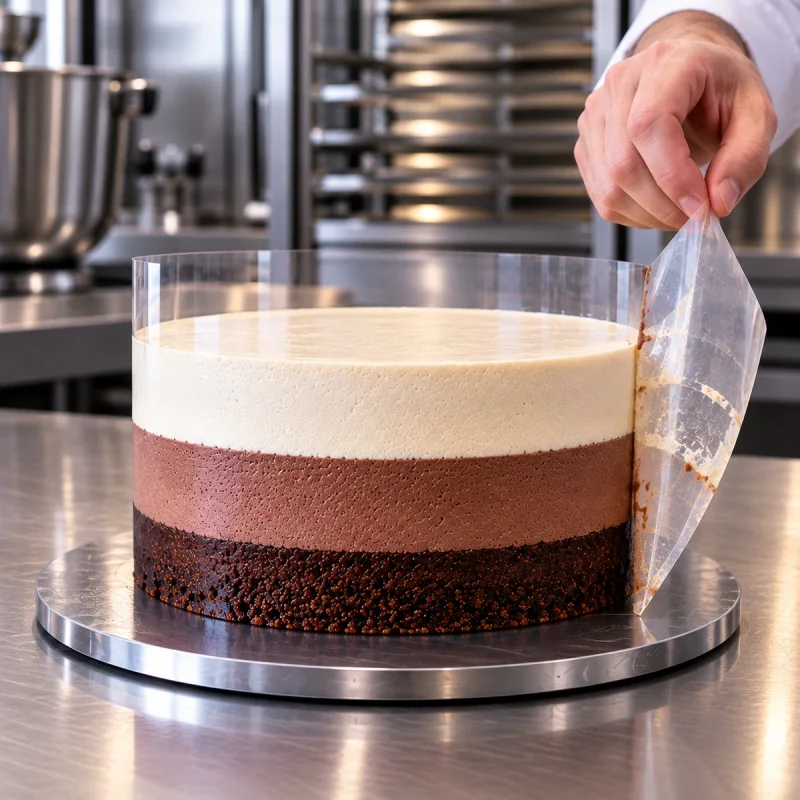
How to remove an acetate cake collar without damaging a mousse cake
Remove an acetate cake collar only after the mousse can support its own edge. For a frozen entremet, the cleanest release is usually achieved by removing the ring and peeling the collar while the dessert is still fully frozen. For a chilled, unfrozen mousse cake, the filling must be completely set before the collar comes off. There is no universal “wait 20–30 minutes” rule; the recipe and the actual stability of the dessert matter more than the clock.
For the wider setup, see Acetate cake collars: height, use and smooth cake sides.
First decide which type of cake you have
| Dessert | When to remove the collar | What to look for |
|---|---|---|
| Frozen entremet or mousse cake for glazing | while fully frozen | edge is solid and does not flex |
| Chilled, unfrozen mousse cake | once fully set according to the recipe | side stays straight after the ring is removed |
| Mousse that is still soft | do not remove it yet | filling pulls with the film or begins to bulge |
This distinction matters because freezing is often part of professional entremet production. The frozen dessert is unmoulded, the collar is removed, glazing or finishing is done, and the dessert is then thawed slowly in the refrigerator. A refrigerator-set mousse cake does not automatically need freezing, but it does need enough structural strength to stand without the ring.
For a frozen entremet
- Freeze the dessert for the full time required by the recipe so the centre is firm, not just the outside.
- Prepare the rack, board and glaze before taking the cake from the freezer.
- Remove the metal ring or outer mould.
- Hold the free end of the collar and peel it back close to the cake surface, rather than pulling sharply outward.
- Continue immediately with glazing or decoration if the recipe calls for it.
- Thaw the finished dessert in the refrigerator.
Do not deliberately leave a frozen entremet at room temperature for 20–30 minutes just to make the acetate easier to remove unless the recipe specifically instructs you to. A partly thawed outer layer can become stickier and more fragile, while condensation develops faster.
For a chilled, unfrozen mousse cake
Check the structure before you start. If the side bulges or slumps as soon as the ring is loosened, the mousse is not ready.
Once it is stable:
- remove the outer ring;
- find the seam of the collar;
- release a few millimetres at the edge;
- peel slowly, keeping the film close and nearly parallel to the side of the cake;
- watch the contact line as you work.
If the mousse starts to follow the acetate, stop. Chill the cake longer rather than increasing the force.
Peeling angle matters more than strength
Pulling the collar far away from the cake increases stress on a very thin surface layer. A low, controlled peeling angle is gentler. Move your grip around the cake in small sections instead of trying to strip off the entire collar in one motion.
If resistance suddenly increases at one point, check for a seam, wrinkle, damaged film or a softer patch of mousse.
What different problems usually mean
A thin layer of mousse sticks to the acetate. The filling is not firm enough, or a frozen surface has already begun to thaw. Stop and chill or freeze again as appropriate for the recipe.
The side bulges after the collar is removed. The mousse lacks its own structural strength. Check the formula, setting system and chilling time.
A vertical line remains on the side. This is usually the collar seam. Next time, keep the overlap flat and free of folds.
The side is wavy. The film was probably wrinkled, creased or not sitting evenly against the ring before the mousse was added.
The surface looks wet or patchy. Condensation is a common cause on frozen desserts. Work efficiently while the cake is cold, then thaw it in the refrigerator.
Manage condensation after freezing
A very cold dessert placed in warmer, humid air quickly gathers moisture. Have everything ready before unmoulding. Do not wipe the mousse surface with fingers or paper towels; that can mark it more severely than the collar itself.
Five common mistakes
- removing the collar before the mousse can stand on its own;
- partially thawing a frozen entremet without a recipe-based reason;
- yanking the film sharply away from the cake;
- using wrinkled or damaged collar film;
- expecting the collar to compensate for an unstable mousse.
An acetate collar creates a smooth contact surface; it does not create mousse stability. If the side collapses once the collar is gone, troubleshoot the formula or the setting process.
Quick check before removal
For a frozen entremet: fully frozen, workstation prepared, next step ready. For a chilled cake: mousse fully set, ring releases without bulging, no fluid filling at the edge.
Start at the seam, peel slowly close to the surface, and stop at the first sign that the mousse is being pulled with the film.
Diagnostics
Common problems and solutions
Mousse sticks to the acetate.
Cause: The structure is still too soft or a frozen surface has started to thaw.
Solution: Stop and chill or freeze again as appropriate for the recipe.
The side bulges after removal.
Cause: The mousse lacks enough structural strength.
Solution: Return it to cold conditions and check the formula or setting system.
A vertical line remains.
Cause: The collar seam or a thick overlap has imprinted the mousse.
Solution: Keep the seam flat and wrinkle-free on the next build.
The side is wavy.
Cause: The film was wrinkled, creased or not sitting evenly in the ring.
Solution: Removal cannot correct this; use a smooth undamaged strip next time.
Technical terms
Terms worth understanding
- Unmoulding
- Removing the ring, mould and collar without changing the shape of the dessert.
- Entremet
- A layered modern pastry dessert that is often assembled and unmoulded with the help of freezing.
- Condensation
- Moisture that forms on a very cold surface when it meets warmer, more humid air.
Frequently asked questions
Answers to common questions
When is the right time to remove an acetate collar?
For a frozen entremet, remove it after the ring while the dessert is still fully frozen. For a chilled cake, wait until the mousse holds a straight side without support.
Why does acetate stick to mousse?
Most often the mousse is not firm enough, or the surface of a frozen dessert has already started to thaw. Stop and chill longer.
Should the collar extend above the cake?
During assembly it should generally reach at least the finished mousse height, often with some extra margin. Match height to the ring and final dessert.
What should I do if marks remain after removal?
A vertical line usually points to the seam, waves to wrinkled or poorly fitted film, and torn mousse to early removal or partial thawing.
How important is the quality of the acetate?
A smooth undamaged surface and suitable stiffness matter, but even good film cannot compensate for an unstable mousse.
Do chocolate and fruit mousses unmould the same way?
The principle is the same: the mousse must be stable. Actual firmness depends on the formula, water content, chocolate, gelling system and temperature.