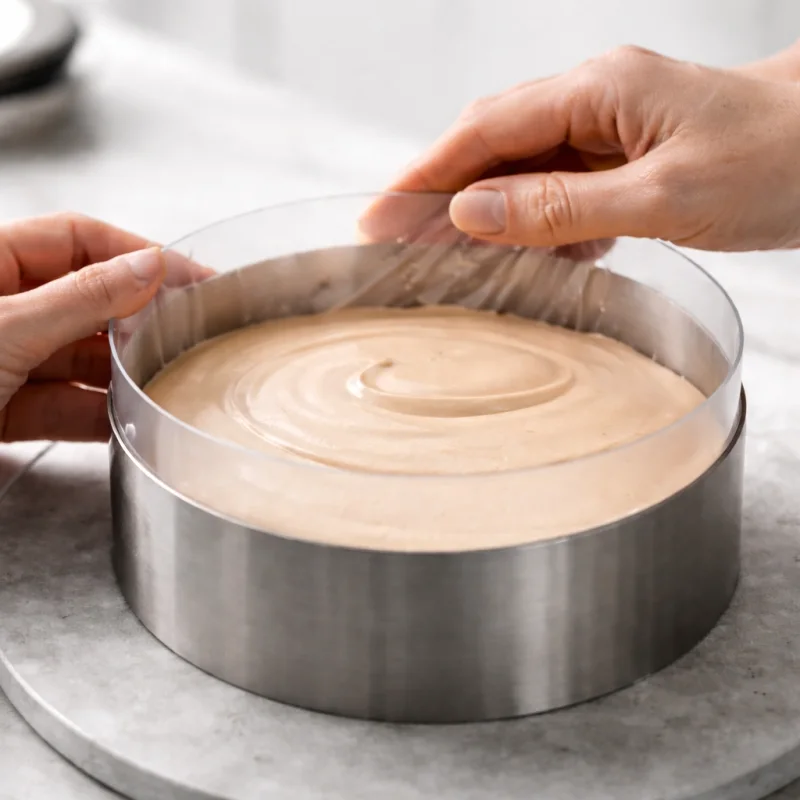
Wrinkles in an acetate cake collar usually are not caused simply because the mousse is “too runny.” Start with the collar geometry: a crease, wave, raised seam, poor ring contact, or a tall unsupported section above the metal ring.
acetate cake collars for mousse cakes.
Inspect the collar before adding mousse
In the empty ring, check for creases, sections pulling away from metal, a raised seam and waves above the ring. If the defect is visible now, mousse will not magically flatten it later.
Fluid mousse is not automatically the cause
Many entremet mousses are filled while soft or fluid. More useful checks are whether the collar is flat, follows the ring, keeps a flat seam and stays stable in the unsupported section.
The defect pattern tells you where to look
A local defect usually points to a local cause, while broad waves suggest contact, stiffness or unsupported height.
One sharp crease or vertical line
Check the seam or damaged collar first. The goal is not “never overlap”; it is a flat seam with no raised edge.
Broad waves around a larger section
For broad waves, check ring contact and stiffness. A flexible collar can work well at low height, yet a tall free section can wave; a very stiff collar can spring away on a small diameter.
Waves mainly above the metal ring
The section above the ring has no lateral support. Judge height together with stiffness and diameter, not just the width printed on the roll.
What about temperature and condensation?
Condensation matters mainly when very cold or frozen desserts meet warmer humid air. For wrinkles during filling, inspect geometry first.
Do not confuse wrinkles with unstable mousse
A sharp crease and a side that bulges after removal are different failures. Bulging after removal points more toward inadequate mousse stability.
A 20-second check before filling
Look from the side, feel the seam, remove sharp creases, check contact around the full ring and see whether the free upper section waves on its own.
Read the pattern on the finished cake
One vertical line, broad waves and post-removal bulging point to different causes. Diagnose the pattern rather than the vague result “not smooth”.
Frequently asked questions
Answers to common questions
Why do wrinkles form in acetate cake collars on mousse cakes?
Most often the collar was already creased, kinked, not sitting flat against the ring, or had a raised seam before filling. As the mousse sets, it takes the shape of the contact surface.
Do wrinkles mean the mousse was too runny?
Not necessarily. Many entremet mousses are intentionally soft or fluid enough to pour or pipe during assembly. Correct collar geometry and proper setting are more useful checks.
Should an acetate cake collar overlap at the seam?
There is no single rule. A butt seam is thinnest, while a small perfectly flat overlap can be mechanically safer. Avoid a large, angled or raised overlap that creates a ridge.
Why does the collar wave above the top of the ring?
The section above the metal ring has no lateral support. If it is tall relative to the collar stiffness, or if a stiff collar resists a small radius, it can pull away or wave.
Can condensation cause wrinkles in acetate?
Condensation matters mainly when a very cold or frozen dessert meets warmer, humid air. It is not a sound general rule that cold mousse against room-temperature acetate automatically creates a wrinkle.
Can I fix a wrinkle after the cake has set?
Usually not without altering the surface. Once mousse has set against a wrinkled collar, the geometry has already been transferred. Prevention before filling is more reliable.