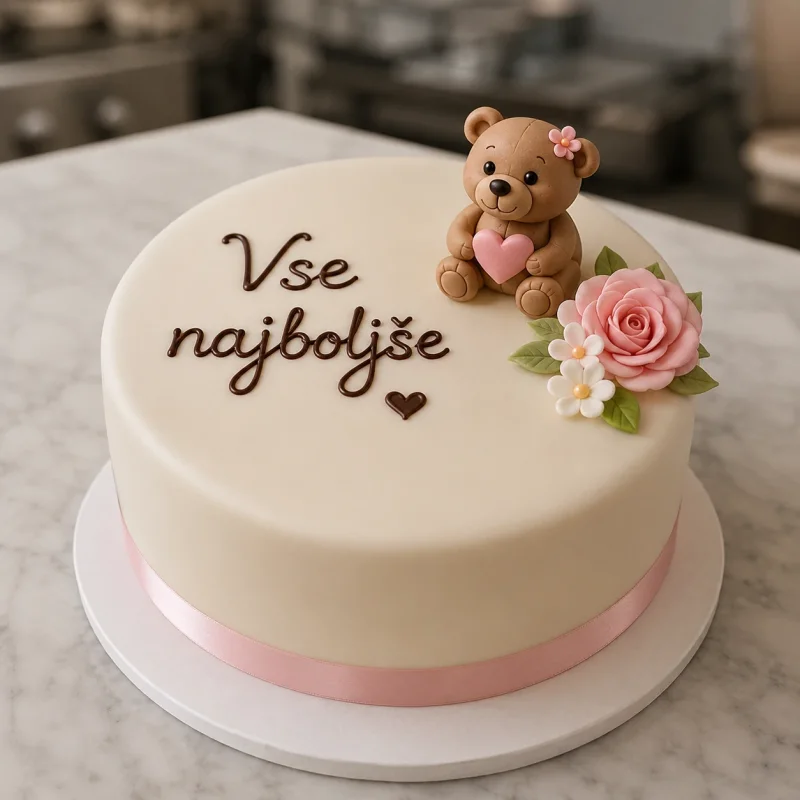
The easiest way to write on a cake
For beginners, two methods are especially simple: ready-made writing icing and an edible marker. They are not interchangeable on every cake surface.
- Writing icing is convenient for a direct message on a sufficiently stable frosting, ganache, chocolate or fondant, depending on the product.
- Edible markers work best on a dry, firm surface, such as fondant, fully set royal icing or edible paper.
Choose the method for the surface first. The style of lettering comes second.
1. Ready-made writing icing – quick and low-prep
A ready-made tube removes much of the preparation, but products vary in formulation and flow. Prepare it exactly as the manufacturer directs, then pipe a short test line on parchment before touching the cake.
Good working flow is easy to recognise: the icing comes out under moderate, steady pressure, the line stays continuous and it holds its shape after landing. If it quickly flattens and spreads, it is too loose for that surface. If you have to squeeze hard, the flow is not right.
Practical tip: write the complete word on parchment at roughly the size you intend to use on the cake. This checks spacing, pressure and line thickness at the same time.
2. Edible markers – best on dry fondant and firm surfaces
An edible marker gives excellent control because it handles much like an ordinary pen, but only when the surface is suitable.
It works best on:
- dry fondant,
- fully set royal icing,
- edible paper,
- firm, smooth sugar or chocolate plaques.
On soft, damp or greasy frosting, the tip may drag, pick up material or skip. Pressing harder usually makes the finish worse. Change the method instead.
When to use other lettering techniques
| Method | Best for | Main advantage |
|---|---|---|
| Ready-made writing icing | smooth, stable surfaces | minimal preparation |
| Edible marker | dry fondant and firm set icing | very precise control |
| Royal icing | firm, dry surfaces | clean, slightly raised lines |
| Chocolate in a parchment cornet | fine lettering and transfers | precise professional finish |
| Separate plaque or transfer | soft or delicate cakes | very low risk to the finished surface |
With royal icing or chocolate, consistency matters more than squeezing harder. The medium should pass through a fine opening without jerking, but it should still hold a clear line after it is piped.
How to space the message properly
The most common failure is not shaky handwriting. It is running out of room.
Before you pipe:
- write the full message on paper at roughly final size;
- mark the start, centre and end on the cake;
- split a long message into two short lines rather than crowding one line;
- on firm frosting, add very light guide points with a toothpick if needed.
A short name, number or birthday message is much easier to balance than a long sentence.
How to pipe with a tube or piping bag
Do not drag the tip across the cake like a pen. Hold it just above the surface and let the line settle onto the cake under steady pressure.
For longer strokes, move the forearm as a unit instead of writing only from the wrist. This produces a much calmer line.
At the end of each stroke: stop squeezing first, then lift the tip. Lifting while pressure is still applied often leaves a thin tail.
If you do not want to risk the finished cake
For soft frosting or an important message, make the lettering separately. Pipe chocolate or royal icing onto parchment, let it become firm enough to handle, then transfer it carefully to the cake.
Do not make chocolate letters unnecessarily thin. Very delicate strokes are more likely to snap while being lifted from the parchment.
Common problems and quick fixes
| Problem | Most likely cause | What to do |
|---|---|---|
| Letters spread | medium is too loose | test on parchment and correct the preparation |
| Line breaks | medium is too stiff or tip is blocked | clean the opening and test again |
| Letters wobble | movement comes only from the wrist or bag is too heavy | use less filling and move the forearm |
| You run out of room | message was not measured | mark the start, centre and end |
| A tail forms at the end | tip is lifted before pressure stops | stop squeezing first |
| Marker skips | surface is damp or soft | let it dry or choose another method |
Which method should you choose?
For the simplest direct cake message on a stable surface, start with ready-made writing icing. On dry fondant or firm set icing, an edible marker can be even easier to control.
If the cake is very soft or the message absolutely has to look right, a separate plaque or parchment transfer is not a compromise. It is a smart professional safety net.
Three things make the biggest difference: the right surface, enough planned space and a few practice strokes before the first line goes onto the cake.
Diagnostics
Common problems and solutions
The lettering spreads
Cause: The writing medium is too loose for the chosen surface.
Solution: Let the medium stabilise or prepare it according to the product instructions.
The line keeps breaking
Cause: The medium is too stiff or the opening is partly blocked.
Solution: Re-prepare the medium or tool and test before returning to the cake.
The letters wobble
Cause: Most of the movement is coming from the wrist or the bag is too heavy.
Solution: Move the forearm as a unit and reduce the amount in the bag.
You run out of space
Cause: The message was not measured before writing.
Solution: Mark the start, centre and end, or split the message over two lines.
The edible marker will not write cleanly
Cause: The surface is damp, soft or greasy.
Solution: Allow the surface to dry or switch to a piped writing medium.
Technical terms
Terms worth understanding
- Cornet
- A small cone folded from parchment paper and used like a precision piping bag for chocolate, glaze or icing.
- Writing consistency
- The working state in which a medium flows evenly through a small opening but still holds a clear line after it is piped.
Frequently asked questions
Answers to common questions
What is the easiest way to write on a cake?
For a beginner, the easiest method depends on the surface: ready-made writing icing is convenient on a stable cake, while an edible marker gives good control on dry fondant. On very soft frosting, a separate plaque or transfer is safer.
How do I keep cake writing straight?
Practise the full message at its intended size, then mark the start, centre and end on the cake. Split a long message into two short lines rather than squeezing it into one.
Can I write on a cake with melted chocolate?
Yes. A particularly safe method is to pipe the message onto parchment, let the chocolate become firm enough to handle, then transfer the lettering carefully to the cake.
Why does the line break while I am writing?
The medium may be too stiff, the tip may be partly blocked or the pressure may be uneven. Clean the opening and test the flow on parchment before continuing.
How do I fix a wrong letter on soft frosting?
Wiping soft frosting often causes more damage. If the mistake cannot be lifted cleanly, disguise it as part of the decoration or switch to a separate plaque for the final message.