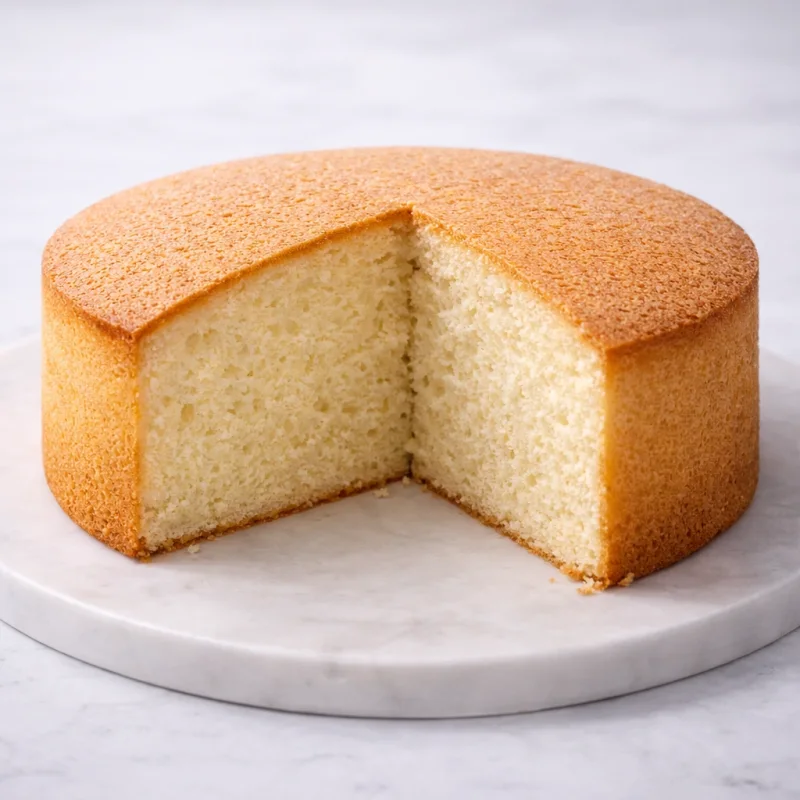
Soft, even sponge starts with stable foam, not one magic number of minutes
In an egg-foam sponge, the goal is to put air into the mixture and keep enough of it there until heat sets the crumb. A reliable result therefore depends on three checkpoints: developed egg foam, flour folded in without unnecessary deflation, and a centre that is fully set before the cake leaves the oven.
For a whole-egg method, look for ribbon stage. The mixture should be pale, thick and voluminous. When you lift the whisk, the batter falls in a broad ribbon and briefly sits on the surface before disappearing. That cue is more useful than “whip for eight minutes” because bowl size, egg temperature, batch size and mixer power all change the clock. PEK's guide to whipping eggs and sugar to ribbon stage goes deeper into this checkpoint.
Separating whites and yolks is not automatically better. It is a different method and should be used when the formula is designed for it.
What eggs, sugar and flour actually do
Egg proteins help form a film around air bubbles. Sugar helps stabilize the foam and also affects tenderness and moisture retention. That is why sugar is not only a sweetener, but it also cannot be changed freely without changing the cake.
Flour contributes starch and protein that later help set the crumb. The critical point is the fold. Aggressive mixing knocks out air, while undermixing can leave dry pockets or a heavy flour-rich layer at the bottom. Sift the flour, add it in portions, and fold from the bottom upward. The goal is not the fewest possible strokes at any cost; it is the fewest strokes that still distribute the flour completely.
The oven turns temporary foam into permanent structure
As the batter heats, gases expand, egg proteins set and starch gelatinizes. This turns the fragile foam into a more stable crumb.
Fully preheat the oven. Place the pan as the formula requires and avoid opening the door while the centre is still fragile. “Never open the oven for the first 20 minutes” is not a universal rule: a thin sheet sponge may be nearly done by then, while a deep cake can still be far from set.
A tray of water is not a general fix for sponge rise. Steam can affect crust formation, but it does not replace stable foam and is unnecessary for most classic sponge formulas.
How to tell when the centre is ready
Top colour is only one signal. Pay more attention to the centre:
- the surface is evenly risen and not wet or deeply sunken,
- the centre springs back after a very light press,
- a skewer from the centre shows no raw batter,
- after cooling there is no dense or gummy line along the bottom.
If the cake drops sharply as it cools, do not assume it simply needed more flour. Check foam development, folding losses and centre doneness first. PEK's guide to why sponge cake sinks after baking explains those causes in detail.
What the cut surface tells you
| Crumb pattern | Likely problem | Next adjustment |
|---|---|---|
| dense bottom band | collapsed foam or poorly distributed flour | fold from the bottom and check for heavy sediment |
| large tunnels | coarse unstable bubbles or uneven batter | develop a finer foam and fold more evenly |
| sunken centre | centre was not fully set | verify oven temperature and bake until springy |
| dry, crumbly crumb | overbaking, weighing error or overly dry formula | check ingredient weights and stop when the centre is just set |
For layer cakes, maximum height is not the only goal
The tallest sponge is not always the most useful one. A layer cake needs a crumb that is soft but elastic enough to slice, soak and fill. Very light foam structures can compress under heavy fillings.
For repeatable baking, record three observations each time: what the foam looked like before the flour, how much volume changed after folding, and what the centre felt like at the end of baking. That turns troubleshooting from guesswork into a controlled process.
Diagnostics
Common problems and solutions
The sponge is low and dense.
Cause: The egg foam was underdeveloped or too much air was lost while folding in flour.
Solution: With whole eggs, reach a stable ribbon stage, then add flour in portions and fold gently but completely.
The centre sinks after baking.
Cause: The centre was not fully set or the structure was weakened before or during early baking.
Solution: Bake until the centre is springy and stable, and avoid opening the oven early just to check it.
There is a dense or gummy bottom band.
Cause: The foam partly collapsed or the flour was not evenly incorporated.
Solution: Fold from the bottom of the bowl upward and make sure there are neither dry flour pockets nor heavy sediment.
There are large tunnels in the crumb.
Cause: The foam contained large unstable bubbles or the batter was unevenly mixed.
Solution: Build a finer, more even foam and fold the flour with calm, efficient strokes.
The sponge is dry and crumbly.
Cause: It was overbaked, ingredients were mis-weighed, or the chosen formula is too dry for the intended use.
Solution: Check the weights and actual oven temperature, then stop baking as soon as the centre is set.
Technical terms
Terms worth understanding
- Ribbon stage
- The stage at which beaten whole eggs and sugar form a thick pale mixture that falls from the whisk in a ribbon and briefly sits on the surface.
- Egg foam
- A network of air bubbles surrounded by unfolded egg proteins; in sponge cake it provides much of the volume.
- Folding
- Gently combining a light foam with dry ingredients using only the movement needed to distribute them evenly.
- Protein coagulation
- Heat-driven setting of egg proteins that helps fix the structure around air cells.
- Starch gelatinization
- The swelling and setting of starch in the presence of water and heat, helping form the cake crumb.
Frequently asked questions
Answers to common questions
How do I know when eggs and sugar are whipped enough?
With whole eggs, look for a thick pale mixture that falls from the whisk in a broad ribbon and leaves a trail for a few seconds. The exact time depends on quantity, ingredient temperature and mixer power, so the visual cue is more reliable than one fixed time.
Why does sponge cake sink after baking?
The centre may not have been fully set, the foam may have lost too much air before baking, or the pan and formula may not match. The related PEK guide on sinking sponge cake covers these failure modes in more detail.
Do I always need to separate the whites and yolks?
No. Some sponge cakes use whole eggs and sugar; others use separately whipped whites. Both methods can work very well. Follow the structure of the specific formula instead of combining techniques without adjusting it.
What does sugar do in egg foam?
Sugar increases the viscosity of the liquid phase and helps stabilize small air bubbles. It also affects tenderness and moisture retention, so changing the amount changes more than sweetness.
Does a tray of water in the oven help sponge cake rise?
Not as a general rule. Added steam can alter crust formation, but it does not replace a properly developed foam or a fully set centre. Use steam only when a specific method calls for it.
Why is my sponge dense or gummy at the bottom?
Part of the foam may have collapsed, flour may have settled, or the centre may have set unevenly. Fold from the bottom upward and check that the finished batter has no heavy layer sitting underneath.
What crumb is best for layer cakes?
For most layer cakes, a fine-to-medium, even crumb without large tunnels or a dense bottom band is a useful target. An extremely light sponge can be soft but may compress under very heavy fillings.