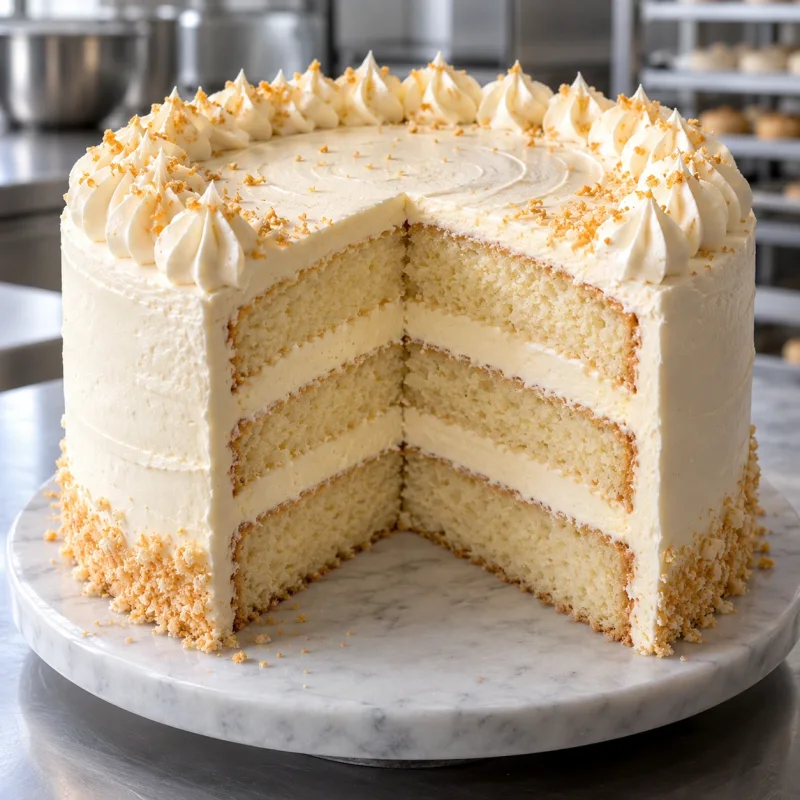
Start by defining what the cream has to do
Before choosing a stabilizing method, answer four questions:
| Job | What the cream must do | Suitable type of structure | Main sign of success |
|---|---|---|---|
| Plated dessert or glass | hold the shape of a spoonful or piping | softer emulsion-based or aerated cream | does not spread into a sauce |
| Slice | give a clean, smooth cut | starch-, chocolate- or lightly gelled structure | the edge stays distinct |
| Cake filling | remain in an even layer | mascarpone, ganache, buttercream or another sufficiently load-bearing cream | the layer does not squeeze out under pressure |
| Mousse cake | stay airy but slice cleanly | emulsion + foam + cold setting or a gel | no watery rim and no collapse |
This matters more than asking “how much stabilizer should I add?”. Two creams that look equally thick in a bowl can behave completely differently under load.
The wider relationship between cream, sponge and the whole dessert is covered in PEK's guide to dessert structure and stability.
Five main mechanisms that create stability
Most creams combine more than one mechanism, but identifying the dominant one makes troubleshooting much easier.
1. Aerated foam
In whipped cream and some mousses, the structure is carried by air bubbles stabilized by a network of fat and proteins. In dairy cream, partially crystallized fat is important: during whipping, fat droplets partially coalesce around the air bubbles.
The cream therefore needs to be properly chilled, but there is no single temperature range that is universally correct for every product and formulation. Cream composition, the state of the fat, equipment, whipping speed and the desired final stage all matter.
Stop whipping when the cream reaches the stage required by the recipe. More whipping does not mean more stability; overwhipping pushes the network away from a stable foam and toward separation of fat and liquid.
For detailed troubleshooting, use a specialist whipped-cream guide when the localized version is available.
2. Emulsion
Ganache, buttercreams and part of many mascarpone creams depend on a stable connection between the water and fat phases.
A well-emulsified cream is uniform, smooth and free from an oily or watery rim. If graininess or separated fat appears, do not try to fix it by randomly adding liquid or whipping harder. First check temperature, the ratio of phases and how the ingredients were combined.
With ganache, texture is not determined only by the “chocolate : cream” ratio. The type of chocolate, cocoa butter, sugars, water content and temperature of use also matter. The same formula can therefore work for glazing but fail as a load-bearing cake filling.
PEK's central chocolate guide explains chocolate emulsions and the role of chocolate in pastry in more detail. If you want a specifically light, aerated chocolate filling, use the whipped ganache guide.
3. Starch and egg proteins
In pastry cream, starch binds water as it heats and creates a thicker continuous phase. In egg-based creams, structure develops through heat-induced changes in the proteins.
The important limit is that cooking time is not a universal number. Different starches, their concentration, the ratio of liquid to egg and the intended use all require different procedures. Follow a tested formula and watch the final consistency rather than only the clock.
Classic crème anglaise is controlled differently from pastry cream. Professional formulas commonly cook it to roughly 82–84 °C, but that range belongs to this particular style of egg custard and should not be transferred to every cooked cream.
Properly made crème anglaise remains a sauce or base. To become a sliceable cake layer, it needs another load-bearing mechanism such as chocolate, a gel or another structured component.
4. Gel
Gelatin, agar and other hydrocolloids create networks that hold water, but they do not produce the same texture.
With gelatin, the result depends on gel strength, quantity, hydration, dissolving temperature and the composition of the dessert. Equal weights of different gelatins are therefore not automatically interchangeable without checking Bloom strength or the manufacturer's instructions.
Agar forms a different gel, usually firmer and less elastic. Activation and dosage depend on the specific product and formula, so it should not be treated as a direct 1:1 replacement for gelatin.
For details, use the guide to common gelatin mistakes. The dedicated agar guide should only be linked once its English target is published.
5. Fat and chocolate structure
Some creams become noticeably firmer only after chilling. Cocoa butter, milk fat and other solid fats can provide substantial mechanical support without a classic gel.
That does not mean that more fat is always better. An overly fatty cream may be firm when cold but feel heavy or waxy when served. Choose the structure for the intended serving temperature and the desired mouthfeel.
Mascarpone is not a universal stabilizer
Mascarpone can increase thickness and total solids, but it does not repair every soft cream.
When combined with cream, sugar or fruit components, the balance between fat and water changes. Mixing for too long, a large temperature difference between components or adding liquid too quickly can cause softening or separation.
Do not use the rule “add mascarpone if the cream is too soft”. Diagnose the cause first. If you are making mascarpone cream, follow the specialist mascarpone cream troubleshooting guide. For a version made without heavy cream, use the mascarpone frosting without heavy cream guide.
Mousse is a system, not a single ingredient
A mousse usually combines:
- a flavored or liquid base,
- an aerated component,
- a load-bearing mechanism that develops during chilling.
The base may be fruit purée, crème anglaise, ganache or another emulsion. Whipped cream or another foam can provide aeration. Final stability may come from chocolate, gelatin, egg proteins or a combination of mechanisms.
Most failures happen while the components are being combined.
If the base is too warm relative to the aerated component, the foam loses volume. If the base is already too cool and the structure has started to set, folding can create lumps or firm particles. There is therefore no single universal mixing temperature for chocolate mousse: the correct range depends on the actual formula.
More reliable signs are:
- the base is smooth and homogeneous before combining,
- no oily rim appears after the first addition of the aerated component,
- the mousse is even, with no cold set particles,
- it falls from the spatula in a broad ribbon, neither like a thin sauce nor like a heavy batter.
Stabilizing without gelatin has a purpose
Gelatin is not mandatory in every cake cream. Chocolate, a properly built emulsion, mascarpone, buttercream or a starch-thickened base can provide enough support for certain uses.
The key question is not “can I leave out the gelatin?” but whether the chosen structure can handle the actual job without it.
For very firm cake creams without gelatin, use the dedicated PEK decision guide once its English target is published.
A plated dessert, a slice and a tall cake need different results
A plated cream can remain very soft if it holds the sweep of a spoon and does not spread during service.
A cream for slices needs greater cutability. When the knife passes through, the edge should remain clearly defined without the center becoming rubbery.
Cream in a tall cake has an additional mechanical job: it supports the weight of sponge layers, other fillings and possibly a coating. Judge it not only by how firm it feels in a bowl, but by how it behaves under real load.
This guide focuses on the stability of the cream or mousse itself. Filling layout, layer thickness, compression and the construction of the whole cake belong in the guide to stable cake layers and clean slices.
If excess moisture from the sponge or a fruit layer destabilizes the filling, also check the guide to moisture control in cakes.
Test before assembling the whole dessert
Before filling an entire cake with a new or adjusted cream, run a small functional test.
Pipe or spoon a small amount onto a cold plate and chill it under the conditions required by the recipe. Then check:
- whether the edge remains distinct,
- whether a watery or oily ring appears,
- whether the center is still creamy,
- whether the piped pattern is stable enough,
- whether the texture changes too quickly after a few minutes at serving temperature.
For a cake filling, a small test between two pieces of sponge is even more useful. It checks load-bearing performance, not just appearance in the bowl.
Diagnostics
Common problems and solutions
The cream is soft but smooth.
Cause: The intended job may require more support, or the planned chilling stage may not be complete.
Solution: Do not add a stabilizer automatically; check the formula and the dominant load-bearing mechanism.
The cream is grainy and oily.
Cause: The emulsion may be breaking, the cream may be overwhipped, or the components may be at incompatible temperatures.
Solution: Use the specialist correction for that system instead of whipping harder without a diagnosis.
Liquid separates from the cream.
Cause: The mechanism that should bind water — foam, starch, gel or emulsion — is not doing its job.
Solution: Correct the failed system rather than masking the symptom with a random addition.
The mousse contains small firm particles.
Cause: The base may have cooled too far before folding and begun to crystallize or gel.
Solution: Next time, coordinate the phases and temperature transition more carefully.
The layer breaks when sliced.
Cause: The gel may be too strong or the serving temperature may be too low for the chosen structure.
Solution: Do not add liquid blindly; adjust the structural mechanism and intended serving temperature in the next batch.
The filling squeezes out between sponge layers.
Cause: The cream may not have enough load-bearing strength for the real load, or the cake construction and layer thickness may exceed its intended role.
Solution: Choose a more suitable supporting structure or review the cake construction in the specialist guide.
Frequently asked questions
Answers to common questions
Can every runny cream be fixed with gelatin?
No. Gelatin strengthens a gel structure, but it does not repair an overwhipped foam, a broken emulsion or a poorly chosen formula.
Is a colder cream always more stable?
No. Chilling can temporarily firm a fat- or chocolate-based structure, but it does not repair a broken emulsion or an incorrect ingredient ratio.
Can agar directly replace gelatin?
No. Agar and gelatin form different gels and require different activation and dosage conditions.
How do I know whether a cream is stable enough for a cake?
Test it after the intended chilling period and, for a load-bearing filling, under a small real load rather than only in the bowl.
Why is a mousse firm in the fridge but quickly loses its shape on the plate?
Its structure may rely mainly on chilled fat and have too little other support at the warmer serving temperature. Check the emulsion, liquid ratio, aerated component and any gel in the specific formula.