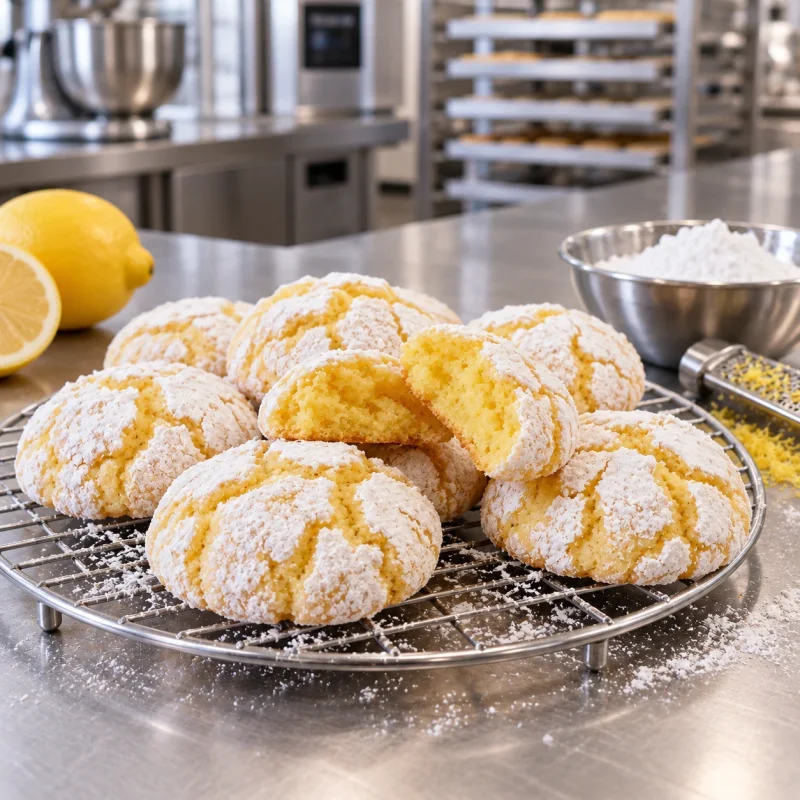
Lemon crinkle cookies get their signature surface when the outside begins to dry and set while the center is still expanding. Confectioners’ sugar is only part of the system. The dough must be cold, the leaveners active, the portions consistent, and the oven genuinely hot enough.
Starting formula for about 22 cookies
- 200 g all-purpose flour
- 3 g baking powder
- 1.5 g baking soda
- 2 g fine salt
- 150 g granulated sugar
- finely grated zest of 2 lemons
- 50 g neutral oil
- 30 g unsalted butter, melted and cooled
- 45 g fresh lemon juice
- 1 large egg, about 50 g without shell
- about 60 g granulated sugar and 80 g confectioners’ sugar for coating
This is a controlled starting formula, not a universal ratio. Egg size, lemon juice and flour absorption can change spread.
Zest and juice do different jobs
Zest contributes a large share of the lemon aroma without adding much water. Juice adds acidity and liquid. If you want a stronger lemon aroma, do not simply keep adding juice; that also changes dough consistency.
Chilling is part of the recipe
Fresh dough can look very soft. Do not automatically add flour. Cover and chill for 2–3 hours. Then portion 23–25 g balls so spread and bake time stay comparable.
Double sugar coating
Roll each cold ball first in granulated sugar and then very generously in confectioners’ sugar. Do not shake the white layer off. The first coat creates a drier outer layer; the powdered sugar supplies the high-contrast finish as the surface splits.
Baking
Use 175°C / 350°F conventional heat as a starting point, or roughly 165°C / 330°F convection where appropriate. If your oven is unreliable, see the PEK guide to convection, temperature and rack position.
For 23–25 g balls, start checking around 11–13 minutes. The edges should be dry and set, the top well cracked, while the center still feels soft. Do not wait for deep browning.
Bake two test cookies before committing the full tray.
If the cookies barely crinkle
Common causes are warm dough, weak leaveners, too much flour, or an oven running cool. Chill first, verify leaveners and oven temperature, and weigh the flour.
If the powdered sugar disappears
The coating may be too thin or may have absorbed moisture from warm, sticky dough before baking. Use the double coat and bake soon after rolling.
If the cookies turn hard
Dark edges usually point to overbaking. Pale but dense, hard cookies suggest too much flour or small portions. For broader troubleshooting, use why cookies turn hard.
Strong crinkles are a process signal: cold dough, controlled expansion and a setting surface have to happen in the right order.
Diagnostics
Common problems and solutions
Barely any cracks
Cause: Warm dough, weak leaveners, too much flour, or a cool-running oven.
Solution: Chill fully, verify leaveners and real oven temperature, and weigh flour.
Powdered sugar disappears
Cause: The coat is too thin or absorbed moisture before baking.
Solution: Use granulated sugar first, a heavy confectioners’ sugar coat second, and bake promptly.
Frequently asked questions
Answers to common questions
Why did my crinkle cookies not crack?
Check dough temperature, leaveners, flour amount, and true oven temperature first.
Why use granulated sugar first?
It helps form a drier first layer so the confectioners’ sugar remains more distinct.
When are they done?
Edges are set and dry, the top is strongly cracked, and the center is still soft.
Can I add more lemon juice?
Only with recipe adjustment, because extra juice also adds water.