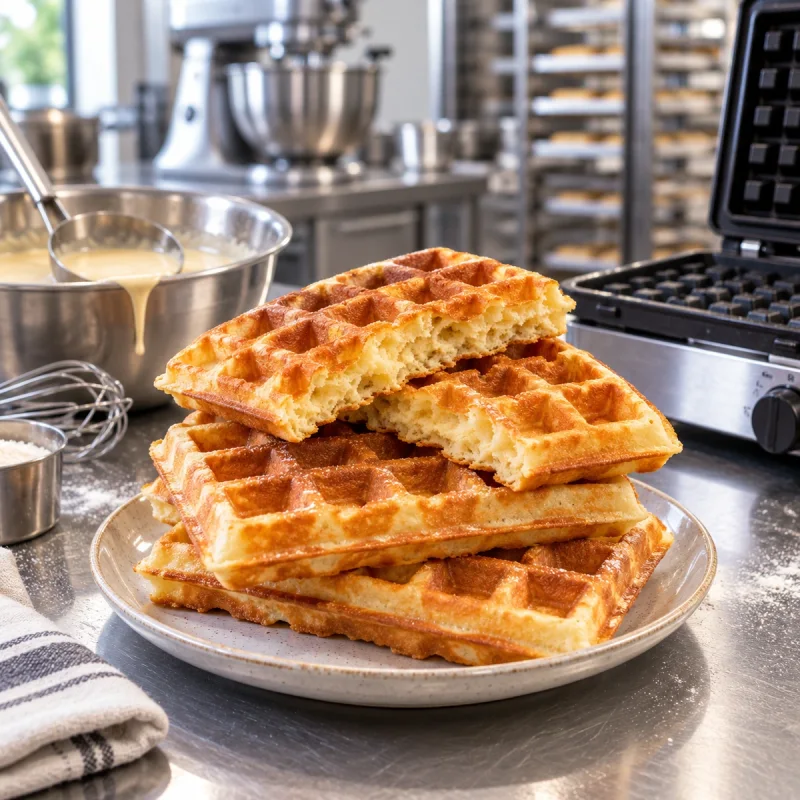
The best waffles are golden and crisp on the outside while staying soft and airy inside. That balance depends on the formula, but just as much on a fully preheated iron and on letting steam escape after cooking.
Starting formula
For about 6 large waffles use 240 g all-purpose flour, 30 g cornstarch, 9 g baking powder, 4 g salt, 25 g sugar, 340 g whole milk, 2 large eggs, 60 g melted butter, 25 g neutral oil, and a little vanilla.
Cornstarch lowers the overall gluten-forming potential and helps the surface dry more readily. Butter provides flavor while a small amount of oil supports crispness.
Fully preheat the iron
Do not pour batter onto lukewarm plates. A properly heated iron sets the outside quickly and drives off surface moisture. If your iron has adjustable heat, start around medium-high and calibrate from there.
Mix briefly
Whisk the dry ingredients separately. Mix the yolks with milk, butter, and oil, then stir the wet mixture into the dry ingredients only until the flour streaks disappear.
Whip the whites to soft or medium peaks and fold them in gently. Once the foam is added, do not beat the batter.
Weigh the batter portion
For a large iron, start around 120–150 g of batter per waffle. Geometry varies, so the most repeatable number is the gram weight that fills your own iron without overflowing.
Cook by steam and color
Many irons land somewhere around 4–6 minutes, but time is not universal. Avoid opening early. When strong steam output drops noticeably, check color. A finished waffle should be deep golden with a dry surface.
Keep them crisp
Never stack hot waffles. Steam from the center condenses against the neighboring waffle and softens the crust. Place each waffle on a wire rack. For a larger batch, hold them on a rack in a 90–100°C / 195–210°F oven.
If waffles are dense
Common causes include overmixing, old baking powder, collapsed egg-white foam, or letting finished batter sit too long.
If waffles stick
Check preheating, the condition of the plates, and whether you are opening too early. If the manufacturer allows it, grease lightly before the first waffle.
If waffles are pale and soft
The iron is often not hot enough or the waffle simply needs more time. Increase heat by one step or cook until the surface is clearly golden and dry.
A crisp exterior and soft center are not opposites: the surface needs to lose enough moisture while the center must stop cooking before it dries out.
Diagnostics
Common problems and solutions
Waffles soften quickly
Cause: Steam is trapped by stacking or waffles are undercooked.
Solution: Cool on a rack and cook a little longer if needed.
Waffles are dense
Cause: Overmixed batter, old baking powder, or collapsed egg-white foam.
Solution: Mix briefly and cook soon after combining.
Frequently asked questions
Answers to common questions
Why aren't my waffles crisp?
Check full preheating, sufficient browning, and rack cooling rather than stacking.
Should waffle batter rest?
This chemically leavened version with folded whites is best cooked relatively soon after mixing.
How much batter should I use?
Start around 120–150 g for a large waffle and calibrate your iron.
How do I keep waffles crisp?
Do not stack them; hold on a wire rack in a 90–100°C / 195–210°F oven if needed.