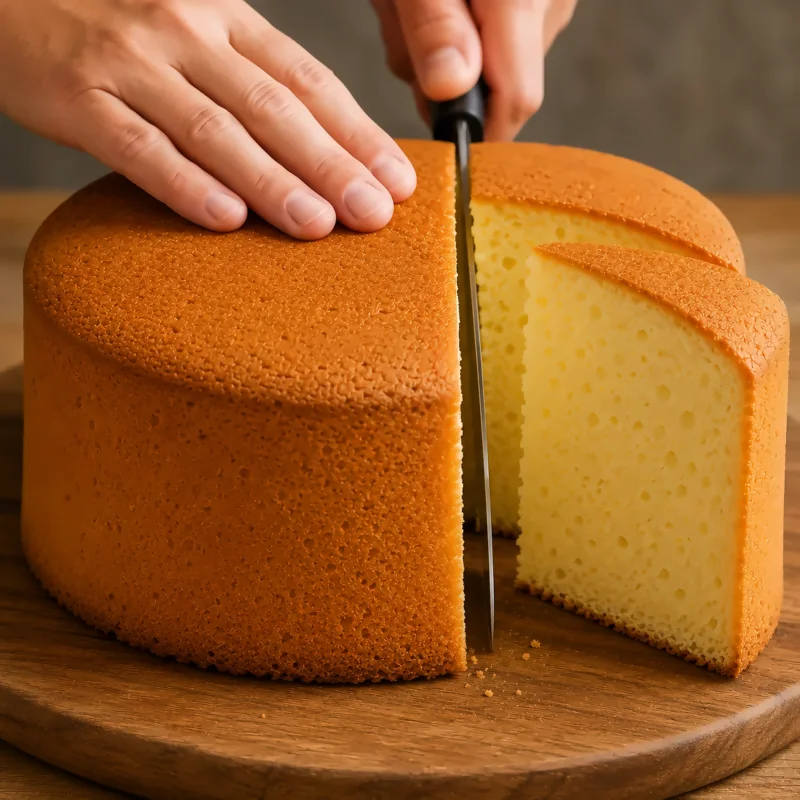
Moistness comes from water held in a stable crumb
The knife should reveal a soft crumb, not a wet band
A well-baked cake feels tender and moist, but the center is not liquid, gluey or rubbery. When you cut it, the crumb compresses slightly and springs back. The knife should not carry raw batter, and the outer edge should not be noticeably drier than the center.
If a cake is dry or wet, start with three checks: weigh the flour, verify the actual oven temperature, and judge doneness by the center rather than crust color alone. Too little available water gives a crumbly, firm texture. Too much free water, or a structure that sets too late, produces a wet, dense or collapsed center.
Moistness is therefore not the same as wetness. Water must be present, but it also has to be held by starch, proteins, sugars and fibers in a stable crumb. For the basic aeration technique, see the guide to fluffy sponge cake.
What water does as batter heats
Steam expands existing air cells; it cannot support them by itself
Liquid dissolves sugar and salt, hydrates flour and helps ingredients distribute evenly. As the batter heats, some water becomes steam. That steam increases pressure inside existing air cells and contributes to expansion.
The expanded crumb still needs a framework. Starch swells in the presence of water, while egg and flour proteins set around the air spaces. Steam can enlarge the structure, but it cannot replace it.
If the foam is unstable, the flour ratio is wrong or mixing knocks out too much air, the expanded cells shrink after baking. The result can be a low, dense or sunken center.
Bound and mobile water are useful practical concepts
It is helpful to think of water as more or less strongly held by the ingredients. This is not a strict two-box system, but it explains why one cake is tender while another is wet or soggy.
Water associated with starch, sugars, fibers and proteins moves less freely and is lost more slowly. Water that is poorly held can migrate, evaporate or collect in dense wet zones.
The difference often becomes clearer the next day. A balanced cake still cuts cleanly and feels soft. If water migrates toward the bottom, a filling or the surface, stickiness and sogginess appear.
Flour determines how much liquid the batter can support
Flour is not merely a dry thickener. Its starch and proteins compete for the available water. Too much flour spreads that water across too many dry particles, leaving a dense, dry and crumbly cake.
Weigh flour whenever possible. Scooping directly from the bag can compact flour into the cup and make the recipe much drier than intended.
After flour is added, mix only until the dry streaks disappear. Longer mixing does not improve hydration; it develops more gluten and can push air out of the batter, producing a firmer crumb.
Alternative flours behave differently. Corn, almond and other non-wheat flours do not absorb and structure water in the same way as wheat flour, so they often need their own liquid and binder balance rather than a direct one-for-one substitution.
Sugar and fat affect moisture in different ways
Sugar holds water but also changes how quickly the crumb sets
Sugar is hygroscopic: it attracts and retains water. That can keep cake softer for longer, but a high sugar level also reduces how quickly water is available to starch and proteins during heating. A cake may brown while its center is still sticky and weak.
Do not increase or reduce sugar without considering its structural role. It affects sweetness, browning, spread, water retention and the rate at which the crumb sets.
If the goal is a softer cake with less sugar, use the principles in moist cake with less sugar rather than automatically adding more liquid.
Fat tenderizes the crumb but does not replace water
Oil remains liquid at room temperature, so it often gives a softer mouthfeel after cooling than butter. Butter also contains water, but its fat firms as it cools and changes the way the crumb feels.
Fat coats flour particles and limits gluten development, which can make the crumb more tender. Too much fat, however, weakens the connections between starch, proteins and air cells and can produce a heavy or greasy cake.
Water and oil therefore do different jobs. Oil changes tenderness and lubrication; water hydrates starch and proteins and participates in setting the structure.
Eggs connect water, fat and air
Egg white contributes mostly water and protein; yolk contributes fat, emulsifiers and water. Replacing whole eggs with only whites or yolks therefore changes both moisture and structure.
In butter-based batters, eggs should usually be close to the temperature of the other ingredients. Very cold eggs can firm the fat and break the emulsion, creating a grainy batter and uneven air-cell coating.
Add eggs gradually when the method calls for creaming. Let each addition become smooth before adding the next.
Oven heat and pan geometry control how fast the center sets
Too much heat browns the edge before the center is ready
A hot oven can brown and dry the outside while the center is still below the point where starch and proteins have set sufficiently. Crust color is not proof that the center is done.
Check whether the center springs back lightly, whether a skewer shows raw batter, and whether the crumb is stable after cooling. Chocolate batters need extra care because their dark color hides browning.
A low oven is not automatically safer. If baking takes much longer, the cake can lose more water before good color and structure develop. Preheat fully and, when accuracy matters, verify oven temperature with an independent thermometer.
A deeper layer of batter needs more time
The same amount of batter in a smaller pan forms a thicker layer. Heat must travel farther to reach the coldest part of the center, so the middle takes longer to set.
A deep cake generally needs a gentler temperature and more time than a thin layer. Dark metal pans absorb heat strongly and can brown edges faster; light metal usually gives a gentler heat transfer, while glass heats and cools differently again.
Do not overfill the pan. The edges are exposed to hot walls while the center of a very deep batter remains insulated.
Muffins and cookies need different doneness signals
A muffin should already have a stable center when it leaves the oven, but it can still be soft. The top should spring back and a skewer may carry a few moist crumbs, not liquid batter.
Cookies contain much less water. Their softness depends strongly on sugar, fat, dough thickness and the moment they leave the oven. A center can look slightly soft while hot, because fat and dissolved sugar firm as the cookie cools.
If cookies are hard after cooling, they may have been baked too long, spread too thin or contained too much flour. See why cookies turn hard for a dedicated troubleshooting guide.
Cooling determines whether moisture redistributes or condenses
Heat transfer continues after a cake leaves the oven. Heat from the edges moves toward the center and steam travels through the crumb.
If you seal a hot cake immediately, escaping steam condenses on the surface and can make the crust sticky or the bottom soggy. If you leave it uncovered for too long, water escapes into the room.
Let the cake cool until visible steam has stopped and the structure can support itself. Cakes that should remain crisp should not be sealed airtight while warm.
In layer cakes, water moves between sponge, cream and filling
A correctly baked sponge can become soggy only after assembly
In an assembled dessert, water migrates from wetter components to drier ones. A fruit filling can soak a porous sponge, while a dry sponge can pull enough water from a cream to change its texture.
At that point the issue is no longer only baking. It is the stability of the whole layered system. For cakes that must hold clean slices, see stable layer cakes.
A thin barrier of cream, chocolate or another suitable fat-rich layer can slow migration between a very wet filling and a porous sponge. The filling should also be thick enough and the finished cake fully chilled before slicing.
Runny cream is not the same problem as a wet cake center
In cream, mousse or whipped cream, water is held by an emulsion, foam or gel rather than a baked starch-protein crumb. More baking, extra flour or “drying” is therefore not the right correction.
Keep the diagnosis separate: a wet cake center is a baked-structure problem; a runny cream is a stabilization problem.
Correct the recipe from the measured cause
If cake is dry, first check flour weight, pan size, actual oven temperature and baking time. Do not add liquid until those four causes have been ruled out.
If the center is wet and dense, do not automatically reduce liquid. Check doneness, loss of aeration during mixing and the balance between flour, eggs and sugar.
PEK recommends recording ingredient weights, pan dimensions, heating mode, actual oven temperature and baking time. On the next bake, change only one variable. That is how you learn whether the improvement came from heat, time, weighing or pan geometry.
Let the cake cool completely before making the final judgment. A reliable result has three signs: the crumb springs back after light pressure, the knife carries no wet batter, and the center and edge have comparable tenderness.
Frequently asked questions
Answers to common questions
Why is sponge cake drier the next day than just after baking?
Water redistributes through the crumb and gradually escapes to the environment. Once the cake is completely cool, wrap or store it airtight before it has time to dry out.
Can I fix a dry cake by adding more oil?
Oil can make the crumb feel softer, but it does not replace water. First check the flour amount, oven temperature, pan size and baking time.
Why is the center wet even when the skewer is almost clean?
A skewer can miss the coolest or densest part. Check more than one spot, the spring of the center and the crumb after the cake has cooled.
When can I wrap a sponge cake?
Wrap it only after steam has stopped escaping and the cake has cooled to room temperature. Wrapping too early traps condensation and can make the surface sticky.
Does more sugar always make cake moister?
No. Sugar retains water, but too much can delay setting and lead to a sticky, dense or collapsed crumb.