First, identify what kind of crescent you are actually baking
The phrase sweet crescent rolls can describe three very different bakes: soft yeast-raised crescents, laminated French croissants, and short, crumbly crescent cookies. This guide is about soft sweet crescent rolls made from enriched yeast dough, shaped by rolling up dough triangles. If the recipe repeatedly folds dough around a separate slab of butter, that is lamination and requires a different process.
For a soft, light crescent roll, one “magic” temperature or an exact number of minutes matters less than the condition of the dough. The dough needs enough strength, must stay soft, must proof properly, and should go into the oven when it is actually ready.
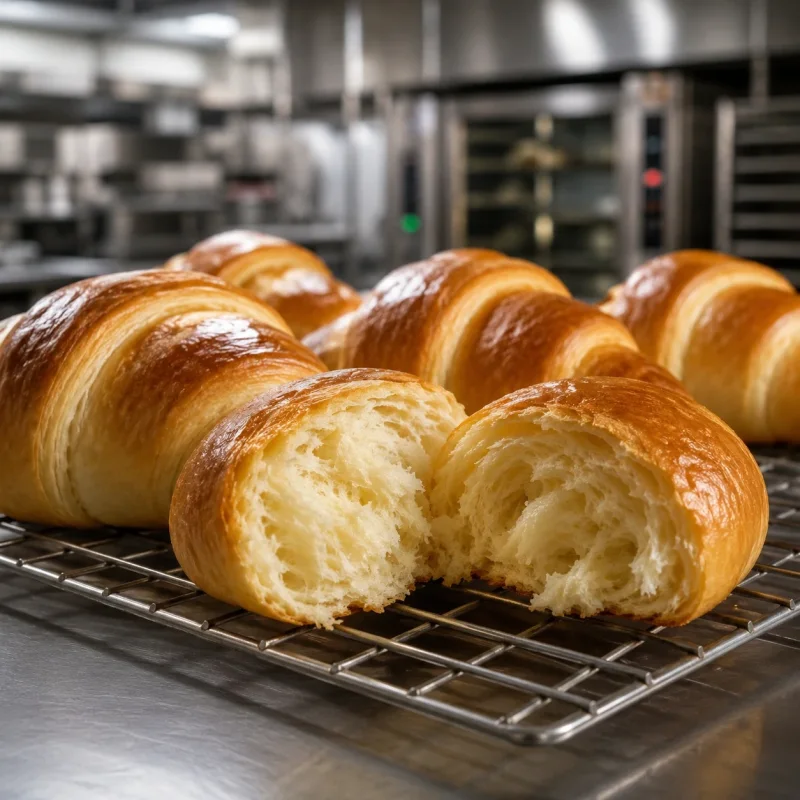
What a good soft yeast crescent roll should look like
A good result has an even golden surface, a soft crust, and a light, elastic crumb that pulls into delicate strands. The interior should not be gummy, wet, or dense, but it should not be dry and crumbly either.
The visible spirals on the outside come from rolling a triangle into a crescent. That does not mean the crumb should contain distinct butter layers like a croissant. In a classic yeast crescent roll, most of the volume comes from a developed gluten network and fermentation gases; fat contributes tenderness, flavour, and a richer mouthfeel.
1. Do not “fix” soft dough with extra flour just to make it easier to handle
One of the quickest routes to a dense crescent roll is simple: the dough feels uncomfortably soft, so more and more flour is added during kneading or rolling. Handling becomes easier, but the finished roll loses moisture and flexibility.
The target is a soft, supple dough, not a dry ball. Mild stickiness early in mixing is not automatically a fault. Give the flour time to absorb the liquid and the dough time to build strength. If it sticks during shaping, dust the work surface lightly rather than kneading extra flour into every piece.
A short rest can make rolling much easier because the dough relaxes. If it keeps shrinking back, cover it and leave it for a few minutes before trying again.
2. Rich dough needs enough structure to carry the butter
Butter does not create croissant-like flakes simply because it is present in the dough. In a non-laminated yeast dough, its main job is different: it adds flavour, tenderness, and richness to the crumb.
With very rich, butter-heavy doughs, it is often useful to develop the base dough first and then add pliable butter gradually, when that matches the formula. The butter should be soft and plastic, not melted or greasy. If the dough becomes shiny, slides around the bowl, and starts releasing fat, it is often too warm; a short chill is safer than adding more flour.
Lighter enriched doughs may use a different mixing order. The end point is still the same: the finished dough should be smooth, cohesive, and elastic enough to retain gas during proofing.
3. Sweet yeast dough rises on its own schedule
Sugar does more than add sweetness. Higher sugar levels bind water and can slow yeast activity, which is one reason richer sweet doughs often rise more slowly than lean bread doughs. Fat and eggs also change how the dough behaves.
Do not treat proofing time as an on/off switch. The time in a recipe is a guide; the state of the dough is the decision. A cooler kitchen or a richer dough may need longer, while warmer conditions may accelerate fermentation.
If the dough is barely gaining volume, do not simply make it hotter. First check the yeast, the dough temperature, and whether the gluten network is strong enough to hold the gas being produced.
4. Shape with gentle tension, not compression
Roll each triangle from the wide end toward the point with light, even tension. Pulling and squeezing too hard pushes out gas and can produce a denser crumb. Rolling too loosely can allow the crescent to open during final proofing or baking.
The tip of the triangle should finish under the roll. The weight of the dough then helps keep it in place. For filled crescents, avoid overfilling: excess filling makes the seam harder to seal and is more likely to leak before the dough is fully baked.
If the dough repeatedly contracts while you roll it, do not fight it. Cover it, let it relax briefly, then continue shaping.
5. Judge the final proof with your eyes and your fingertips
Before baking, shaped crescents should look noticeably fuller, lighter, and softer, not merely a little larger. The surface should be smooth and gently taut rather than dry or tight.
A light fingertip press can provide another clue: adequately proofed dough usually springs back more slowly. If the indentation disappears immediately, the rolls often need more time; if it remains deep and the structure begins to sag, proofing may have gone too far. This is not an absolute test, so always combine it with appearance and feel.
6. Watch colour and crumb in the oven, not just the clock
Use the temperature and time in the specific recipe as your starting point. Sweet enriched dough can brown faster than lean bread dough because of its sugar, milk, and eggs, so a dark crust does not automatically mean the centre is properly baked.
If the tops regularly darken too quickly while the crumb remains heavy or damp, check the rack position and the oven's actual temperature. If the rolls stay pale but are already dry, the bake may be too long at too low an effective temperature.
Steam is not a universal requirement for sweet yeast crescent rolls. For this style of enriched bread, a stable oven and a process suited to the specific formula matter more. Do not automatically transfer high-steam bread methods to soft sweet dough.
Common problems and what they tell you
The crescent rolls are dense and heavy
If the dough is already firm and dry before shaping, too much flour or too little liquid relative to the formula is a likely cause. If the dough is soft but barely expands during proofing, investigate fermentation. If it rises well and then collapses in the oven, the structure may be too weak or the final proof may have gone too far.
The dough is greasy and tears
This is different from simple stickiness. A greasy surface, sliding in the bowl, and visible fat release suggest that the butter is too soft or the dough is overheating. Chill the dough instead of hiding the problem with extra flour.
The rolls open during baking
Start with shaping. The point of the triangle should sit underneath the roll, and the dough should be closed with gentle tension rather than compressed. With filled crescents, too much filling or filling smeared onto the sealing edge is another common cause.
The crumb is dry and crumbly
Think first about two things: too much extra flour during handling or overbaking. Dryness starts at the mixing stage; once a dough has been made too stiff with flour, the oven cannot restore the missing moisture.
Can you make the dough a day ahead?
Yes. Cold fermentation is useful for many richer yeast doughs because it slows fermentation and makes buttery dough easier to shape. But refrigeration does not replace the final proof. After shaping, the crescents still need to reach the correct state before baking.
If a formula was not designed for an overnight rise, do not change yeast levels and timing at random. Cold fermentation is a method, not a universal fix for every recipe.
The PEKI approach: measure dough condition, not just minutes
For a repeatable next batch, record four things: how soft the dough felt after kneading, whether the butter was fully incorporated, what the shaped crescents looked like at the end of final proofing, and how quickly they browned in your oven.
That is much more useful than writing “proofed for 60 minutes.” Kitchens, flours, temperatures, and formulas vary. Good dough still tells you when it is ready — if you know which signals to read.
Frequently asked questions
Answers to common questions
Why are sweet crescent rolls dense and heavy?
Separate three cases. Dough that is firm and dry before proofing often contains too much flour. Soft dough that barely gains volume points more toward fermentation or yeast. Rolls that rise well and then collapse may be overproofed or may not have enough structural strength.
How do I know when shaped crescent rolls are fully proofed?
They should look noticeably fuller, lighter, and softer. A gentle finger press is only an extra clue: adequately proofed dough usually springs back more slowly. If it rebounds immediately, it often needs more time; if the dent stays deep and the structure weakens, proofing may have gone too far.
Do all ingredients need to be at room temperature?
Not as a universal rule. Temperature should serve the process. In rich butter dough, the key is that the butter is pliable rather than melted and that the dough does not overheat while mixing. Cooler ingredients may extend proofing but are not automatically a problem.
Why do crescent rolls open while baking?
Shaping is a common cause. The point of the triangle should finish underneath the roll, and the dough should be closed with light tension rather than squeezed. With filled crescents, excess filling or filling on the sealing edge can also cause opening.
How do I keep crescent rolls from turning dry after baking?
Limit extra flour during handling, then do not extend baking just to obtain a darker crust. Sweet enriched dough can brown quickly, so judge the crumb as well as the colour. Dryness is often a combination of dough that was made too stiff and baking that went too long.
Can I make the dough a day ahead?
Cold fermentation is useful for many richer yeast doughs and can make shaping easier. It does not replace the final proof. If a formula was not designed for cold fermentation, do not change yeast levels and timing at random.