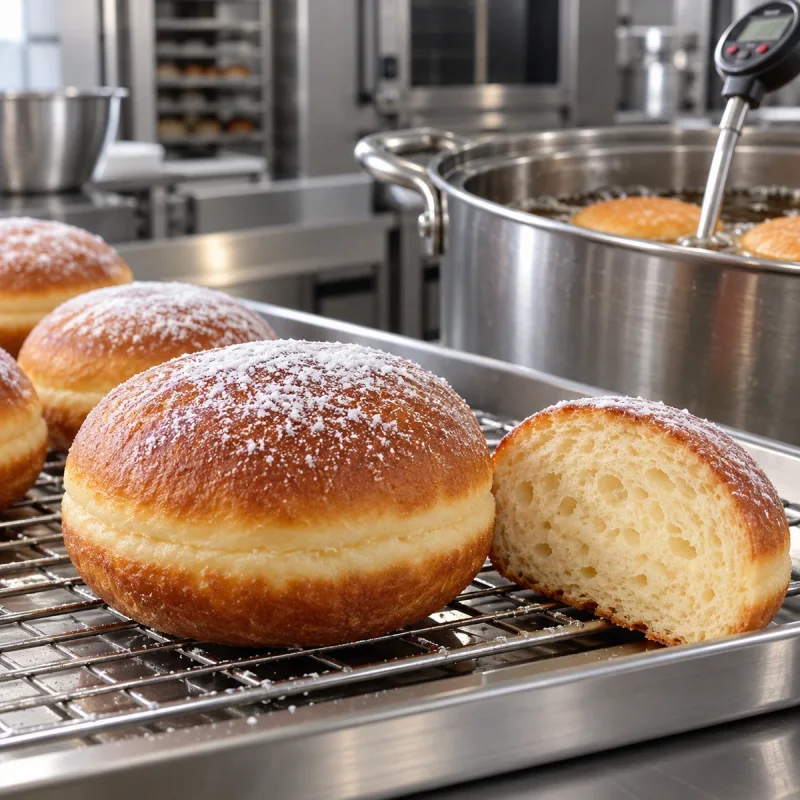
If doughnuts absorb oil, check temperature before changing the recipe
A greasy doughnut is often blamed on too much fat in the dough. During frying, the first variable to check is usually different: oil that is too cool or unstable. When the oil temperature is low, the surface sets more slowly, frying takes longer, and the doughnut can take up more oil and feel heavy.
The opposite extreme is no better. If the oil is too hot, the outside browns very quickly while the center lags behind. You can end up with a dark doughnut and a wet or raw core.
Many published yeast-doughnut formulas work roughly around 175–185°C / 350–365°F, but that is not one universal target for every dough, size, or pot. The specific formula comes first. More important than chasing one number is measuring the oil and keeping it reasonably stable after the dough goes in.
For the broader fermentation model, see Bread Dough Fermentation: How to Know When It’s Ready. The same principle matters here: gas production only helps if the dough can still hold that gas.
The pale ring comes from buoyancy, not from a cosmetic trick
The light band around the middle of a yeast doughnut is often called the proof line. It forms because a well-aerated doughnut floats high enough that the top and bottom spend time in the oil while the middle band remains just above the surface.
That makes the ring useful as a diagnostic signal. It reflects proofing, buoyancy, shape, oil depth, and handling. It is not, by itself, proof that every part of the process was perfect.
A doughnut without a dramatic ring is not automatically a failure. If it is light, fully cooked, thin-crusted, and not greasy, the result may still be technically sound. Likewise, a very wide ring does not prove ideal proofing.
Before frying, the doughnut should be puffy but still strong enough to handle
Final proof is not something you can judge by the clock alone. Doughnuts should become visibly lighter and puffier, while the skin stays strong enough that you can move them without flattening them.
Press the edge of one test piece very gently. On a properly proofed doughnut, a light indentation should remain visible without the piece collapsing. If the dough springs back quickly and still feels firm, it generally needs more time. If it collapses under a very light touch or is so fragile that transfer is difficult, it may be overproofed.
This is not a laboratory test and enriched doughs do not all behave alike. Butter, yolks, sugar, flour strength, and dough temperature change the feel. Combine the indentation with volume, handling strength, and the overall feel of the dough.
Underproofed doughnuts are dense; overproofed doughnuts are fragile
An underproofed doughnut contains less developed gas structure. It may rise less in the oil, finish with a denser crumb, and show a weak or absent pale ring.
An overproofed doughnut has the opposite problem. There may be plenty of gas, but the structure has lost strength. The piece can flatten during transfer, expand unevenly, or partially collapse after an initial puff.
If this keeps happening, do not solve it by adding more yeast. Check dough temperature, time, and actual proof level first. For the relationship between yeast quantity, dough temperature, and time, use How to control yeast activity for an even rise.
Oil temperature has to survive the moment the doughnuts go in
The number on the thermometer before the first doughnut is not enough.
Each piece of dough removes heat from the oil. Add too many at once and the temperature can fall sharply. That is why an overloaded pot often produces a familiar pattern: the first batch looks good, later batches become paler and greasier.
Fry in small batches and watch both the drop and recovery of oil temperature. Use enough oil for the doughnuts to float freely without crowding the bottom or one another. A very small oil volume has less thermal mass and is harder to keep steady.
Think of frying as a controlled system, not a timer. Measure, add a limited batch, observe the drop, and let the oil recover before the next one.
Oil that is too hot can brown the outside before the center is cooked
If a doughnut turns dark very quickly but the cut center remains sticky or raw, simply extending the frying time at the same temperature usually makes the outside even darker.
Lower the heat and check the size and thickness of the doughnut. A larger piece needs more time for heat to reach the center. Making pieces much larger than the formula expects changes the entire heat-transfer problem.
For the first batch, make a control cut. Let one doughnut rest briefly, then cut through the center. You want an even, soft, aerated crumb with no wet line of raw dough.
Surface color is not enough. It shows what happened outside, not necessarily what happened at the center.
Transfer should not destroy the final proof
A correctly proofed doughnut can be damaged in the last few seconds before frying.
If you squeeze it, stretch it, or lift it by one edge, you can push out part of the gas and distort the structure. Soft pieces then puff unevenly in the oil.
Shape and proof the doughnuts so they can be transferred with as little handling as possible. The goal is simple: the same puffy doughnut that sat on the tray should enter the oil.
Avoid excessive bench flour. Loose flour falls into the fryer, settles, and darkens.
Why the pale ring is missing
First ask whether the doughnut actually floated high enough.
Likely causes include insufficient final proof, a dense dough structure, unstable oil temperature, too little oil, uneven shaping, or damage during transfer.
Do not change all of these at once. If the crumb is good but the ring is weak, check oil depth and handling first. If the doughnut is also dense and heavy, start with fermentation.
If you suspect the yeast dose itself, do not swap fresh and dry yeast gram for gram. Use Fresh vs dry yeast: conversion ratios and how to use each.
Why doughnuts absorb too much oil
Measure the oil temperature during frying, not only before it begins.
If it drops sharply when doughnuts are added, reduce the batch size and wait for the oil to recover before the next batch. Also check whether the pot is heavy enough and whether the oil volume is adequate.
If the temperature is stable and the doughnuts still feel heavy, then examine the dough structure. An underproofed dense doughnut behaves differently from a light, well-aerated one.
Do not add extra flour just because the finished doughnuts were greasy. That can make the crumb even denser and hide the real cause.
Quick diagnosis from the first doughnut
| Symptom | Check first | Next action |
|---|---|---|
| Greasy and pale | Oil temperature during frying | Reduce the batch and stabilize the oil |
| Browns fast, raw inside | Excessive heat or oversized piece | Lower the heat or standardize size |
| Dense with no pale ring | Final proof and dough strength | Extend proof only if the dough is still firm and underinflated |
| Flattens during transfer | Overproofing or rough handling | Shorten final proof or change transfer method |
| First batch good, later batches greasy | Temperature drop between batches | Fry fewer pieces and allow recovery |
| Collapses strongly after frying | Center structure and proof level | Separate undercooked center from overproofed dough |
Frying safety is part of the technique
Use a stable, deep, heavy pot and do not fill it close to the rim. The oil level rises and bubbles strongly when dough is added.
Keep hands and tools dry. Lower doughnuts into the oil away from you rather than dropping them from a height.
If the oil starts smoking, turn off or remove the heat source and let the oil cool safely.
If the oil catches fire, never pour water onto a grease fire. If the fire is small and you can do so safely, smother it with a lid and turn off the burner. If you cannot control it safely, leave the area and call for help.
PEKI recommend: use the first doughnut as a measurement
Do not begin a new batch with a full pot. Fry one or two test doughnuts first.
Record the temperature before loading, the lowest temperature after loading, approximate time on each side, color, presence or absence of the pale ring, and most importantly the crumb after a short rest.
Then change only one variable: oil temperature, batch size, doughnut size, or final proof.
That is the fastest way to find out why doughnuts are greasy, dense, raw in the center, or missing the proof line — and to make the next batch repeatable instead of lucky.