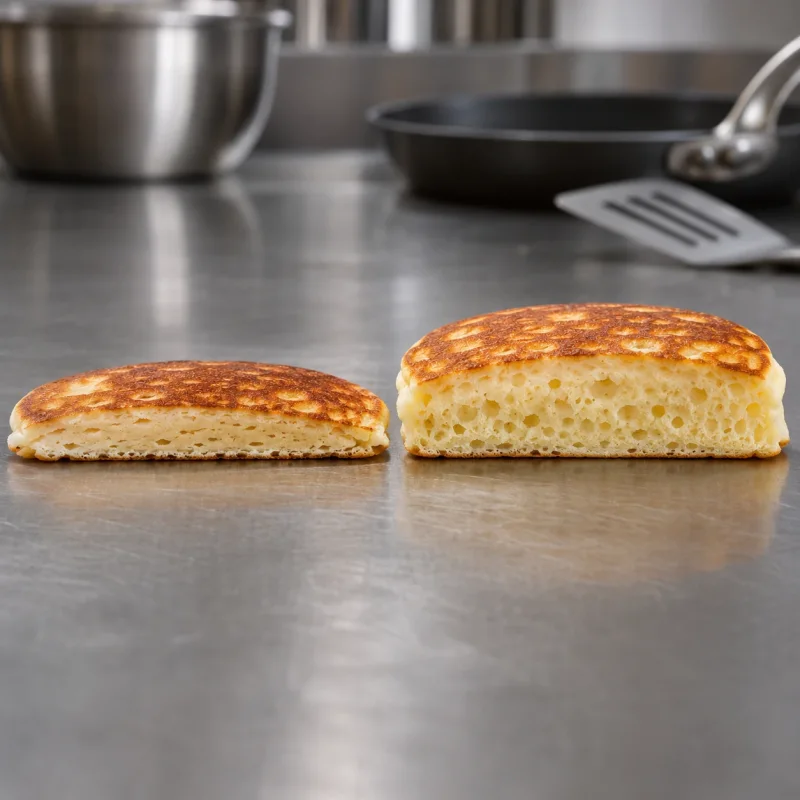
American-style pancakes can look beautifully golden yet turn out low, rubbery or even wet in the middle. Those are three different problems. Adding more flour, milk or baking powder without identifying the cause can make things worse. Start by cooking one test pancake, cutting it open and changing only one variable. This guide concerns thick American-style pancakes, not thin crêpes or traditional British pancakes.
Quick diagnosis: what does the cut pancake tell you?
| What you see | Check first | Smallest useful change |
|---|---|---|
| Low, evenly dense but fully cooked | How vigorously you mixed and whether the raising agent was measured correctly | Mix the next batch only until combined; do not change ingredient quantities yet |
| Dark underside, wet or liquid centre | Pan temperature relative to pancake thickness | Reduce the heat, let the pan settle and repeat with the same portion |
| Pale, wide and slow to set | Pan not heated through, or batter too runny | Check the heat first; then compare the weighed ingredients with the recipe |
| Rises initially but becomes chewy as it cools | Overmixing or an unsuitable ingredient balance | Mix the next batch less and compare at the same cooling time |
Treat this table as a diagnostic starting point, not proof of one cause. Look at colour, how quickly the edges set and the texture of the cut crumb together. A low pancake does not automatically mean that the baking powder is old.
1. Overmixing: perfectly smooth batter is not always better
Once wheat flour is combined with liquid, mixing begins to develop the gluten network. Some structure helps the pancake hold together. Too much vigorous stirring, however, can make the crumb tougher and displace bubbles of gas that would otherwise help it rise. For thick, tender American pancakes, stir the wet and dry ingredients just until there are no pockets of dry flour. A few small lumps are normal; flour left dry at the bottom of the bowl is not.
Can you fix it now? You cannot undo gluten development simply by stirring in another direction or adding flour. If the ingredients were measured correctly, cook a test pancake to see whether the pan is part of the problem. For the next batch, shorten the mixing while keeping the original formula unchanged. Extra flour is not a reliable first response to a tough pancake.
2. Baking powder, baking soda and keeping the gas in
Baking powder produces carbon dioxide when moistened and/or heated, depending on its formulation. Baking soda needs a suitable acidic ingredient to react effectively. They are not interchangeable measure for measure. Gas production alone is not enough: a batter that spreads too readily, or one whose bubbles are lost during vigorous mixing, may still produce flat pancakes.
Check which raising agent the recipe actually specifies and how much you added. Look at its storage conditions and best-before date, but do not blame the powder solely because a pancake is flat. If you used the correct ingredients, investigate mixing, batter consistency and cooking temperature before changing the recipe. For a deeper explanation, see our guide to baking powder and baking soda.
3. Batter consistency: too runny or too stiff?
Thick American pancake batter generally spreads more slowly than batter for thin crêpes. If it instantly runs into a wide, almost translucent circle, first check the amount of flour and liquid you measured and which flour you used. If it is so stiff that you have to force it across the pan with a spatula, the liquid may be insufficient for that particular formula, or the flour may absorb more water than expected.
There is no universal flour-to-milk ratio that works for every flour, egg size and recipe. Compare the batter against the recipe before adding more milk or flour. If all amounts are correct and the pancake is both pale and overly thin, check that the pan has had time to heat through. Changing several ingredients at once would make the next result impossible to interpret.
4. Pan temperature: a brown outside is not a cooked centre
A very hot skillet can brown the surface quickly while the centre of a thick pancake remains raw. At the opposite extreme, insufficient heat can allow a runny batter to spread further before it sets. Start with steady, moderate heat and a thin film of fat. Numbers on different hobs are not comparable; the first pancake is a better test than the setting on the dial.
If your recipe allows, measure out about 60 ml (¼ cup) of batter per pancake to keep the test portions comparable. Watch for small bubbles on top, edges beginning to set and a golden underside. Turn gently, usually just once, then allow the second side to cook through. If the cut middle is still wet, lower the heat and review the cooking time and pancake thickness. Do not turn the heat up simply because the centre is undercooked. Cook any raw centre thoroughly before serving.
The one-pancake control test
- Record your starting point. Keep the same recipe, measured ingredients, pan and portion size. A photo of the failed pancake can make comparison easier.
- Examine the batter. Are there pockets of dry flour? Has it been mixed excessively until completely smooth? Does it immediately run across the pan? Record what you see rather than adding several ingredients.
- Cook one pancake. If suitable for the recipe, portion about 60 ml of batter. Use moderate heat and watch the surface, edge and underside before turning.
- Cut and compare. Decide whether the middle is fully cooked but dense, genuinely wet, or chewy. A wet centre shows incomplete cooking; it does not prove a problem with the raising agent.
- Change one variable only. If the crust is too dark, adjust the heat first. If a fully cooked pancake is chewy, change the mixing method in the next batch. If a gently mixed, correctly cooked pancake still will not rise, check the type and dose of raising agent.
What can you correct in the same batch? Heat and portion size can usually be adjusted immediately. You cannot remove developed gluten or reliably repair an imbalance of raising agents after mixing. Test those changes in a fresh batch with the same baseline quantities.
Frequently asked questions
Must the batter be completely smooth?
No. Small lumps are usually preferable to prolonged stirring, as long as no dry pockets of flour remain. The aim is to combine the ingredients, not to beat them into a perfectly uniform liquid.
Will more baking powder guarantee fluffier pancakes?
No. Too much can spoil flavour and texture. First check whether the recipe calls for baking powder or baking soda, the amount measured and the composition of the batter.
Why are my pancakes dark outside but raw inside?
The pan may be too hot for their thickness. Reduce the heat and repeat with an equal portion of batter. Pancakes with a wet, raw centre must be cooked through before eating.
Must pancake batter always rest?
Not for every recipe. A short rest may allow flour to hydrate, but its effect also depends on the raising agent and the formula. Follow the recipe rather than applying a universal resting time.
What about thin pancakes and crêpes?
Thin crêpes that do not tear have a different goal: a flexible, even sheet rather than substantial height. Their batter and cooking technique need different troubleshooting.
The technical takeaway
Fluffiness does not come from one secret trick. The raising agent must generate gas, the batter must retain enough of it, and the pancake must cook gently and evenly. Cut one pancake open, identify a plausible cause and test one controlled change. That will help you find the real problem instead of hiding its symptoms.
Sources and limitations: the explanations of mixing and batter behaviour draw on King Arthur Baking, “Don't make this pancake mistake” (2017), “How to make fluffy pancakes” (2019) and “Simply Perfect Pancakes” (updated 2026). This is a troubleshooting guide, not a report of a controlled test of one specific recipe. Exact heat settings, cooking times and resting needs depend on the formula, pan and pancake thickness.
Diagnostics
Common problems and solutions
Low pancake with a uniformly dense, cooked middle.
Cause: Too much mixing, weak leavening or a batter that is too thick could be involved.
Solution: Check the measured ingredients and baking powder; next time mix less while keeping the other variables constant.
Dark brown outside but still liquid in the centre.
Cause: Pan heat is too strong for the pancake’s diameter and thickness.
Solution: Lower the heat, allow the skillet to settle and cook one equally sized test pancake.
Pale pancake spreading wide and setting slowly.
Cause: The pan may be too cool or the batter too thin for the formula.
Solution: Test the pan heat first; then check the actual flour and liquid quantities.
Pancake rises but turns chewy after cooling.
Cause: Overmixing after adding flour, or a combination of formula and cooking conditions.
Solution: In the next batch stop mixing once the flour is moistened, and compare after the same cooling time.