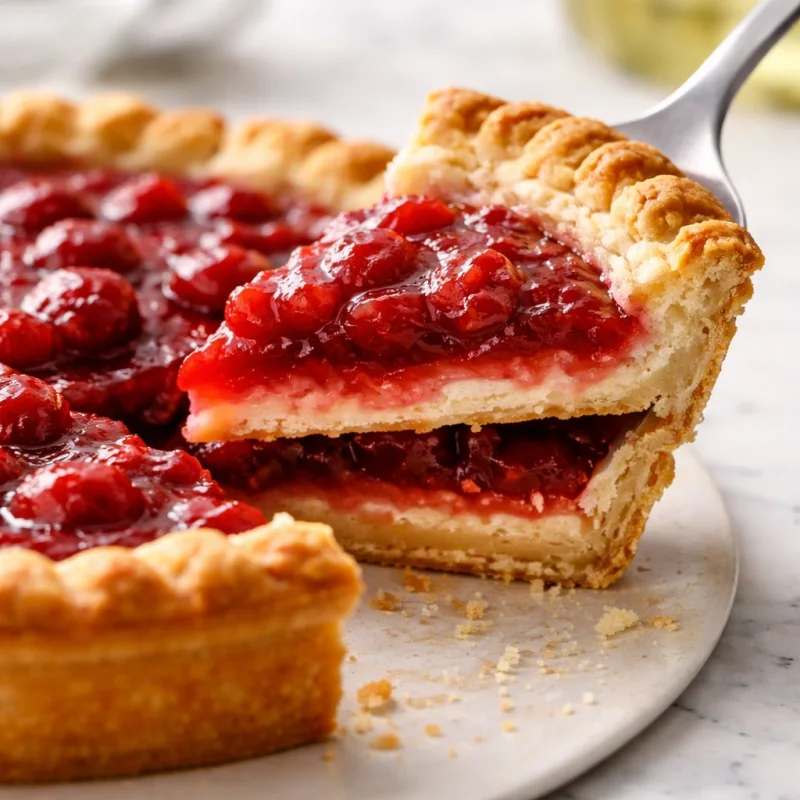
When the layers pull apart: what happens between crust and filling
Quick answer
If pie filling pulls away from the crust after baking, a soggy bottom is not the only possible cause. The filling may shrink more than the crust, release free moisture, or set too slowly. Diagnose in this order: filling shrinkage → free moisture → setting → crust condition → cooling. Blind baking is useful for some wet fillings, but it is not required for every pie.
First separate two different kinds of gaps
In a double-crust fruit pie, fruit can lose volume while the top crust has already set and stays higher. In an open pie or tart, the filling can instead pull away from the lower crust. Those failures can look similar but need different fixes.
For the broader mechanics of stable layers, see stable layer cakes and clean slices.
Why filling loses contact with the crust
The most common mechanisms are:
- filling shrinkage during baking and cooling,
- too much free moisture at the interface,
- weak setting from starch, egg, or another structural system,
- a crust that sets too slowly relative to a wet filling.
With fruit pies, control starts with a fruit filling that is properly thickened and does not leak. The goal is not simply to add more starch; it is to manage how much free juice enters the bake.
Do you always need to blind bake the crust?
No. Partial or full pre-baking is most useful when the filling is very wet, the final bake is short, or you specifically need a dry, firm shell. Pies designed to bake the crust and filling together may not benefit from blind baking.
A better question is: does the crust need to set before the filling starts releasing a lot of moisture?
Filling temperature is not a universal rule
A very hot filling can soften a high-fat crust quickly, while a very cold filling can delay the time it takes the center to reach its setting temperature. Follow the logic of the recipe rather than a blanket rule that filling must always be warm or at room temperature.
For batters that depend on a stable emulsion, it also helps to understand how to add eggs without curdling the mixture.
How to improve contact between crust and filling
- spread the filling evenly and remove large air pockets,
- reduce free juice in very wet fruit or bind it appropriately,
- pre-bake the crust only when moisture load or short final baking makes it useful,
- bake the filling until its structure has set through the center,
- wait for sufficient cooling before slicing.
A professional way to diagnose the failure
Look at a fully cooled slice and ask whether the interface is a dry void or a wet sliding layer. A dry void points more strongly to shrinkage; a wet interface points more strongly to free moisture or an under-set crust. Change only one variable on the next test.
When the layers work as one system again
A good pie does not need the filling to be chemically glued to the crust. It needs stable contact without excessive free water and without a large mismatch in shrinkage. Once you identify the mechanism, the fix becomes precise instead of random.
Frequently asked questions
Answers to common questions
Why does pie filling pull away from the crust after baking?
The filling may shrink more than the crust, release free liquid, or fail to build a stable enough set. A wet interface points more toward moisture; a dry void more often points toward shrinkage.
How can I tell whether a filling is too unstable before baking?
A very fluid mixture, rapid juice release, or an unstable emulsion are warning signs. With fruit, evaluate free juice; with egg- or dairy-based fillings, follow the intended setting method rather than thickening blindly.
Do I always need to blind bake a pie crust?
No. Blind or partial baking is especially useful for very wet fillings, short final bakes, or when a dry, firm shell is required. Pies designed to bake crust and filling together often do not need it.
Why is there a gap under the top crust of a fruit pie?
Fruit loses water and volume as it bakes while the top crust may set earlier and stay elevated. That is different from filling separating from the bottom crust; pre-cooking fruit and venting the top crust can help.
How important is cooling for a stable slice?
Very important. Starch gels, fruit fillings, and many custards continue to firm as they cool. Cutting too early can shift the filling and make it look separated even though it would stabilize later.
Can overbaking make separation worse?
Yes. Some egg- and dairy-based fillings shrink and weep when proteins coagulate too aggressively. Higher heat is therefore not a universal solution.