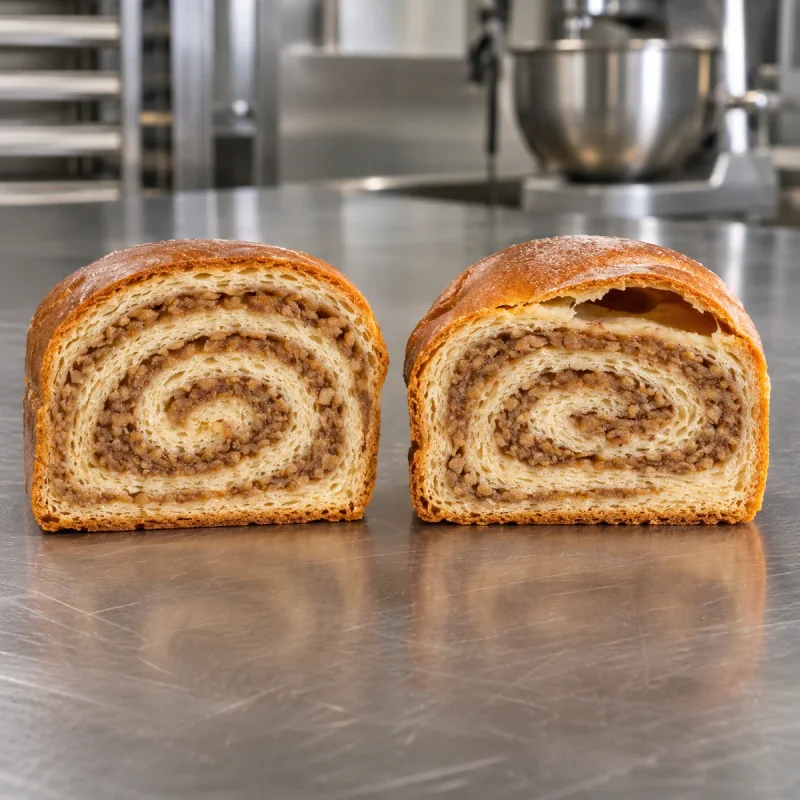
When potica bursts open in the oven, the roll may have been underproofed or its outer layer stretched too tightly. A baked crust lifted above a collapsed interior suggests overproofing. A hollow space between the swirls points instead towards the filling, rolling technique or trapped steam. Identify where the defect occurs before deciding what to change.
Make two observations: what happened while the roll was baking and what the fully cooled cross-section looks like. A crack alone cannot establish the cause. Check doneness separately, too: a deeply browned crust does not guarantee that the centre is baked.
Quick diagnosis: crack, lifted crust or gap?
| What you see | Likely explanation | What to check next time |
|---|---|---|
| The top splits wide open during baking | Insufficient final proof or a stretched outer layer | Check volume and softness before baking |
| The firm upper crust sits like a lid | Excessive proofing followed by collapse inside | Do not continue proofing once the roll loses strength |
| A gap separates the inner spirals | Wet filling, poor layer contact or trapped steam | Check spreadability, rolling and open vent holes |
| The roll unwinds and has few turns | Stiff dough combined with overly soft filling | Balance dough flexibility and filling consistency |
Why does potica split during baking?
A large crack opening across the top often means that the shaped roll had not completed its final proof. The dough expands rapidly in the oven, and the outer layer cannot stretch far enough. A tightly pulled, unevenly thin surface can contribute. Pricking the roll again will not correct either problem.
A small split along the outer top edge is not necessarily the same fault. It can appear when the last turn of dough is very thin and spread with filling right to the edge. On the next bake, leave some of the finishing dough unfilled so the outer layer has room to stretch. Do not blame the oven temperature based on the crack alone.
Why does the upper crust separate?
If the crust has set but the interior has sunk, leaving a space underneath, consider excessive final proofing. The exterior firms up in the hot oven while overexpanded inner layers lose support. The remedy is not the same as for a roll that splits because it was underproofed.
Look at the whole cross-section. Is the crust a separate cap above a sunken centre? If the top remains firm but the gap follows one layer of filling, contact between dough and filling is more relevant. A detached crust is therefore a clue, not a definitive diagnosis.
Why are there holes between the swirls?
Filling that is too runny can release enough moisture during proofing and baking to weaken the bond between layers. Walnut filling should be spreadable but not liquid: it should coat the dough without tearing it, running away or gathering in wet clumps. Making the filling excessively dry is not the answer.
Loosely or unevenly rolling the dough can also trap air pockets. Equally, do not squeeze the roll so hard that the dough becomes compressed. Piercing the roll as directed by the recipe lets air and steam escape, provided that any thin egg wash does not seal the openings.
Four checks for your next potica
- Assess the filling before spreading. If it flows, allow the walnuts to absorb moisture or adjust its consistency within your chosen recipe. It should spread in an even layer.
- Roll the dough out evenly and coil it firmly without pulling the outer skin tight. Gently push out larger air pockets as you roll; close the seam and join the ends.
- After placing the roll in the potica mould, monitor the final proof. It should visibly increase in volume and feel softer. If it starts to lose strength, extra waiting will not help. There is no universal proofing time.
- Pierce the potica according to your recipe. If you brush it with egg wash, keep the coat thin and the holes open. Bake according to a reliable recipe, taking the roll’s size and your oven into account.
What if the potica is already baked?
Pressing baked layers together will not make them bond again. If the potica has cooled and the centre is fully baked, a gap is mainly a structural and appearance defect; the slices can still be served. If the centre is raw, wet or paste-like, do not judge it safe to serve solely because the crust is brown.
For the next attempt, record one specific observation: a crack opening in the oven, a lifted top crust, or a gap between the swirls. Change the most plausible cause while keeping other steps comparable. That makes the result easier to interpret.
Frequently asked questions
Why did my potica crack even though I pierced it?
Piercing lets air and steam escape; it cannot replace the final proof. If the top splits wide open, check how much the shaped roll had risen and whether the outer layer was overstretched.
Should walnut filling be dry to prevent gaps?
No. It should be moderately thick and spreadable, moist enough for an even layer but not so runny that it leaks or slides between layers.
Is a gap the same as a dense ring beside the filling?
No. A gap means the layers are no longer in contact. A dense or gummy ring consists of compressed dough and requires a different diagnosis.
Is oven temperature always the reason for a cracked potica?
No. Oven heat can affect the bake, but a crack alone does not prove the temperature was wrong. First compare proofing, surface tension and the location of the split.
Related baking guides
If you see compressed dough rather than an empty space, read about dense rings in potica. For preparation problems, see kneading yeast dough for an even rise and rolling dough without tearing.
Diagnostics
Common problems and solutions
The top splits wide open during baking
Cause: Insufficient final proof or a stretched outer layer
Solution: Let the shaped roll visibly gain volume and soften before baking; judge the final proof by the dough, not a fixed number of minutes.
Prevention: Do not pull the outer dough layer taut or roll it excessively thin while shaping.
The firm upper crust sits like a lid
Cause: Excessive proofing followed by collapse inside
Solution: Monitor the final proof in the mould. If the roll begins to lose strength, stop proofing and move it gently into the oven.
Prevention: Do not treat a detached top crust as an underproofing crack: extra proofing can make this problem worse.
A gap separates the inner spirals
Cause: Wet filling, poor layer contact or trapped steam
Solution: Keep the walnut filling spreadable but not runny. Roll evenly without large air pockets and pierce the potica as directed by your recipe.
Prevention: If using egg wash, brush it on thinly and leave the vent holes open.
The roll unwinds and has few turns
Cause: Stiff dough combined with overly soft filling
Solution: Check that the dough is flexible and the filling holds its shape. Roll firmly without crushing the dough, and seal the final seam.
Prevention: Avoid pairing very stiff, dry dough with a filling that is too fluid.
A firm or gummy ring of dough appears beside the filling rather than an empty gap.
Cause: This is a different fault. Compacted dough, a filling that is too dry or uneven baking may be involved.
Solution: Distinguish the dense ring from a hollow gap and consult the separate guidance on dense rings in potica; extra piercing is not a universal fix.
Prevention: Inspect the fully cooled cross-section so a dense dough ring is not mistaken for an empty pocket.