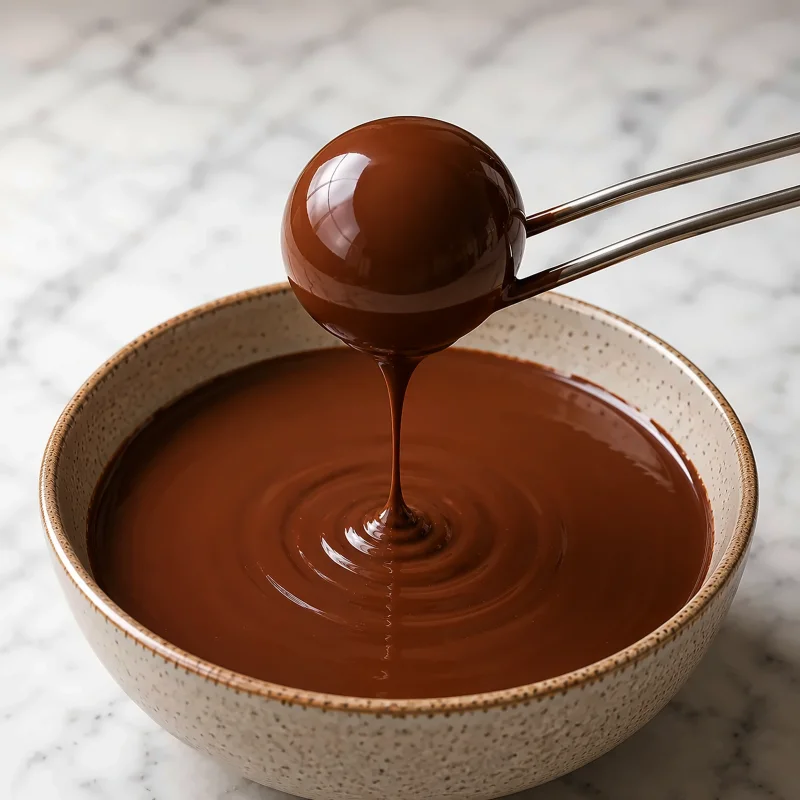
Chocolate truffles without cracks, stickiness or a blotchy coating
For a smooth chocolate truffle, do not wait until dipping to tackle problems. First make sure the ganache is properly emulsified and evenly set. Shape it quickly, without warming it excessively in your hands, then coat it with correctly tempered (pre-crystallised) chocolate. If the centre sticks, cracks or develops an oily film, correct that condition first. A chocolate shell will not reliably hide a faulty centre.
This is a troubleshooting guide, not another basic truffle recipe. The aim is to identify why a truffle's surface looks uneven, then choose the right correction rather than guessing.
Start with the symptom you can see
| What you notice | Likely cause | What to do |
|---|---|---|
| Ganache sticks to your palms and loses its shape | The centre is too soft or warms up during rolling | Stop, let the portion firm up again, then work more quickly with a lighter touch |
| The surface cracks as soon as you start shaping | The ganache is too cold, too firm or unevenly set | Let it become pliable and test it again with gentle pressure |
| The centre has oily patches | The emulsion is unstable or fat is separating | Do not dip it yet; check how the ganache was emulsified and its working temperature |
| The coating is thick and forms ridges | The chocolate is too viscous, too cold or over-crystallised for dipping | Check the working temperature and fluidity of the particular couverture |
| White, rough patches appear after chilling | Moisture or condensation has reached the surface | Let the packaged product adjust gradually to the warmer environment before unwrapping |
This diagnosis matters more than prescribing a fixed time in the fridge. Two ganaches with different chocolate, liquid content or added ingredients can behave very differently after the same chilling period.
The ganache must be smooth before it sets
Smooth truffles start with a stable emulsion. As you combine the liquid with chocolate, the result should be uniform and glossy, with no oily rim or visible dry particles. If using an immersion blender, keep its head below the surface so you do not whip unnecessary air into the mixture.
There is no single chocolate-to-cream ratio for every truffle. Dark, milk and white chocolate vary in composition, fluidity and cocoa-butter content; flavourings and other additions also affect firmness. For formulation guidance, see how to make a smooth, stable chocolate ganache.
Before shaping an already prepared ganache, check three things: the surface looks even, a scooped portion shows no separate fat, and the mass holds its shape after light pressure. Only then move on to rolling.
Judge readiness by texture, not the clock
The ganache should set evenly throughout. If the edge of the container is firm but the centre is much softer, a single portion may crack in one area and smear in another.
Test both the middle and the edge. A spoon or spatula should meet similar resistance, and a scoop should hold together without a liquid rim. Soft ganache needs longer to set. If it is so hard that it splits under light pressure, let it become pliable before shaping.
Some professional recipes call for crystallisation at a controlled room temperature; others use refrigeration. Follow the actual formulation, especially when fruit purée, alcohol, extra liquid or other ingredients change stability and shelf life.
Shape quickly, using minimal pressure
Equal-size portions warm at a similar rate during handling. Weigh them for consistency if needed, but no universal weight is required: choose a size that suits the finished product.
Round each portion roughly first. Finish smoothing with a brief, light rolling motion. Keep your hands dry and avoid kneading; the aim is simply to close small surface imperfections.
If a truffle starts sticking to your fingers or develops an oily sheen, stop: the centre has left its workable range. If it cracks, do not squeeze harder. An overly firm centre needs more flexibility, not more force.
A thin pre-coat can help, but it is optional
For a softer filling, a very thin layer of correctly pre-crystallised chocolate before the final dip can reinforce the surface and close tiny cracks. It must not become a thick shell concealing an uneven centre.
Skip this step when the recipe does not call for it. The essential rule is unchanged: the centre must be dry, stable and free of condensation before coating.
For dipping, fluidity and temper matter more than one universal temperature
Use chocolate or couverture designed for coating. A viscous chocolate leaves a thick layer and ridges; chocolate that is too cool or over-crystallised flows too slowly to level on the truffle.
Set the working temperature for the actual product. General ranges are only a starting point; manufacturer instructions take precedence. For the complete process, consult how to temper chocolate at home.
Dip the truffle, lift it with dipping forks and let the excess chocolate drain away. Do not keep repositioning it after placing it down: repeated movement pushes chocolate towards the base and leaves a heavy foot.
If a well-prepared coating nevertheless sets dull or patchy, distinguish poor tempering from moisture. Our guide to dull chocolate glaze and how to restore its shine explains the difference.
Condensation can spoil even properly tempered chocolate
Never expose a very cold truffle immediately to warm, humid air. Moisture may condense on the shell, dissolving surface sugar that later recrystallises as rough, whitish sugar bloom. Keep the product covered or packaged while it gradually comes to the new temperature; unwrap it only when condensation is no longer a risk.
Sugar bloom is different from fat bloom, which is associated with changes in cocoa-butter crystallisation or fat migration. A dry, rough, pale surface after a temperature shock suggests moisture; smoother greyish streaks require a check of tempering, storage temperature and fat movement.
For a broader guide to chocolate selection, fluidity and applications, see chocolate in pastry: types, composition and uses.
Final check before dipping
Test one centre first. It should hold its shape, yield slightly to a gentle press and have no oily film, open cracks or visible water droplets. Next check the coating: it must be correctly tempered for that chocolate and fluid enough for excess chocolate to drain off.
A smooth shell follows a controlled sequence rather than luck: stable emulsion → even setting → brief shaping → dry centre → sufficiently fluid, properly tempered coating.
Diagnostics
Common problems and solutions
Ganache sticks to your palms and loses its shape
Cause: The centre is too soft or warms up during rolling
Solution: Stop, let the portion firm up again, then work more quickly with a lighter touch
Prevention: Portion first and shape in smaller batches so the rest of the ganache does not stay warm unnecessarily.
The surface cracks as soon as you start shaping
Cause: The ganache is too cold, too firm or unevenly set
Solution: Let it become pliable and test it again with gentle pressure
Prevention: Check the firmness of both the middle and edge before rolling.
The coating is thick and forms ridges
Cause: The chocolate is too viscous, too cold or over-crystallised for dipping
Solution: Check the working temperature and fluidity of the particular couverture
Prevention: Use a couverture suitable for dipping and monitor flow as well as temperature.
White, rough patches appear after chilling
Cause: Moisture or condensation has reached the surface
Solution: Let the packaged product adjust gradually to the warmer environment before unwrapping
Prevention: Avoid sudden temperature changes and humid air around cold chocolate.
Frequently asked questions
Answers to common questions
How long should ganache set before rolling truffles?
There is no universal time. Test the centre and edge: similar resistance, no oily rim and a portion that holds together without cracking mean it is workable.
Why do chocolate truffles stick to my hands?
The ganache is usually too soft or warms during prolonged rolling. Stop, let it firm up and resume with shorter, lighter movements.
Do I always need a chocolate pre-coat?
No. A very thin layer of pre-crystallised chocolate can steady a softer centre, but cannot replace properly emulsified and shaped ganache.
Why do rough white patches appear after chilling?
A sudden shift into warm, humid air can create condensation and sugar bloom. Keep the cold truffles packaged while they acclimatise.
Will cocoa powder hide an uneven truffle?
It may mask minor visual irregularities, but it will not repair cracks, separated fat or an unstable centre. A fully dipped truffle needs a sound centre first.