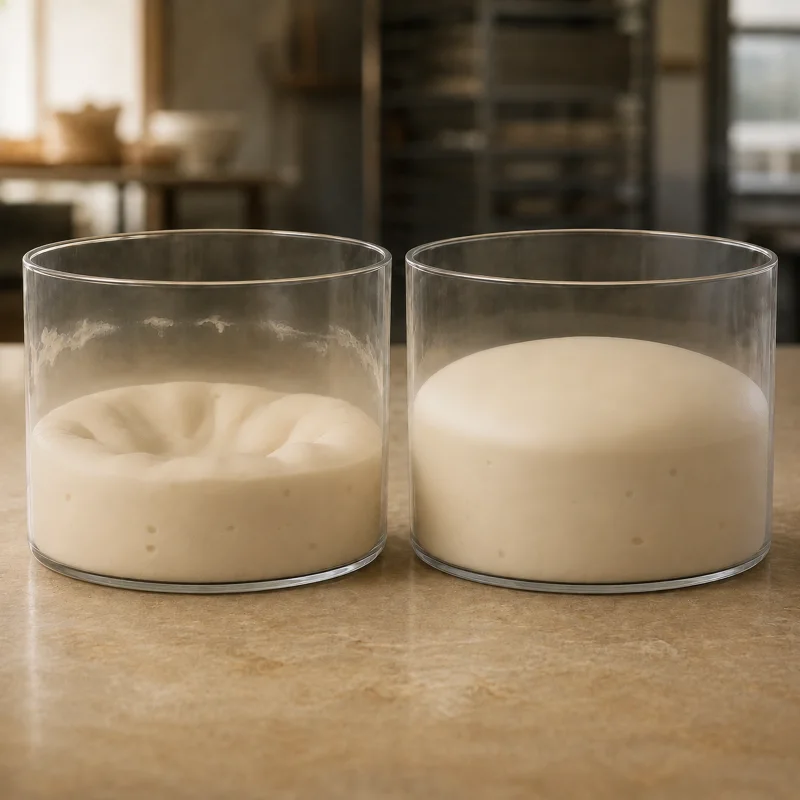
Yeast mistakes: more yeast does not mean more stable dough
Yeast produces gas but does not build the dough's load-bearing structure. If yeast quantity, temperature and time are mismatched, dough can rise rapidly, lose tension and collapse.
The biggest mistake is treating yeast quantity separately from time and temperature. More yeast speeds fermentation but does not strengthen dough structure; if gas production outruns the dough's ability to retain it, the usable window narrows and the dough can lose tension or collapse.
If the dough barely moves at all, use why dough does not rise.
1. Yeast quantity always belongs with time and temperature
There is no single correct yeast dose for every dough. A short room-temperature proof, long cold fermentation and very sweet dough require different process speeds.
For conversion between yeast types, use fresh and dry yeast conversion.
2. High dough temperature narrows the safe timing window
For many wheat doughs, about 24–26 °C after mixing is a useful starting point. Warmer dough can ferment much faster than a recipe clock suggests.
3. More sugar does not automatically mean faster fermentation
In very sweet dough, high sugar increases osmotic stress and can slow standard baker's yeast. Added sugar is not required simply to activate yeast.
4. Fast fermentation can expose weak structure
If dough inflates and then spreads, yeast may not be the only issue. Check gluten development, hydration and fermentation stage.
Where available, also use how to knead yeast dough to separate structural problems from fermentation speed.
5. Doubling in volume is not a universal endpoint
Judge volume together with surface tension and response to gentle pressure. Very soft dough with little recovery may already be overproofed.
For a separate overproofing diagnosis: overproofed dough.
6. Cold fermentation needs control, not one universal dose
A refrigerator does not stop fermentation instantly. Check starting dough temperature, actual refrigerator temperature, yeast dose and cooling time.
Diagnostics
Common problems and solutions
Dough rises very quickly, then loses tension
Cause: Fermentation is too fast for the available time and structural capacity.
Solution: Next time slow the process with less yeast, lower temperature or a shorter proof.
The same dough is much faster in summer than winter
Cause: Final dough temperature after mixing is inconsistent.
Solution: Adjust liquid temperature and measure the whole dough.
Very sweet dough rises slowly despite enough yeast
Cause: Osmotic stress and a rich formula slow standard yeast.
Solution: Use a tested formula and, when appropriate, yeast suited to rich dough.
Dough contains plenty of gas but spreads
Cause: Structure is too weak or fermentation has passed its stable peak.
Solution: Check mixing, hydration and fermentation stage.
Dough overproofs overnight in the refrigerator
Cause: Starting temperature is high, the refrigerator is warm or the process is too aggressive.
Solution: Lower starting temperature or yeast dose and verify refrigerator temperature.
Frequently asked questions
Answers to common questions
Can too much yeast make dough collapse?
It can contribute by accelerating gas production and shortening the usable window. Collapse usually reflects a mismatch between fermentation rate and structural capacity, not one cause alone.
How much yeast should I use for 500 g flour?
There is no universal amount. Dose depends on yeast type, temperature, fermentation duration and dough composition.
Does water for yeast always need to be warm?
No. The desired final temperature of the whole dough and the yeast manufacturer's directions matter more.
Why does sweet dough rise more slowly?
High sugar binds water and increases osmotic stress on yeast, so very sweet dough may ferment more slowly than lean bread dough.