When dough loses strength, the clock stops being enough
Overproofed dough is not simply dough that became large. A more useful sign is loss of load-bearing strength: surface tension fades, the shaped loaf spreads quickly, scoring becomes less controlled, and there is little reserve left for oven spring. One symptom is not enough, because weak gluten, excessive hydration, or loose shaping can create a similar loaf.
Start with a better question: At what stage did the dough first stop behaving strongly? If it was slack immediately after mixing, proofing time is probably not the only issue. If it was elastic and supportive at the end of bulk fermentation but became fragile and spread during final proof, overfermentation is much more likely.
What actually changes when fermentation goes too far
Fermentation produces gas and acids, but more gas only creates useful volume while the dough structure can retain it. When fermentation advances beyond what the flour, hydration, and developed gluten network can support, the dough may look inflated while becoming mechanically weaker.
After turning out of the basket it can spread rapidly. The blade may drag the skin rather than making a clean score, and oven spring may be modest. This is different from underproofing. Underproofed dough is often tighter and more elastic, may rupture aggressively in the oven, and can show a few large tunnels next to dense areas. The relationship between stages is explained in bulk fermentation vs. final proof.
Read the end of bulk with more than one signal
A straight-sided marked container is useful, but there is no universal percentage rise that fits every dough. Pair volume with bubbles along the sides, a gently domed surface, elasticity, jiggle, and the amount of resistance you feel when lifting or folding the dough.
Dough with useful reserve can be airy and larger while still holding its edges and stretching as one connected mass. Dough that is going too far progressively loses definition, becomes sticky or fragile in a new way, and spreads quickly after each movement.
Temperature changes the pace dramatically. The same formula ferments faster when the dough is warmer, so a recipe time is a process reference, not proof of readiness. With commercial yeast, dose also matters; see the guide to fresh and dry yeast conversion.
Final proof: look for remaining tension
After shaping, the loaf should become lighter and more aerated without losing all of its surface tension. The poke test can help, but it is only a supporting signal. Very wet, cold, or whole-grain dough can respond differently, so interpret the indentation together with shape, tension, and how quickly the loaf spreads after turning out.
A puffy loaf that still holds a dome and does not immediately flatten is a stronger sign than a number of minutes. A very fragile, ballooned loaf that offers almost no resistance and quickly becomes a disk is more consistent with an overextended final proof.
What can still be saved
If the dough is only slightly past its best point, do not give it more time. Handle it gently, shorten any remaining proof, and bake sooner. If it is spreading badly, a loaf pan, focaccia, or another lower format is usually more forgiving than forcing a tall free-standing loaf.
Adding a large amount of flour is a poor repair because it changes the whole formula and can create a loaf that is both heavy and unevenly baked. Refrigeration does not rebuild structure that has already broken down. Cold fermentation is mainly a timing tool when the dough is chilled early enough.
Use the baked loaf as a record, not a single verdict
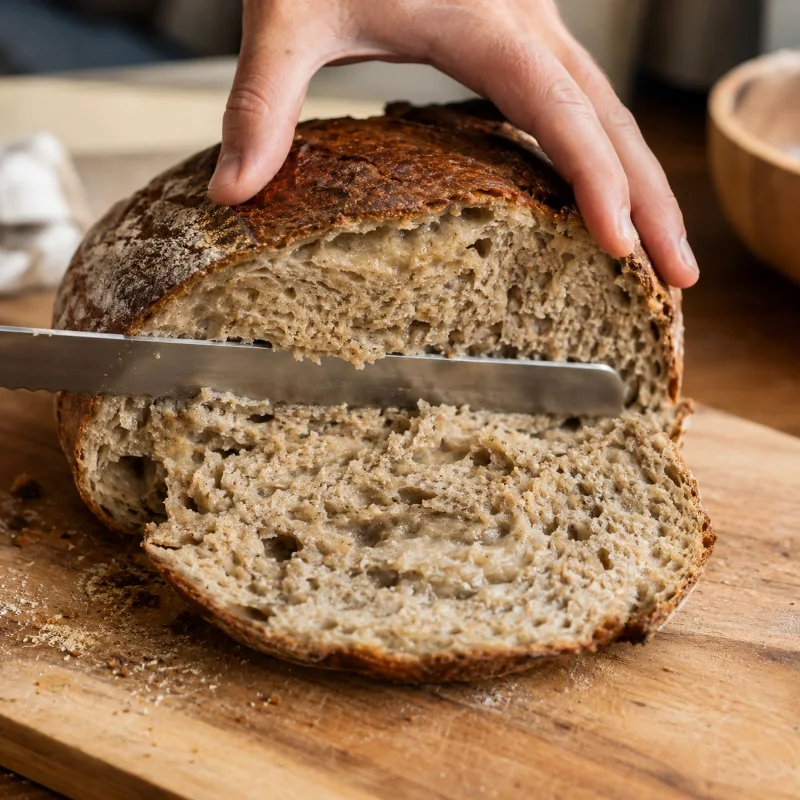
A collapsed or gummy crumb does not automatically prove overproofing. Hot bread is still redistributing moisture and stabilizing its crumb, so slicing too early can create a compressed, sticky appearance even when fermentation was sound.
If the fully cooled loaf is low and wide with weak oven spring, and the dough was very soft and tensionless before baking, the signals fit overfermentation well. If the loaf shows large tunnels next to dense areas with explosive, uncontrolled oven spring, check underproofing or shaping first.
Internal temperature can help you judge whether the loaf was baked through, but it does not prove the cause of the fault. Diagnosis is stronger when the pre-bake dough state, oven behavior, and cooled crumb all point in the same direction.
Prevent the same mistake by changing one main variable
On the next bake, do not change yeast, temperature, hydration, and time all at once. Record dough temperature after mixing, approximate rise at the end of bulk, how the dough behaved during shaping, and its condition before baking.
If strength was already fading before shaping, shorten bulk fermentation or reduce dough temperature or inoculation. If the dough was strong after shaping and weakened only near baking time, shorten final proof. PEKI recommend a simple working criterion: the dough should be airy, but it still needs enough strength to carry itself.
Frequently asked questions
Answers to common questions
How do I know if dough is truly overproofed?
Look for several signs together: very soft dough with little tension, rapid spreading after shaping, weak scoring response, and little oven spring. The poke test alone is not enough.
Can overproofed dough still be saved?
If it still has some structure, shape gently and bake sooner. If it spreads badly, a loaf pan or focaccia is usually more forgiving than a tall free-standing loaf.
Does internal temperature prove the problem was overproofing?
No. Internal temperature helps judge whether the loaf was baked through, but it does not prove overfermentation. Compare it with the dough state before baking and the crumb after cooling.
Does bread dough always need to double in volume?
No. The useful rise depends on the formula, dough temperature, flour, hydration, and how much fermentation will continue after shaping. Volume is one signal, not a universal threshold.