Mascarpone frosting without lumps: first identify the type of problem
Smooth mascarpone frosting is not the result of whipping for as long as possible. If you see large, soft white pieces, the mascarpone has not been incorporated evenly. If the frosting is finely grainy, dull or greasy, you have already moved past the safe whipping stage. If it feels sandy on the tongue but still looks glossy, undissolved sugar crystals may be the problem. These are three different faults, and each needs a different response.
For a firmer cake filling, a useful practical starting point is 500 g (17.6 oz) mascarpone + 250 g (8.8 oz) cream + 60–80 g (2.1–2.8 oz) powdered sugar. This is not a universal ratio: mascarpone firmness, the fat percentage of the cream, the amount of sugar and any added flavorings all affect the final structure. More important than the number of minutes on the mixer are cold ingredients, gradual incorporation and stopping while the frosting still has a satin sheen, smooth whisk trails and a stable peak.
When a spatula cuts through the frosting and leaves small white pieces behind, either the mascarpone is still not evenly incorporated or the fat structure has already started to break down from overwhipping. The order matters: briefly loosen the mascarpone first, add the cream gradually, and increase the mixer speed only once the mixture is uniform. Large temperature differences, aggressive mixing at the start and overwhipping can all make the texture less even.
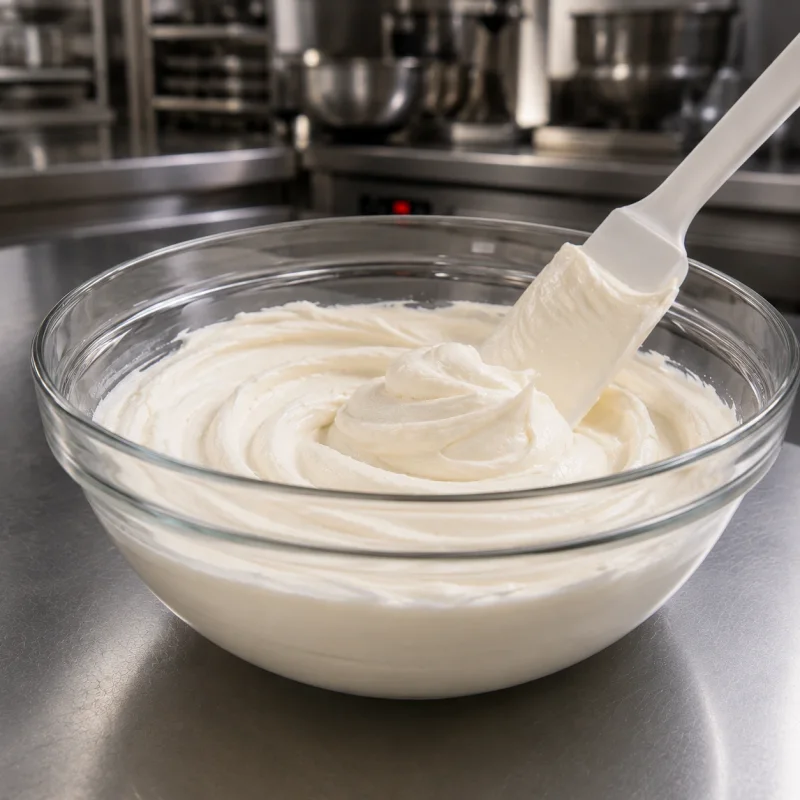
Properly mixed mascarpone frosting should have an even satin sheen, smooth trails and enough body to fall from a spatula in a broad, continuous ribbon.
Mascarpone is a fresh, unripened dairy product with a high fat content. It does not benefit from long whipping. What it needs is short, controlled mixing.
Once the frosting has reached the desired firmness, every extra turn of the whisk increases the risk that fat droplets will aggregate further and liquid will begin to separate. The surface loses its sheen, the texture turns grainy, and the frosting tears during spreading instead of gliding smoothly.
Stop mixing when the trails are smooth, the peak is stable and there are no visible firm pieces of mascarpone.
Keep the fat cold but the mascarpone pliable
Keep both the cream and mascarpone cold. In cream, a low temperature helps preserve part of the milk fat in a crystalline state, which is important for the partial coalescence that builds structure during whipping. Research shows that relatively small temperature changes can alter whipping behavior, so it is not sensible to declare one exact temperature ideal for every product and mixer.
In a home kitchen, use the cream straight from the refrigerator. The mascarpone should also stay cold, but it needs to be pliable enough to smear smoothly under a spatula without crumbling.
If the mascarpone is extremely firm and breaks apart when pressed, leave it out of the refrigerator for about 5 minutes. Do not warm it to room temperature. You only want it soft enough to spread with moderate pressure.
Chill the bowl and whisk if they have become noticeably warm from a hot kitchen or from sitting on the counter. A warm metal bowl can soften the outer layer of the mixture faster than the colder center, creating an uneven texture that extra whipping will not correct.
If the frosting is smooth but too soft, chill it first. Longer whipping can easily make the problem worse.
A method that reduces lumps and overwhipping
Loosen the mascarpone first, then add the cream in stages
For a firmer frosting or filling for cake layers, use:
- 500 g (17.6 oz) mascarpone
- 250 g (8.8 oz) heavy cream or heavy whipping cream, at least 35% fat
- 60–80 g (2.1–2.8 oz) sifted powdered sugar
For UK readers, use a cream with at least 35% fat and check the label rather than relying only on the product name. “Powdered sugar” or “confectioners’ sugar” in US recipes is the same role as icing sugar in the UK.
Put the mascarpone in a chilled bowl, add the powdered sugar and mix at the lowest speed only long enough to smooth and loosen it. The mixture should become uniform, not airy. The exact time depends on your mixer and on the firmness of the mascarpone.
Stop the mixer and scrape the bottom and sides of the bowl with a spatula. Firmer pieces often remain there.
Add about one third of the cream. Mix slowly until the mixture is smooth and slightly softer. Add the remaining cream in two additions. Increase to medium speed only when there are no visible firm pieces of mascarpone left.
The frosting is ready when the whisk leaves a clear trail and the lifted peak stands up with a slight bend at the tip.
Stop the mixer immediately. An extra ten seconds is not a safety margin.
Not every lump means the same thing
Large, soft white pieces usually mean the mascarpone was not loosened or incorporated evenly. Press a small portion of frosting against the inside of the bowl with a spatula and smear it into a thin layer. If the pieces disappear smoothly, fold that portion gently back into the rest.
Frosting that looks smooth but feels sandy on the tongue may contain undissolved sugar crystals. Use finely ground, sifted powdered sugar. Do not try to dissolve coarse sugar by whipping for longer, because the fat structure can break down before the sugar problem is solved.
Fine, evenly distributed granules, a dull surface and noticeably stiffer resistance under the spatula indicate the beginning of fat separation. This is no longer under-mixed mascarpone; it is overwhipped frosting.
If liquid begins to collect at the bottom, the surface develops a greasy film and you can see firmer fatty particles, the structure has broken down severely. The frosting is no longer suitable for smooth coating, clean piping or structural cake layers.
Test a slightly grainy frosting by hand, not with the mixer
At the very first signs of graininess, you can test a small portion of the frosting with a small amount of very cold liquid cream. Incorporate it by hand with a whisk or spatula, slowly and without whipping.
If the small test becomes glossier and smoother, apply the same correction cautiously to the rest. If liquid has already separated or the surface is greasy, more mixing will usually not restore the original structure.
Do not pour in a large amount of cream at once. The frosting may become smooth but so soft that it will no longer support the weight of a cake layer.
If the problem is only a few soft mascarpone pieces, extra cream is unnecessary. Smear them against the side of the bowl instead.
Do not use badly separated, greasy frosting for structurally demanding desserts. It can still be repurposed in a layered dessert served in a glass or another preparation where a perfectly smooth, load-bearing texture is not essential.
Do not heat the whole batch. Heat can make lumps appear to disappear temporarily, but after chilling you may be left with a softer, greasier and unevenly firm mixture.
Add-ins need to be adjusted to the frosting first
Thin or temperature-mismatched additions can quickly disrupt the texture
Add vanilla paste, finely grated citrus zest or a thick flavoring while you are first smoothing the mascarpone. Thin fruit purée, lemon juice or a larger amount of alcohol increases the free-liquid fraction and can reduce structural strength.
For a cold, thick fruit addition, first mix it with a small portion of the mascarpone frosting. Then fold that mixture into the rest so the liquid is distributed more evenly.
Melted chocolate should still be fluid but not hot. Stir a couple of spoonfuls of mascarpone frosting into the chocolate first and check that the mixture is smooth and free of set chocolate pieces. Only then fold it into the main batch. Chocolate that is too cool can seize into small pieces on contact with the cold frosting; chocolate that is too warm can soften the milk fat.
A suitable mascarpone-to-cream ratio plus thorough chilling is usually enough for ordinary cake layers. Use gelatin only when the cake height, filling thickness, transport time or warmer conditions genuinely require additional support. Do not pour gelatin directly into cold frosting; temper it first with a small portion of the mixture.
Agar requires heating and is not a direct cold substitute for gelatin.
Can you make mascarpone frosting without cream?
Yes, but that is a different formulation, not the same frosting with one ingredient omitted.
Mascarpone combined with sugar, chocolate, fruit or another structuring ingredient can make a cream-free frosting, but it will usually be denser, less aerated and behave differently when spread or piped.
If you are looking for “mascarpone frosting without cream,” do not simply omit the cream halfway through this method and expect the same volume or stability. This article is specifically about the classic mascarpone-and-cream combination and how to diagnose lumps, graininess and overwhipping.
Chill to firm the frosting, not to dry out the surface
If the finished frosting is slightly too soft for clean spreading, chill it briefly and check it repeatedly rather than waiting for a fixed amount of time. Cover the bowl with a lid or food-safe wrap so the surface does not dry out or absorb refrigerator odors.
If the frosting already holds clear trails and a stable peak, use it immediately.
Long chilling can firm the edges faster than the center. When you stir the frosting again, those firmer areas can break into pieces and look like lumps even though the frosting was not overwhipped.
Do not rewhip chilled frosting. Before use, fold it gently two or three times with a spatula.
Cake layers and fruit fillings should be completely cool. A warm layer softens the fat where it touches the frosting, so even a well-made filling can begin to squeeze toward the edge.
A simple practical check: draw a channel through the center of the bowl with a spatula. If the channel remains visible for two to three seconds and the edges stay smooth while slowly closing, the frosting is firm enough for filling. If the channel closes immediately, chill the frosting. If the edges crack and look grainy, do not whip it again.
Because this frosting contains fresh dairy products, keep it refrigerated and follow the storage instructions and use-by date of the most perishable ingredient you used. Before spreading or piping, check the sheen, smoothness and resistance under the spatula; those texture cues tell you more than another minute of mixing.
Diagnostics
Common problems and solutions
There are large soft white lumps in the frosting
Cause: The mascarpone was not loosened evenly, or firmer pieces remain on the bottom or sides of the bowl.
Solution: Smear the pieces against the bowl and fold the mixture gently; do not whip the entire batch longer.
The frosting looks smooth but feels sandy on the tongue
Cause: Coarse or incompletely dissolved sugar crystals.
Solution: Next time use finely ground, sifted powdered sugar (icing sugar); do not try to solve the problem by whipping longer.
The surface is dull, finely grainy and noticeably stiffer
Cause: Early overwhipping and excessive aggregation of the fat phase.
Solution: Stop the mixer immediately. At a very early stage, test a small portion by gently incorporating a little cold cream by hand; if it does not improve, do not continue whipping.
Liquid appears at the bottom and the surface looks greasy
Cause: The structure has broken down severely.
Solution: Do not use it for smooth coating, piping or structural cake layers; further whipping will accelerate separation.
The frosting is smooth but too soft
Cause: Insufficient structure, ingredients that are too warm or too much liquid flavoring.
Solution: Chill the frosting briefly first. If the formulation itself is too soft, adjust the ratio or stabilization next time rather than simply extending whipping time.
Technical terms
Terms worth understanding
- partial coalescence
- Controlled joining of partly crystallized fat droplets during whipping, helping build a network around air bubbles.
- satin sheen
- An evenly glossy surface without a greasy film or dry granules; a useful visual cue that the frosting is still smoothly emulsified.
Frequently asked questions
Answers to common questions
Can I whip the mascarpone and cream together from the start?
It can work, but it gives you fewer diagnostic checkpoints. With a very firm or inconsistent mascarpone, it is safer to loosen the mascarpone briefly first, then add the cream gradually while watching the texture.
Should mascarpone and cream be at room temperature?
No. For this frosting, keep both cold. More important than one exact temperature is that the cream is well chilled and the mascarpone is pliable enough to smear smoothly.
Can I make mascarpone frosting without cream?
Yes, but that is a different formulation. Mascarpone without cream produces a denser, less aerated frosting, so do not simply omit the cream from this method and expect the same volume or structure.
How can I tell whether the lumps are caused by overwhipping?
Overwhipped frosting develops fine particles, loses its sheen and often looks greasy. Larger soft white pieces that smear smooth under a spatula are usually just incompletely incorporated mascarpone.
Can I rewhip badly separated mascarpone frosting?
No. Once liquid has separated and the surface is greasy, further whipping will usually accelerate the breakdown.