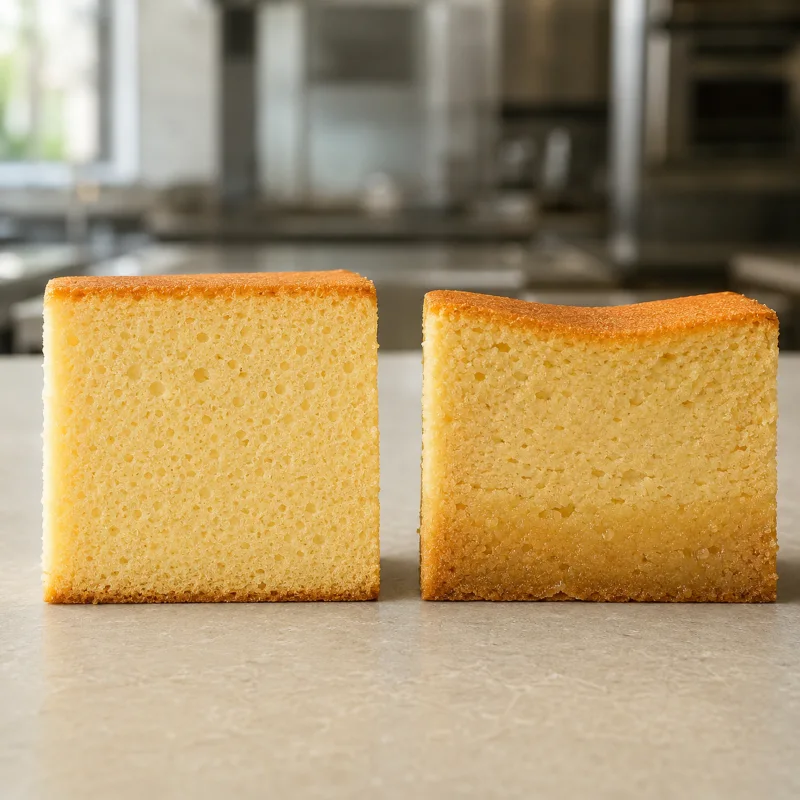
Almond flour is not a neutral stand-in for wheat flour. Search results use the same name for products that can be very different: finely ground full-fat almonds and flour made from almond press cake after part of the oil has been removed. The first step is therefore to read the label, not calculate a substitution percentage.
Full-fat and defatted almond flour are different ingredients
Finely ground almonds bring their natural oil, flavour and tenderness. Defatted almond flour contains less fat and often proportionally more protein and fibre, so it can bind water very differently. A formula written for one type can become dry, greasy or structurally weak with the other.
Why wheat flour is not a 1:1 swap
Wheat flour supplies both starch and a gluten-forming protein system. Almond flour supplies neither in the same way. When replacing wheat flour in gluten-free baking, treat the whole formula as a system rather than changing one ingredient by equal weight.
Particle size changes cake structure
Fine, evenly milled almond flour is more predictable for delicate cake layers. Coarse ground almonds create a rougher crumb and distribute less evenly. If grinding almonds at home, pulse briefly and stop before enough oil is released to turn the mixture toward almond butter.
Starch, eggs and binders must carry the structure
Gluten-free structure is shared across several ingredients. Starches, proteins, fibres and binders build the framework together; egg proteins coagulate during baking while starch gelatinises in the presence of water. Too much almond flour for that supporting system can produce collapse or crumbling.
Adjust added fat to the flour you actually have
With full-fat almond flour, keeping all the original butter or oil can push the formula beyond a stable fat level. In a fluid cake batter, look for a homogeneous mixture without a separate oily ring. With defatted flour, do not copy that correction blindly: check its label and water absorption first.
Do not troubleshoot texture blindly
A cooled cake that crumbles does not automatically need more liquid. It may need more structural starch or binding. The same diagnostic logic used for a gluten-free flour blend that resists crumbling applies here: hydrate, observe, then change one variable at a time.
Crust colour is not proof the centre is baked
Almond-rich batters can brown before the centre has fully set. Protect the top only after it has formed a stable surface. If the same formula repeatedly browns too early, test roughly 5–10 °C lower on the next bake and extend the time rather than judging doneness by colour alone.
Cooling is part of the structure
Do not slice almond cake while hot. As it cools, fat firms, moisture redistributes and the starch-protein structure becomes more stable. For the wider process, see the best methods for gluten-free cakes and desserts.
Gluten-free also means controlling cross-contact
Almonds are naturally gluten-free, but a product or kitchen is not automatically safe for someone with coeliac disease. In the EU, the “gluten-free” claim is limited to no more than 20 mg/kg gluten, so check the label, other ingredients, equipment and work surface.
Diagnostics
Common problems and solutions
The bottom is dark and greasy
Cause: With full-fat almond flour the total fat may be too high, the emulsion may be unstable, or the crumb may not have set fully.
Solution: Confirm the flour type. In the next test reduce added fat only if the product is full-fat; with defatted flour evaluate liquid first.
The cooled crumb falls apart badly
Cause: The formula lacks enough starch, protein or another binder for the amount of almond flour.
Solution: Use a formula with a stronger structural system or reduce the almond-flour proportion; do not simply add random extra liquid.
The centre sinks after baking
Cause: Gas cells expanded faster than the structural network set, or the cake left the oven too early.
Solution: Bake until the centre is stable first; if the fault repeats, review almond-flour level, leavener and structural ingredients.
The crust is dark but the centre is still wet
Cause: Heat transfer and batter depth are out of balance, so colour develops before the centre sets.
Solution: Protect the top once it is set; on the next bake, if needed, lower the temperature about 5–10 °C and extend the time.
The crumb is coarse or gritty
Cause: Almond particles are too large or unevenly distributed.
Solution: For delicate cake layers use fine, even almond flour and distribute it thoroughly through the other dry ingredients.
Technical terms
Terms worth understanding
- Full-fat almond flour
- Finely ground almonds that retain most of their natural almond oil.
- Defatted almond flour
- Flour milled from almond press cake after part of the oil has been removed; function depends on the degree of oil removal.
- Starch gelatinisation
- The swelling and structural change of starch during heating in the presence of water, helping the crumb set.
- Protein coagulation
- The setting of proteins during heating, helping stabilise gas cells and the final slice.
Frequently asked questions
Answers to common questions
Can I replace a gluten-free flour blend completely with almond flour?
Not automatically. The swap changes starch, fat, bound water and structural solids. Use a recipe developed for almond flour or replace only part of the blend.
Can I make almond flour at home?
Yes, but pulse the almonds briefly and stop as soon as the particles are fine. Longer grinding releases oil and turns the mixture toward almond butter.
Is almond flour suitable for someone with coeliac disease?
Only when it carries appropriate gluten-free assurance or cross-contact has been reliably excluded. The same applies to the other ingredients, tools and work surface.
Why does an almond cake slice more cleanly the next day?
As it cools, fat firms, moisture redistributes and the starch-and-protein structure becomes more stable. Wrap the cake only after it is fully cool.