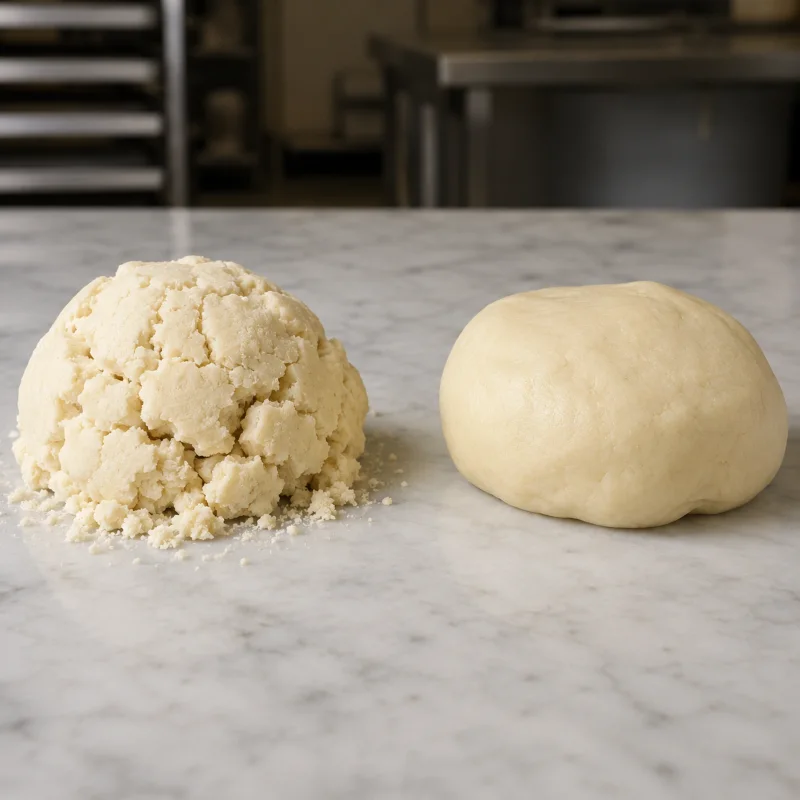
Crumbling is a system problem, not a single-flour problem
Gluten-free dough can crack under a rolling pin, while cakes may shed dry crumbs as soon as they are sliced. The cause is rarely just one flour. When replacing wheat flour in gluten-free baking, fine flour, starch, binder, liquid and hydration time all have to work together.
Wheat dough is held together by a viscoelastic gluten network. A gluten-free formula has no single equivalent network. Instead, swollen starches, proteins, fibres and hydrocolloids such as xanthan gum and psyllium share the structural work. Their functions overlap, but they are not interchangeable gram for gram. The structural roles are explained in more detail in how gluten-free flours build dough structure.
That is why changing the flour alone is not enough. The flour-to-starch balance, binder and water level must be treated as one system.
A basic gluten-free flour blend for sweet baking
For cakes, muffins, pancakes and simple sweet bakes, PEK uses the following as a practical starting blend:
- 600 g finely milled white rice flour;
- 250 g potato starch or cornstarch (cornflour in the UK);
- 150 g tapioca starch.
Weigh the ingredients, sift twice and whisk thoroughly for at least one minute. Store the blend in an airtight container and mix it again before each use because fine starches and flours can settle differently during storage.
This is a working starting point for sweet baking, not a universal 1:1 replacement for wheat flour. Rice flour provides the bulk. Potato starch usually swells strongly and can give a softer, moister crumb, while cornstarch often gives a firmer structure. Tapioca adds flexibility and cohesion. Too much tapioca can make the crumb stretchy, sticky or gummy. For its function and substitutions, see the guide to tapioca starch.
As a first trial, up to 20% of the rice flour can be replaced with finely milled buckwheat, millet or sorghum flour. That changes flavour, colour and water absorption, so make final liquid adjustments only after the batter or dough has rested.
Almond flour is not a direct replacement for rice flour or the starch component. It is rich in fat and protein but low in starch, so it can soften a bake without building the same starch-based framework.
How much binder helps prevent crumbling?
Do not automatically add a full dose of binder to your entire flour supply. The required amount depends on the product: shortbread does not need the same structure as bread.
Useful starting ranges are:
| Product | Xanthan as % of total flour + starch | Psyllium as % of total flour + starch |
|---|---|---|
| Cakes and muffins | 0.3–0.5% | usually not needed |
| Cookies and short pastry | 0.2–0.4% | 0–1% |
| Bread and rolls | 0.5–1% | 2–4% |
With 500 g of flour blend, 0.4% xanthan is 2 g, while 3% psyllium is 15 g.
Xanthan is often practical in cakes and muffins because a small amount increases viscosity and cohesion. Too much can produce a gummy, sticky texture.
Psyllium is especially useful in bread, rolls, pizza and doughs that need to hold a shape. It binds a large amount of water and forms a gel that improves stability. If xanthan and psyllium are used together, do not simply add the full individual doses from both ranges. The total binder and water need to be adjusted as one formula.
Water needs time to move into the flour
Freshly mixed gluten-free dough often looks too dry even when it already contains enough liquid. Rice flour, fibres and hydrocolloids do not reach their final hydration immediately. Adding extra water too soon can leave the dough overly soft after resting.
After mixing, let the batter or dough rest for roughly:
- 15–20 minutes for muffin and cake batters;
- 20–30 minutes for cookies and short pastry;
- 20–40 minutes for bread dough containing psyllium.
Keep the bowl covered. Then assess the texture again. Properly hydrated short pastry should press into a cohesive mass, and its edge should not collapse into dry sand when flattened. A pourable muffin or cake batter should fall from a spatula in a broad, continuous ribbon rather than in dry clumps.
If the dough is still dry after resting, add 5–10 g liquid per 250 g flour blend. Mix well after each addition and wait another two or three minutes before adjusting again.
A wheat-flour recipe cannot be converted by changing only the flour
Replacing 300 g wheat flour with 300 g gluten-free blend can sometimes work in a moist cake containing eggs, sugar and fat. It is usually not enough for bread, brioche, stretched doughs or very short cookies.
First identify what already builds structure in the recipe. Eggs coagulate during baking, sugar retains water, fat tenderises the crumb, and starches need enough water and heat to gelatinise.
For short pastry, reduce mechanical handling: press the dough together, chill it and roll it between two sheets of baking paper. For cakes and muffins, mix only until uniform, allow the batter to rest, then judge consistency before filling the tin. More product-specific differences are covered in the best methods for gluten-free cakes and desserts.
Structure finishes setting during baking and cooling
Even a well-formulated blend can remain sticky, gummy or unstable if the bake is underdone. Starch must absorb water and gelatinise, while proteins need to set.
Edge colour is not a reliable doneness test. In a cake, the centre should spring back after light pressure, and a wooden skewer should not be coated in liquid batter.
Do not slice gluten-free bread or cake while it is hot. Hot starch gel is still soft, steam is moving through the crumb and fat is liquid. Leave a cake in its tin for about 10–20 minutes, then cool it completely on a rack. Bread should also cool through to the centre before slicing.
Gluten-free flour also needs to be genuinely safe
Rice, buckwheat, corn and tapioca are naturally gluten-free, but that does not mean every flour made from them is automatically suitable for someone with coeliac disease. Cross-contact can happen during growing, milling, packing or through shared kitchen equipment.
For someone with coeliac disease, use ingredients clearly labelled gluten-free. Under European Union rules, the claim “gluten-free” may be used when a food contains no more than 20 mg of gluten per kilogram.
Use a clean scale, bowls, sieve, whisks and work surface. Equipment with cracks, crevices or old flour residue is harder to clean reliably.
The most repeatable method is simple: make the base blend, weigh the binder separately for each recipe, add the intended liquid, allow enough hydration time, then correct the texture. That turns gluten-free baking from guesswork into controlled formulation.
Diagnostics
Common problems and solutions
The dough still crumbles after the intended rest and the edges break into dry sand.
Cause: Too little available water, too little binder, or a high proportion of dry flour relative to the starch and binding system.
Solution: Check the binder dose first. Then add 5–10 g liquid per 250 g blend, mix well and wait a few minutes before adding more.
The baked crumb is gummy, stretchy or unusually sticky.
Cause: Too much hydrocolloid, a high tapioca level, excess water for the formula, or incomplete baking.
Solution: Change only one variable in the next batch: check binder first, then the tapioca or water level; cool the finished bake completely before judging.
A rice-flour bake feels gritty even though it does not crumble.
Cause: Rice flour that is too coarsely milled or insufficient time for the particles to hydrate.
Solution: Use finely milled rice flour and let the batter or dough rest before baking; judge extra liquid only after hydration.
A homemade gluten-free blend does not perform like wheat flour when swapped 1:1.
Cause: The blend was not designed as a measure-for-measure replacement and the recipe needs different binder, water or process.
Solution: Use a recipe developed for that specific gluten-free blend or a product designed for 1:1 replacement; for bread, treat the conversion as a new formula.
Technical terms
Terms worth understanding
- Hydrocolloid
- A substance that increases viscosity or forms a gel in water; in gluten-free baking it helps bind water and build structure.
- Xanthan gum
- A hydrocolloid that increases viscosity and cohesion in small amounts; too much can produce a gummy texture.
- Psyllium husk
- The husk of Plantago ovata with high water-binding capacity, especially useful in gluten-free bread and shaped doughs.
- Starch gelatinisation
- The change starch granules undergo when heated with water; they swell and help set the crumb structure.
Frequently asked questions
Answers to common questions
Can I use a homemade gluten-free flour blend 1:1 instead of wheat flour?
Not automatically. Direct replacement works best with blends specifically designed for measure-for-measure use and within the recipe types they are intended for. A homemade blend usually needs adjustments to binder, liquid and process.
Does xanthan gum have to be mixed into the base blend?
No. Keeping it separate lets you adjust the dose to the type of bake. A cake, cookie and bread do not need the same level of binding.
Can psyllium always replace xanthan gum?
Not at the same weight and not without adjusting water. Psyllium binds substantially more water, so the swap should be treated as a change to the whole formula.
Why does rice flour make baked goods gritty?
Common causes are a coarse grind and insufficient hydration time. Use finely milled rice flour, let the mixture rest, then decide whether it actually needs more liquid.