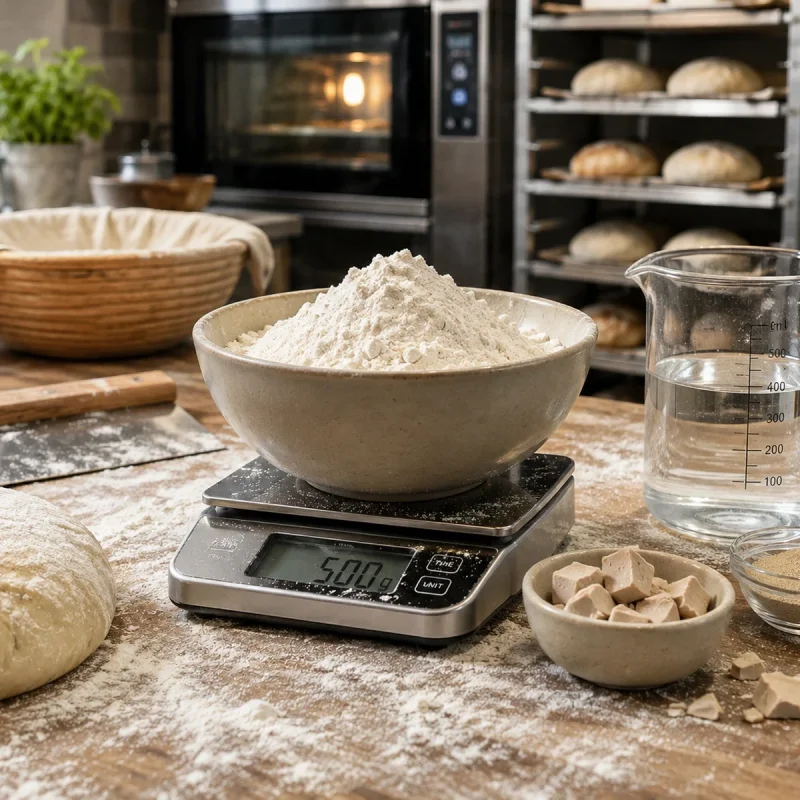
Baking for beginners becomes much more predictable when you stop trying to master every recipe at once. First stabilize a few basic decisions: weigh ingredients, distinguish yeast dough from cake batter and shortcrust dough, judge the dough or batter instead of only the clock, and bake in a well-preheated oven while changing one variable at a time. Then, when something fails, you have a realistic chance of knowing what to fix.
1. Start with weighing, not intuition
In baking, a small difference in flour, liquid or leavening changes the result faster than it does in most stovetop cooking. For a beginner, a digital kitchen scale is therefore more useful than a collection of specialized tools.
Weigh flour and other dry ingredients in grams whenever the recipe allows it. Measuring flour by volume is less repeatable because it can be packed more or less tightly into a cup. If today's batter is much thicker than last time, do not immediately assume that the recipe needs more liquid. First check whether the ingredients were measured in the same way.
PEK's first learning rule is simple: create repeatable conditions first; only then adjust the recipe.
2. Do not use the same rule for every dough or batter
The word “dough” covers very different systems. In yeast dough you want a structure that can retain gas during fermentation. In a light sponge, you need to preserve the air created during whipping or mixing. In shortcrust dough, excessive gluten development often means a tougher product and more shrinkage.
That is why advice such as “knead longer” or “mix as little as possible” is poor advice without context.
Use three questions as orientation:
- Yeast dough: is the dough cohesive and elastic enough to retain gas?
- Sponge or cake batter: are you using the mixing method the recipe requires, and is the mixture homogeneous without losing the air it needs?
- Shortcrust dough: have you brought the ingredients together without unnecessary kneading and warming the fat?
Once you know which structure you are building, the recipe instructions become much more logical.
3. Temperature affects the process, but there is no single correct number
Beginners often look for one “correct ingredient temperature.” There is no universal rule.
In yeast dough, temperature strongly affects fermentation speed. In butter-rich doughs, too much warmth can soften the fat and damage layering or tenderness. In some cake methods, the temperature of butter and eggs influences how easily a stable emulsion forms.
Instead of blindly following “everything must be at room temperature,” follow the method of the specific recipe. If the recipe calls for cold butter, do not soften it simply because you saw the opposite advice elsewhere.
For yeast dough there is a useful next step: if results vary a lot between attempts, start measuring dough temperature after mixing. Professional bakers monitor dough temperature because it helps make fermentation more predictable.
4. During mixing, watch the goal, not just the minutes
Mixing time is useful information, but the result changes with the mixer, batch size, flour and method. More important is knowing what should be different when mixing is finished.
With yeast dough you are looking for a more cohesive, elastic structure. With cake batter you check whether the ingredients are evenly combined and whether the required method was followed. With foamed mixtures, you try not to lose more incorporated air than necessary when adding flour.
The common rule “never overmix” is also too simple. Undermixed cake batter can be structurally poor as well. A good recipe should therefore describe the state of the mixture, not only a number of minutes.
5. Judge yeast dough by progress, not by an alarm
If a recipe says the dough should rise for one hour, that does not guarantee the dough will be ready after exactly sixty minutes. Dough temperature, yeast amount, sugar, fat, flour type and room temperature all affect the rate.
Watch volume change, bubbles, surface tension and the general liveliness of the dough. If almost nothing is happening, separate slow fermentation from inactive yeast and from dough that produces gas but does not retain it well. This is explained in more detail in Why dough doesn't rise and stays dense.
If yeast problems keep returning, continue with a systematic yeast-error diagnosis when that localized PEK guide becomes available. Adding extra yeast blindly is not a good first response.
6. Treat the oven as part of the recipe
A well-prepared mixture can still fail in the oven. Before baking, the oven needs to be sufficiently preheated for the method, the correct heating mode and rack level should be chosen, and during troubleshooting you should avoid changing several things at once.
If the surface becomes dark quickly while the center lags behind, the answer is not necessarily only a lower temperature. Rack position, pan material, fan setting and the oven's actual temperature also matter.
For basic orientation, use Convection vs conventional oven for baking: temperature and rack position. While learning, keep one oven setup and one familiar pan for several attempts. That helps separate changes in the recipe from changes in the equipment.
7. After a failure, change only one thing
This is the fastest way to turn a mistake into useful information.
If bread is dense and you simultaneously change flour, water, yeast, temperature and time, the next loaf may succeed, but you will not know why. Instead, write down three things:
- what you actually measured and which method you used;
- what you observed before and during baking;
- which single variable you will change next time.
After a few repetitions, you have your own process record. That is far more useful than collecting random “hacks.”
Quick diagnosis of first baking problems
The mixture is much thicker than expected. Check weighing first and whether the recipe includes a rest before adding more liquid or flour.
Yeast dough is barely progressing. Check dough temperature and signs of activity. If there are no bubbles or volume change, check the yeast as well; if there are bubbles but the dough spreads, structure may be the problem.
The sponge or cake is dense. Do not automatically blame baking powder. Check the mixing method, quantities, air loss, pan and bake.
The surface is already dark but the center is not done. Check heating mode, rack level, pan and the actual behaviour of your oven before simply extending baking time.
What you really need at the beginning
You need little equipment to learn baking: a digital scale, a few reliable bowls, a spatula or whisk, one good pan or tray and an oven whose behaviour you start to understand. A kitchen thermometer is also useful for yeast dough if you want to make repeated attempts more comparable.
More equipment does not repair an unclear process. First master measurement, the state of the mixture and heat.
The first goal is not perfection, but repeatability
A good beginner does not improve by learning more secret tricks. Progress comes from being able to state what you want to achieve before baking, recognize a key signal during the process, and identify the most likely cause after seeing the result.
For your first repetitions, choose one simple recipe and bake it several times under conditions that are as similar as possible. Once the result becomes predictable, change one variable and observe the difference.
That is when baking stops being guesswork.
Diagnostics
Common problems and solutions
The batter or dough is much thicker than the recipe describes.
Cause: Flour was measured inaccurately, the flour absorbs differently, or the mixture was corrected too quickly before a planned rest.
Solution: Check the weighing and the recipe method first; if a rest is part of the process, reassess the mixture afterward.
Yeast dough is making almost no progress.
Cause: The dough may be too cold, the yeast may be weak, or the structure may not retain gas well.
Solution: Check temperature and signs of yeast activity, then distinguish lack of gas production from poor gas retention.
The sponge or cake is dense.
Cause: The cause may be weighing, mixing method, air loss, the leavening system, or the bake itself.
Solution: Check the process in order instead of automatically adding more baking powder.
The surface is dark but the center is still underdone.
Cause: The oven mode, rack position, pan, or actual oven heat may be unsuitable for the product.
Solution: Check oven settings and pan position; do not simply extend baking time without judging both surface and center.
Frequently asked questions
Answers to common questions
What should a beginner baker buy first?
A digital kitchen scale. It makes attempts comparable, so you can tell more easily whether a problem came from the recipe, the method or the measuring.
Do all ingredients need to be at room temperature before baking?
No. Temperature depends on the method. Some butter-based doughs require cold fat; other methods intentionally use softened butter. Follow the function of the ingredient and the recipe instructions.
Why does the same recipe work once and fail another time?
At least one condition usually changed: measuring, ingredient or dough temperature, process time, mixing method, pan or oven. Record conditions and change one thing at a time.
Is proofing time alone enough for yeast dough?
No. Time is only a guide. Also watch volume change, bubbles and dough tension, and consider temperature and formula.