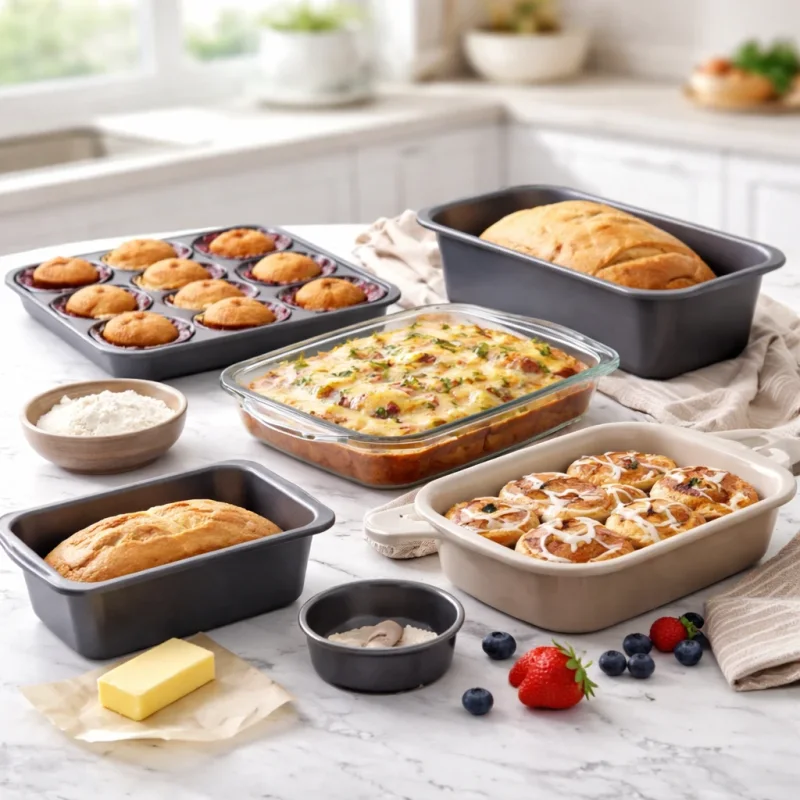
Pan material changes browning and heat flow
Two pans can hold the same batter and still produce noticeably different results. A dark metal pan often colours the edge and base sooner; a light aluminium pan is usually more forgiving; glass and ceramic heat more slowly and keep releasing heat after the oven. A baking pan is therefore part of the heat-transfer system, not just a container. When choosing among baking tools for home use, match the pan to the batter, the crust you want and the distance heat has to travel to the centre.
For most layer cakes, sponge cakes and loaf cakes, light-coloured metal is the most predictable starting point. Aluminium conducts heat well and responds quickly to oven changes. Dark surfaces absorb more radiant heat and can brown the perimeter sooner. If a recipe was developed in a light pan and you switch to a very dark one, reducing the oven by roughly 10–15°C or checking earlier is a sensible first test, not a fixed rule.
Which material suits which bake
| Material | Good for | Typical behaviour | Watch for |
|---|---|---|---|
| Light aluminium | layer cakes, sponge, loaf cakes, cookies | quick, fairly even heat transfer | bare aluminium can react during long contact with very acidic foods |
| Aluminised/coated steel | loaves, muffins, tray bakes | rigid and good browning | damaged coatings should be replaced |
| Dark non-stick steel | muffins, breads, stronger crusts | faster edge and base colouring | may need earlier checking or a lower temperature |
| Stainless steel | rings and specialist bakeware | durable but relatively poor conductor on its own | thin pieces can heat unevenly |
| Glass | pies, bakes served in the dish | slower heating, good heat retention | avoid thermal shock |
| Ceramic | pies, gratins, baked desserts | slow, steady heating and heat retention | heavier and slower to cool |
| Silicone | shaped cakes, muffins, chilled desserts | flexible, low heat conduction, paler crust | support large soft moulds on a rigid tray |
| Cast iron | crusty breads, cornbread, robust pies | very high thermal mass, strong browning | heavy and stays hot for a long time |
Silicone is useful for release and intricate shapes, but flexibility is a trade-off. Put a large or soft mould on a flat metal sheet before filling it. Let delicate bakes firm before peeling the silicone away.
Size and shape matter as much as material
Diameter does not scale linearly with capacity. A 24 cm round pan has about 44% more base area than a 20 cm pan. The same amount of batter will therefore be much shallower and usually bake faster in the larger pan.
A tall narrow pan places the centre farther from the heated wall. The edge can set long before the middle. Shallow pans do the opposite: they increase surface area and favour faster moisture loss, which suits roulades, bars and cookies. Decorative grooves and sharp corners also increase contact area, so those spots colour sooner.
Fixed base, loose base or springform
A fixed-base pan is the most structurally reliable choice for fluid batters. A removable base is useful for tarts that need to be lifted without breaking the edge. A springform is excellent for cheesecakes and delicate desserts that cannot be inverted, but the joint between ring and base is not watertight.
For a true water bath, a fixed-base pan is the safer construction. If a springform is used, protect it from water and treat foil as risk reduction rather than proof of a watertight seal.
Match pan volume to batter rise
For many cake batters, filling somewhere around half to two-thirds full leaves useful headroom, but the exact limit depends on aeration, leavening and viscosity. A fluid, highly leavened batter needs more free space than a dense butter cake.
When dividing batter between layers, put each filled pan on a kitchen scale and portion by weight. That small step makes the final layers visibly more even.
Prepare the pan for the batter, not by habit
Greasing every pan heavily is not automatically correct. Some foam cakes need to cling to the side to climb. Butter cakes and dense batters usually benefit from a thin, continuous layer of fat or a correctly placed liner. Baking paper helps release, but it does not stop a dark or very thin pan from overheating.
What to check when buying bakeware
If you are building a basic kit, start with the pans you will actually use and compare them with the essential baking tools for beginners. Check that the base sits flat, the walls are rigid and any clasp or removable base fits without wobbling. Very thin bakeware is light but reacts sharply to temperature swings; heavier-gauge metal usually behaves more calmly.
Choose the bake first, then the material, size and construction. That order is more reliable than buying a pan for its shape and trying to force every recipe to fit it.
Diagnostics
Common problems and solutions
Cake edges are dark and dry while the centre is still soft.
Cause: A dark or thin pan is heating the perimeter faster than heat can reach the centre.
Solution: Use a lighter or heavier pan, or start about 10–15°C lower and bake until the centre is set.
Batter spills over the rim.
Cause: The pan is too small or filled too high for the expected rise.
Solution: For many cake batters, leave substantial headroom; bake excess batter separately rather than overfilling.
A bake from a silicone mould comes out distorted or cracks when unmoulded.
Cause: The flexible mould bent during handling or the bake was removed before its structure had firmed.
Solution: Support the mould on a rigid tray and allow the bake to firm before peeling the silicone away.
Thin batter leaks from a springform pan.
Cause: The joint between the ring and base is not watertight.
Solution: Use a fixed-base pan for fluid batters and place a springform pan on a separate tray to catch leaks.
The base browns in uneven patches.
Cause: The pan is warped, very thin or not sitting flat.
Solution: Replace distorted bakeware and use a pan with a flat, sufficiently rigid base.
Technical terms
Terms worth understanding
- Thermal conductivity
- How readily a material transfers heat from the oven and pan walls into the batter.
- Thermal mass
- How much heat a pan can absorb and retain; heavier materials warm more slowly but stay hot longer.
- Non-stick coating
- A surface layer that reduces sticking but can be damaged by overheating, scratching and abrasive cleaning.
- Base area
- The area over which batter spreads; for a round pan it depends on the square of the radius.
- Thermal shock
- A rapid temperature change that can crack glass or ceramic bakeware.
Frequently asked questions
Answers to common questions
Can I use aluminium bakeware with acidic fruit fillings?
For short baking it is commonly used, but prolonged contact with highly acidic foods can react with bare aluminium. A coated pan, stainless steel, glass or ceramic is a safer choice when long acidic contact is expected.
Is a springform pan better than a fixed-base cake pan?
A fixed-base pan is more stable and reliable for fluid batters. Choose a springform when the finished dessert cannot be safely inverted.
Can silicone bakeware sit directly on the oven rack?
Large or flexible silicone moulds are easier and safer to handle on a flat rigid tray. Follow the manufacturer's instructions for any mould designed to be used directly on a rack.
Why does a recipe bake differently in glass than in metal?
Glass transfers heat differently from metal and retains heat after leaving the oven, so edges and the base can continue to firm while the dish cools.