Open crumb is not decided in a single stage
Bulk fermentation builds the base; final proof determines how much strength remains for the oven
If you want a more open, elastic crumb, do not look for one magic minute between bulk fermentation and final proof. During bulk fermentation the dough ferments as one mass: it accumulates gas, develops flavor, and builds a gluten network through mixing and folds that can retain that gas. Final proof begins after shaping and continues fermentation in the shaped loaf. Both stages matter, but they do different jobs.
There is another important point: very large holes are not automatically evidence of good fermentation. Large tunnels next to dense or gummy areas often point to under-fermentation or uneven shaping. A better target is an airy, elastic crumb in a loaf that holds its shape and expands in a controlled way in the oven.
The practical question is therefore: does the dough need a longer bulk fermentation, a longer final proof, or is time not the main problem at all?
If bulk is ended too early, the dough has not accumulated enough gas or internal development. It may look tight after shaping, yet bake with a dense crumb or a few large tunnels surrounded by compact areas. If bulk goes too far, the dough increasingly loses its ability to retain gas: it becomes very soft, holds shape poorly, and may spread during preshaping.
Final proof cannot rebuild a structure the dough has already lost, but it can complete part of the fermentation that was still missing at the end of bulk. That is why the final proof is not always supposed to be short. Its required length depends on the state of the dough leaving bulk, how firmly it was shaped, dough and room temperature, and whether a cold proof follows.
How to judge the end of bulk fermentation
Percentage rise is a measurement, not a universal cutoff
For wheat doughs, a straight-sided marked container or a small aliquot sample can be useful because it lets you measure actual rise. But 50–75% rise is not a universal target. The useful range depends on dough temperature, starter or yeast amount and activity, flour strength, hydration, and how much fermentation will happen after shaping.
If the shaped loaf will spend several hours or overnight in the refrigerator, its center does not become cold immediately. Fermentation continues while the dough cools, so it can make sense to end bulk earlier than for a loaf that will be baked soon after shaping. A cooler dough with a short final proof may need more rise during bulk.
Instead of following one number, combine several signals:
- volume is clearly greater than it was after mixing,
- bubbles are visible at the sides and under the surface,
- the surface looks smoother and slightly domed,
- the dough jiggles as one aerated, connected mass when the container is moved,
- with a wet hand, the dough feels elastic and offers some resistance rather than only loose stickiness.
Dough temperature strongly changes fermentation speed. A dough around 24–26°C / 75–79°F will generally progress faster than the same formula at 20–21°C / 68–70°F, but that does not create a universal timetable. Use the clock as a process record, not as proof that the dough is ready.
If the dough spreads during preshaping, do not automatically diagnose over-fermentation. The same symptom can come from too much water for the flour, insufficient gluten development, or weak shaping. Good troubleshooting asks: when did the problem first appear?
With commercial yeast doughs, controlling dose and temperature is usually more useful than focusing only on fresh versus dry yeast. For conversion, see fresh vs dry yeast.
How to judge final proof
The poke test is supporting evidence, not a verdict
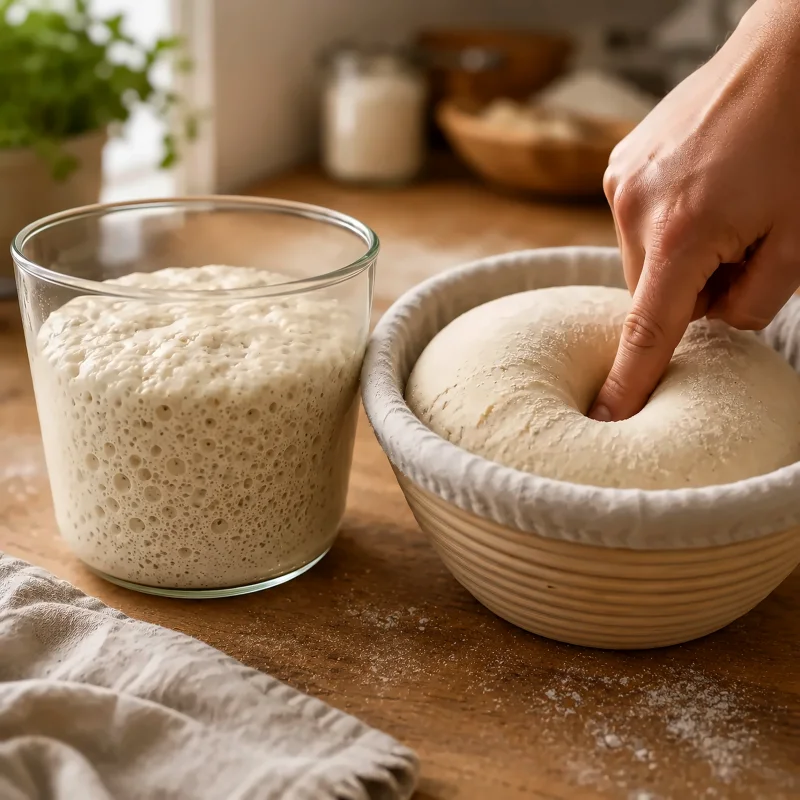
After shaping, the loaf needs to regain some of the aeration lost during preshaping and shaping. At room temperature, judge several things together: increase in volume, a lighter feel, surface tension, and response to gentle pressure.
The poke test can help with some wheat loaves. If a shallow indentation springs back very quickly and the loaf still feels tight, it probably needs more time. If it returns more slowly and a partial mark remains, the loaf may be near a useful proof point. But the test is less reliable with very wet dough, cold dough, high whole-grain formulas, or doughs with different structures. Do not use it alone.
During a cold final proof, the refrigerator does not stop fermentation instantly. The outside cools before the center, so gas and acids continue to develop for some time. Refrigeration is therefore part of the total fermentation schedule, not a pause. For more detail, see cold fermentation overnight.
Before baking, look for a loaf that is noticeably more aerated yet still able to hold its shape. If it spreads rapidly after being turned out of the banneton, the final proof may have gone too far, but the problem may also have started earlier in bulk, gluten development, or shaping. If the loaf is very tight and the score tears open violently in the oven, total fermentation may be too short.
Read the crumb as a record of the process
Hole distribution tells you more than the biggest hole
Let the bread cool completely before cutting it, then judge the whole crumb rather than the largest alveolus.
If the crumb is mostly dense with a few long tunnels under the crust or through the center, the dough is often under-fermented or gas was distributed unevenly during shaping. The automatic fix is not more water. Check bulk fermentation, dough temperature, and shaping first.
If the crumb is finer but evenly aerated and the loaf is tall, there may be nothing wrong. Open crumb is a style, not a universal measure of quality. Higher whole-grain content, seeds, or weaker gluten naturally produce a different structure from strong white wheat flour.
If the loaf is low and wide and the score barely opens, check three groups of causes: fermentation that went too far, insufficient surface tension during shaping, or a dough structure too weak for the chosen hydration. Do not diagnose over-proofing from one symptom alone.
If the dough barely gains volume, first check yeast or starter activity, temperature, salt, and the basic water-to-flour balance. For that type of problem, see why dough does not rise.
What actually helps produce a more open crumb
Fermentation has to work with flour, water, gluten development, and shaping
Higher hydration can allow larger gas cells, but only if the flour can absorb and support that water and the gluten network is sufficiently developed. Adding more water to an already weak dough often does the opposite of what you want: the loaf spreads and gas escapes.
For wetter wheat doughs, 2–4 gentle folds or stretches during the early part of bulk can help build strength. Their job is to develop structure, not squeeze out gas. Once the dough is cohesive and aerated, aggressive late folds can disturb the bubble network you spent hours developing.
Shaping also needs balance. Too little surface tension encourages spreading; overly aggressive shaping can expel too much gas and tighten the crumb. Build tension at the surface without unnecessarily compressing the interior.
Basic bread does not need added sugar for yeast to work at all. Flour and enzymatic activity already provide fermentable sugars. If sugar is not part of the formula for flavor, browning, or texture, do not add it as a repair for slow dough. See does yeast need sugar?.
With sourdough, make sure the starter is active enough and predictable for the schedule you are using. A weak or very acidic starter can change both fermentation speed and dough properties. For the basic workflow, see sourdough starter to first loaf.
The most reliable way to improve the next bake
Change one main variable and keep a short fermentation log
If the crumb is too tight, do not increase water, time, temperature, and starter percentage all at once on the next bake. You will not know which change actually helped.
Record at least the dough temperature after mixing, approximate starting volume, rise at the end of bulk, final-proof time and temperature, and the crumb pattern after complete cooling. Then change one main variable, such as a slightly longer bulk or slightly lower hydration.
PEKI recommend aiming for a repeatable balance between gas and dough strength, not the largest possible holes. Good fermentation shows up throughout the process: the dough can hold gas before shaping, retain useful tension after shaping, and still have enough reserve to expand in a controlled way in the oven.
Frequently asked questions
Answers to common questions
How much should dough rise during bulk fermentation?
There is no universal percentage. For some wheat doughs, 50–75% can be a useful reference range, but dough temperature, flour, starter or yeast amount, and a planned long cold proof can shift the target. Confirm with bubbles, tension, and dough movement.
How do I know final proof has gone too far?
The loaf loses tension, spreads quickly after turning out, and feels very slack. Similar behavior can also come from weak gluten or excessive hydration, so compare it with the dough at the end of bulk and during shaping.
Does a cold proof help create an open crumb?
It can help with scheduling, flavor, and scoring, but it does not automatically create a more open crumb. The loaf does not cool instantly in the refrigerator, so fermentation continues for some time.