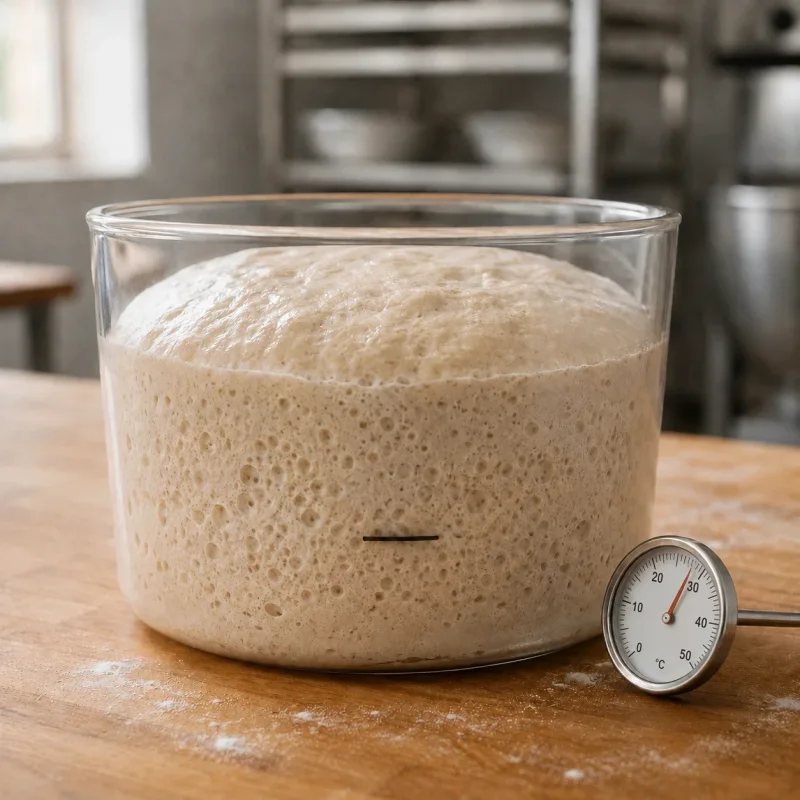
Judge fermentation by two things: activity and dough strength
Dough is not ready simply because an hour has passed or because it looks bigger. Two things happen at the same time during fermentation: microorganisms produce gas and other metabolites, while the dough must retain that gas in a network whose properties are also changing. Good fermentation is therefore a balance between activity and the dough’s ability to hold structure.
If activity is too low, the dough stays dense and underdeveloped. If a lot of gas has formed but the dough has already lost tension, a large volume is no longer an advantage. The useful point lies between those extremes: the dough is noticeably aerated and shows gas production, but it can still be folded or shaped without simply spreading or tearing.
That is a more reliable mental model than any universal rule about time, temperature, or doubling in volume.
Fermentation and rising are not the same thing
Fermentation is the biological and chemical process inside the dough. Baker’s yeast consumes available sugars and produces carbon dioxide and other metabolites; in sourdough, lactic acid bacteria also take part. Rising is mainly the visible effect of one part of that process: the dough expands as gas accumulates.
If you are wondering whether those sugars have to be added separately to bread dough, see Does yeast need sugar? Rising dough without added sugar, which separates naturally available fermentable sugars, added sucrose and osmotic stress.
For the broader context of how fermentation differs between bread dough, vegetables and other foods, see food fermentation and pickling. Do not transfer rules from one fermentation system directly to another.
This is why dough can rise quickly and still be in a poor state for shaping or baking. Conversely, dough that has not come close to “doubling” may already show enough gas and development for the next stage. Always combine several signals.
If the dough shows almost no activity, start with why dough does not rise and stays dense rather than blindly extending the fermentation time.
Four signals to track during dough fermentation
1. Change in volume
Mark the dough height at the start of fermentation. This gives you a real baseline instead of forcing you to judge growth by memory.
The right amount of rise depends on the dough and the method. With different breads, bulk fermentation may end well before doubling or closer to it. Doubling is therefore not a universal target. If a formula specifies a target increase in volume, that target is more useful than a generic rule.
2. Bubbles and gas distribution
Small bubbles along the container wall and just below the surface show that fermentation is active. What matters, however, is how that gas relates to the structure of the dough.
Large, fragile bubbles in soft dough that is already spreading are not a reason to wait longer. They may mean that plenty of gas has formed while the gluten network is becoming less able to retain it.
3. Tension, elasticity and extensibility
During bulk fermentation, notice what happens when you fold the dough or lift an edge. Well-developed dough stretches, but it also regains some tension after a fold. Under-developed dough can be dense and very resistant; over-fermented dough tends to become soft, sticky and unable to tighten again after handling.
Do not expect a very wet dough to feel as firm as a lower-hydration loaf. The useful cue is change within the same dough, not comparison with a different formula.
4. Temperature and time as context
Time is a measurement, not proof of readiness. Dough temperature has a strong effect on fermentation speed, so the same formula will not progress at the same pace at different temperatures.
For repeatability, record the dough temperature after mixing and the actual time needed to reach the next stage. If you later use the same flour, a similar yeast level and a similar dough temperature, that record is far more useful than “rise for one hour.”
If you want to deliberately control speed by changing yeast level and temperature, continue with the guide to controlling yeast activity.
Yeast and sourdough set the pace, not one universal time
With baker’s yeast, fermentation speed is influenced mainly by dosage, yeast activity, temperature and dough composition. More yeast can speed the process up, but it does not automatically improve structure or flavor. When switching between yeast forms, first correct the quantity; the ratios and differences between instant, active dry and fresh yeast are covered in fresh vs dry yeast.
If you have no baker’s yeast at all, do not jump straight to baking powder or baking soda. The guide Yeast substitute: what works for bread, pizza and baking? explains when a substitution still involves fermentation and when it changes the process to chemical leavening.
If you are unsure whether stored yeast is still active enough, check how to store yeast correctly before changing your fermentation time.
If the problem already begins during mixing and the dough rises unevenly, first review how to knead yeast dough for an even rise, which separates hydration, gluten development and final dough temperature.
Sourdough is a wider system because lactic acid bacteria work alongside yeasts and the acidity of the dough also changes. Do not transfer the timing of a commercial-yeast loaf directly to sourdough. If you are still establishing your starter and feeding rhythm, begin with sourdough starter to first loaf.
If your sourdough loaf is dense, excessively sour or cracks unpredictably, continue with sourdough baking troubleshooting.
In both cases the core decision stays the same: enough activity, but still enough mechanical strength for the next stage.
Bulk fermentation and final proof require different signals
Bulk fermentation takes place after mixing or kneading and before dividing or shaping. Here you are judging the whole mass: rise, gas, extensibility and its ability to tighten again after a fold.
Final proof happens after shaping. The question is different: has the shaped loaf relaxed and filled with enough gas for baking without losing its form when scored or transferred?
The poke test can be useful for some shaped doughs, but it is not a universal fermentation meter. Hydration, flour, temperature, dough surface and shaping all affect the response. During bulk fermentation, marked volume, bubbles and dough behavior are usually more informative than a single finger indentation.
For a detailed distinction between the two stages, see bulk fermentation vs final proof.
Cold fermentation is a brake, not a repair
The refrigerator slows the process; it does not restore structure that has already been lost. If the dough goes into the cold while it is still stable, slower fermentation can widen the working window and change flavor development. If it is already very soft, spreading and losing tension before refrigeration, a longer cold rest will not fix that.
So when planning an overnight dough, do not ask only “how many hours in the refrigerator?” Also ask what condition should the dough be in when it goes into the cold? That decision is covered in more detail in overnight cold fermentation.
Flour and hydration change what the same fermentation stage looks like
High-hydration dough is softer and more extensible by design. Do not look for a firm ball; check whether it still holds some tension after a fold and whether gas bubbles develop without the whole mass losing its structure.
A firmer dough gives a clearer sense of resistance and holds height more easily after shaping. Whole-grain flour, a higher bran content, very long fermentation and more acidic systems can also change both feel and the speed at which the dough softens.
With formulas that use levain, poolish, biga or another preferment, also consider the percentage of prefermented flour and how it is calculated.
That is why it helps to change one thing at a time while learning. If you change the flour, sharply increase hydration, reduce yeast and move the dough into the refrigerator all at once, the result will not tell you which change mattered most.
How to distinguish under-fermented, well-fermented and over-fermented dough
| State | What you usually observe | Next decision |
|---|---|---|
| Under-fermented | little increase in volume, few bubbles, dough feels dense or very tight | give it more time and check temperature plus yeast or starter activity |
| Well progressed | clear volume increase, distributed bubbles, airy dough that still tightens after a fold | move to the next stage for the formula: dividing, shaping, chilling or baking |
| Over-fermented | plenty of gas but weaker tension; dough spreads, sticks or quickly loses height after shaping | do not extend the process just to gain more volume; shorten the next stage and end fermentation earlier on the next bake |
This table is diagnostic, not absolute. A very soft focaccia dough and a firm wheat loaf will not show the same resistance. What matters is the combination of cues and the change from the starting state of the same dough.
If the dough has clearly lost strength, use the detailed guide to over-fermented bread dough. If the problem begins with too much yeast or incorrect yeast handling, see common yeast mistakes.
Four fermentation rules that often mislead bakers
“The dough must double in size”
Not as a general rule. Different methods target different increases. Doubling is useful only when the specific formula actually uses it as a reference.
“Rising takes one hour”
Time without dough temperature and yeast dosage is incomplete information. The same hour can represent an early or a late stage of fermentation.
“If it rises more, the bread will be airier”
Only while the dough structure can retain the additional gas. Once its load-bearing ability starts to decline, a larger volume in the container may lead to worse shape retention or less oven spring.
“The poke test tells you everything”
It does not. It is one signal and is more useful for some shaped doughs than for wet bulk fermentation. Combine it with volume, bubbles and dough stability.
A repeatable home method
If you want to apply these signals to a complete wheat loaf, use homemade bread with a soft, airy crumb and crisp crust, where dough condition, shaping and baking are connected in one process.
On your next bake, make four simple records:
- mark the starting height of the dough in the container;
- record the dough temperature after mixing;
- at the end of bulk fermentation, note the approximate increase in volume and how the dough feels during a fold;
- after baking, note whether the loaf held its shape and what the crumb looked like.
If the result is good, you now have a reference for that formula. If it is not, change one main variable next time: time, temperature or yeast level. That turns fermentation from guesswork into a comparison of signals from the same dough.
Diagnostics
Common problems and solutions
After a long time the dough is still dense, with almost no bubbles and no clear increase in volume.
Cause: Fermentation activity is too low or the process started under unsuitable conditions; temperature, yeast or starter activity, or the formula may be responsible.
Solution: Check dough temperature and the activity of the leavening culture. If there is almost no progress, troubleshoot why the dough is not rising instead of simply extending the time.
The dough is very inflated, but it spreads during a fold and no longer gains tension.
Cause: A lot of gas has formed, but the dough’s mechanical support has already weakened; fermentation has probably gone too far for this formula.
Solution: Do not wait for more volume. Move to the next stage as soon as practical, and next time end fermentation earlier or slow the process.
After a night in the refrigerator, the cold dough is large, sticky and lacks support.
Cause: The dough may already have been too advanced when it went into the refrigerator, or fermentation continued too long before the dough cooled.
Solution: Next time refrigerate it earlier, while it still clearly holds tension; do not use the refrigerator to repair dough that is already over-fermented.
The same time from the same recipe is enough on one bake but not on another.
Cause: Dough temperature, room temperature, yeast or starter activity, or another ingredient changed, so the same clock time no longer represents the same fermentation stage.
Solution: Record dough temperature after mixing and the starting volume, then compare actual dough signals rather than time alone.
Technical terms
Terms worth understanding
- Dough fermentation
- The biological and chemical process in which microorganisms produce gas and other metabolites while the properties of the dough change.
- Bulk fermentation
- The first fermentation of the entire dough mass after mixing or kneading and before dividing or shaping.
- Final proof
- The stage after shaping in which the loaf continues to build gas and volume before baking.
Frequently asked questions
Answers to common questions
How do I know when dough has fermented enough?
Do not look at the clock alone. Combine change in volume, bubbles or gas, dough tension and extensibility, and temperature as context. Dough is generally closer to ready for the next stage when it is airy but still retains enough mechanical strength.
Does dough always have to double during fermentation?
No. The target rise depends on the formula, flour, hydration, temperature and process stage. If a recipe gives a specific target, use that; doubling is not a universal rule.
How long does dough fermentation take?
There is no universal number of hours. Time depends on temperature, the amount and activity of yeast or starter, dough composition and the process you are using. Treat time as one cue alongside the dough itself.
Is the poke test enough to check fermentation?
Not as a universal test. It can be useful for some shaped doughs, but it should be interpreted together with volume, bubbles and dough stability. It may be much less informative during a very wet bulk fermentation.
Can the refrigerator fix over-fermented dough?
No. Cold slows further fermentation but does not restore mechanical structure that has already been lost. Refrigerate the dough while it still retains clear tension.