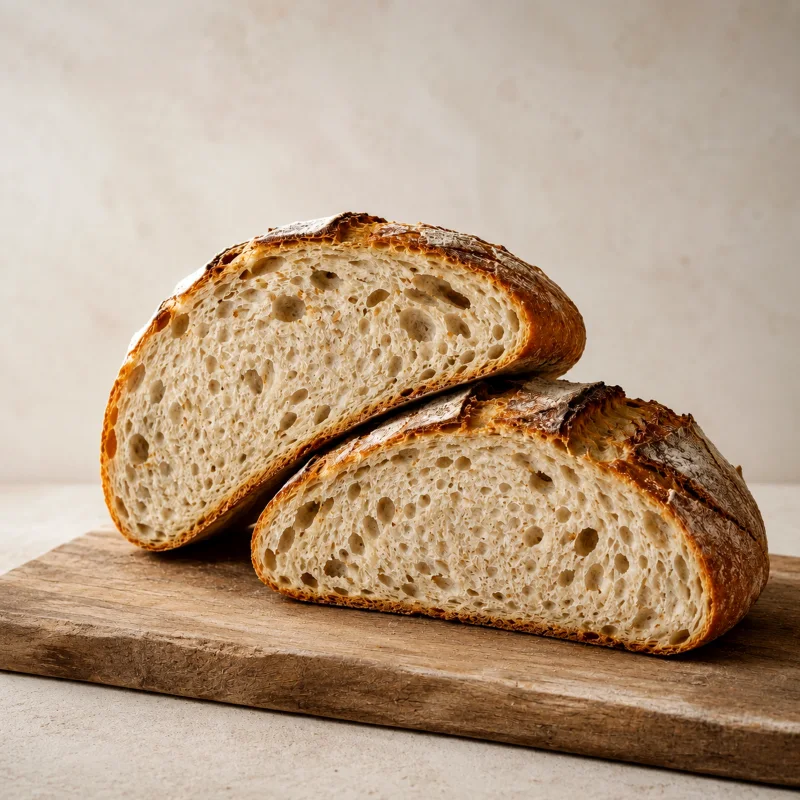
Oven temperature decides whether bread is baked or merely browned
A dark crust is not proof that the centre is ready. The surface heats much faster than the crumb, so a loaf can look finished while the inside is still wet and unstable. Treat bread baking as a temperature curve rather than one fixed number.
Start hot, then let the centre catch up
For many lean wheat loaves, a well-preheated oven around 230–250°C (446–482°F) gives strong oven spring. After roughly 15–20 minutes, lowering to about 200–220°C (392–428°F) often gives the centre more time without pushing the crust toward bitterness. A baking stone, steel or heavy pot needs real preheating time; 30–45 minutes is a practical starting point in many home ovens.
Use steam early, not for the whole bake
Steam keeps the surface flexible while the loaf is expanding. That is why it belongs mainly in the first part of the bake. Read more about steam in bread baking. With an open steam pan, remove the source after roughly 10–15 minutes; with a covered pot, uncover after about 20 minutes. Then finish drier so the crust can set and crisp.
Rack position changes the result
If the base colours too quickly, move the loaf higher or place an empty sheet pan below it as a heat shield. If the top colours too fast, protect the surface and reduce the finishing heat rather than simply shortening the bake. Every oven has hot spots, so note where your loaf browns first.
Internal temperature checks the centre
For many lean wheat loaves, about 94–98°C (201–208°F) in the centre is a useful doneness check. It is not universal: enriched breads, high-rye loaves and very wet doughs can behave differently. Insert a thermometer from the side or base to avoid damaging the top.
If the crust is still pale when the centre is ready, finish for 5–8 minutes in a dry oven. If the crust is already dark while the centre is below the target range, reduce to about 190–200°C and continue in short intervals.
Cooling is part of baking
Do not slice immediately. During cooling, steam and moisture redistribute and the crumb continues to set. A small loaf may need at least 45 minutes; a larger loaf often benefits from 60–90 minutes or more. Cool on a rack so the base does not soften.
Let crust colour follow the crumb
A good crust should support the bake, not hide an underdone centre. If colour is running ahead, see the guide to controlling bread crust colour. Record four things for your next bake: starting temperature, when you lowered it, final internal temperature and cooling time. That turns your own oven into a repeatable system.
Diagnostics
Common problems and solutions
Dark crust, gummy centre.
Cause: The oven stays too hot for too long, so the surface sets before heat reaches the centre.
Solution: Reduce the temperature after the first 15–20 minutes and extend the calmer finishing phase.
Pale, soft crust.
Cause: The oven was not fully preheated or steam remained too long.
Solution: Preheat thoroughly, use steam mainly at the start and finish the loaf dry.
Bottom browns too fast.
Cause: The loaf is too close to strong bottom heat or a very hot baking surface.
Solution: Move the loaf one level higher or use an empty sheet pan as a heat shield.
Crumb smears when sliced.
Cause: The loaf was cut while still hot or the centre was not fully set.
Solution: Cool on a rack for at least 45–90 minutes depending on loaf size.
Crust is thick, hard and bitter.
Cause: The loaf spent too long in high, dry heat.
Solution: Lower the finishing temperature and use core temperature plus crust colour to decide when to stop baking.
Technical terms
Terms worth understanding
- Initial baking temperature
- The higher heat used at the start to support oven spring before the crust sets.
- Finishing phase
- The calmer part of the bake after oven spring, when heat continues moving into the centre.
- Internal temperature
- The temperature measured in the centre of the loaf as one check of doneness.
- Steam
- Moisture used mainly at the beginning to keep the surface flexible during expansion.
- Crumb stabilization
- The setting and moisture redistribution that continue during baking and cooling.
Frequently asked questions
Answers to common questions
What temperature should I bake homemade bread at?
Many lean wheat loaves can start around 230–250°C, then finish at a lower temperature. The exact setting depends on loaf size, formula and oven.
When should I lower the oven temperature for bread?
Usually after the main oven spring, often around 15–20 minutes for a medium loaf. Reduce sooner if the crust is colouring too fast.
How do I know bread is baked inside?
Use several signals together. For many lean wheat loaves, about 94–98°C in the centre is a useful check, then cool fully before judging the crumb.
Why is my bread dark outside but wet inside?
The crust has received heat faster than the centre. Lower the finishing temperature, remove excess steam and allow more time for heat to reach the crumb.