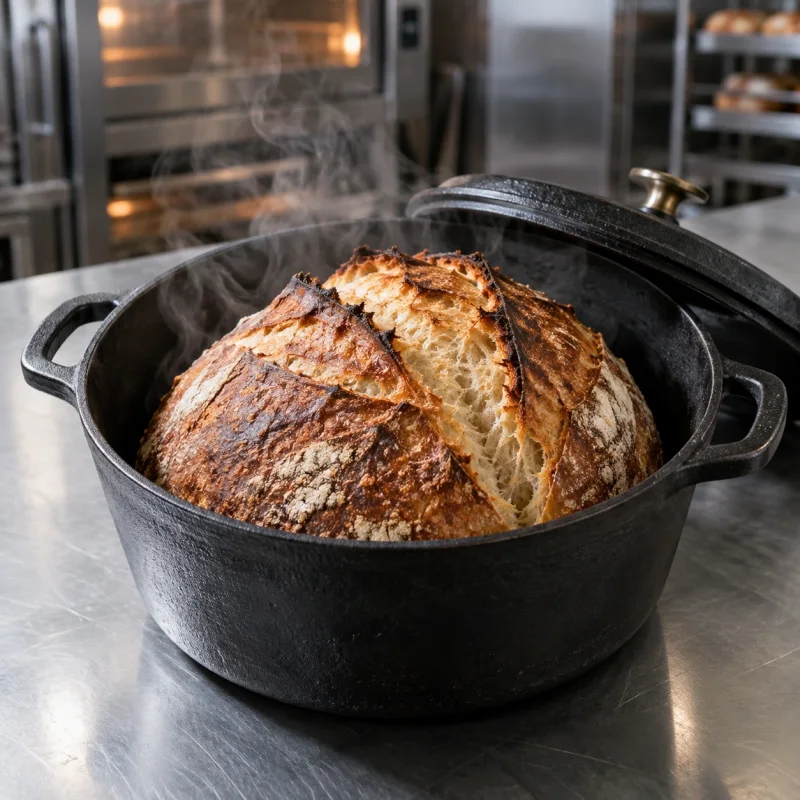
Why steam changes the crust and volume of bread
How a humid start keeps dough flexible and supports oven spring
The moment a loaf enters a hot oven, its final expansion begins. Gas in the dough expands, moisture turns to vapor, and the loaf gains height before the crust becomes rigid. If the oven is dry from the start, the surface can set too early and act like a shell around the dough.
Steam during the early bake delays that surface setting. The skin of the loaf stays moist and flexible for longer, giving the dough more room to expand and allowing scores to open where you intended them to. Moisture at the surface also helps starches form a thin gel layer; once the steam is vented and the surface dries, this contributes to a crisp, glossy crust.
The timing matters more than simply having “a lot of steam.” Steam is most useful while the loaf is making its main oven spring. After that, the bake needs to become drier so the crust can lose moisture, brown, and firm up.
Steam, scoring, and crust formation
During the initial phase, steam does three important jobs:
- delays premature crust setting,
- supports expansion and loaf volume,
- helps scoring open cleanly and predictably.
Scoring is not just decoration. It creates a controlled weak point where the loaf can expand. When the surface remains flexible, the cut can keep opening as the loaf rises. In a dry oven, the outer layer may harden too soon, limiting the score or forcing the loaf to rupture elsewhere.
Once the main expansion is over, the goal changes. The crust now needs to dry and brown. That is why successful bread baking has two distinct environments: a humid start and a drier finish. Too much late steam can leave the crust pale or soft; too little early steam can restrict volume and create a thicker, duller surface.
What to remember about steam
- Steam matters most at the beginning of the bake.
- There is no single steaming time that suits every loaf.
- Loaf size, baking method, and oven design all affect timing.
- After the main oven spring, moisture should be allowed to escape.
- Steam cannot compensate for underproofing, weak shaping, or inadequate oven heat.
Creating steam at home
Professional deck ovens can inject steam directly into the baking chamber. At home, the same physical principle can be created by trapping the moisture that the dough naturally releases. A Dutch oven or baking cloche is effective because it forms a small enclosed baking chamber around the loaf.
Open baking can use other steam methods, but any method involving water and a hot oven should follow the appliance manufacturer’s safety guidance. Oven design also matters: convection, venting, rack position, and heating elements can all change how quickly moisture leaves the chamber. If results are inconsistent, first check how to choose convection or conventional heat, temperature, and rack position.
Practical baking tips
- Preheat the oven thoroughly before loading the loaf.
- Score immediately before baking.
- Use steam for early expansion, then allow a drier finishing phase.
- With a covered vessel, remove the lid only after the main expansion phase, following the recipe and loaf size.
- If the crust darkens too quickly, do not automatically add more steam; check temperature, rack position, and loaf size.
Does every bread need the same amount of steam?
No. Free-form hearth loaves benefit most when the goal is strong oven spring and a crisp crust. Pan breads, soft sandwich loaves, and enriched doughs often aim for a thinner or more tender crust and may need less steam. The humidity strategy should match the bread style.
The key idea
Good crust is about transition. Steam at the beginning keeps the surface extensible and gives the loaf time to expand. After the main oven spring, the baking environment must become drier so the crust can set, brown, and crisp. Once you understand that two-stage process, steam becomes a precise baking tool rather than a trick.
Frequently asked questions
Answers to common questions
Why is steam important when baking bread?
Steam keeps the dough surface moist during the early bake, delaying crust formation. This gives the loaf more time to expand and allows scoring to open before the surface becomes rigid.
How long should steam stay in the oven?
Use steam during the initial phase while the loaf is making its main oven spring. The exact timing depends on loaf size, baking method, and oven; after that, release moisture so the crust can dry and brown.
Can too much steam hurt bread?
Yes. If the baking environment stays humid for too long, the crust can remain pale, soft, or rubbery. Steam is mainly useful for early expansion; the finishing phase should be drier.
How does steam affect scoring?
A moist, flexible surface lets a score continue opening as the loaf expands. In a dry oven, the surface can set too soon and restrict the opening or force the loaf to rupture elsewhere.
Is steam equally important for every bread?
No. It matters most for free-form hearth loaves where strong oven spring and a crisp crust are desired. Pan breads and enriched doughs may need less steam or a different humidity strategy.