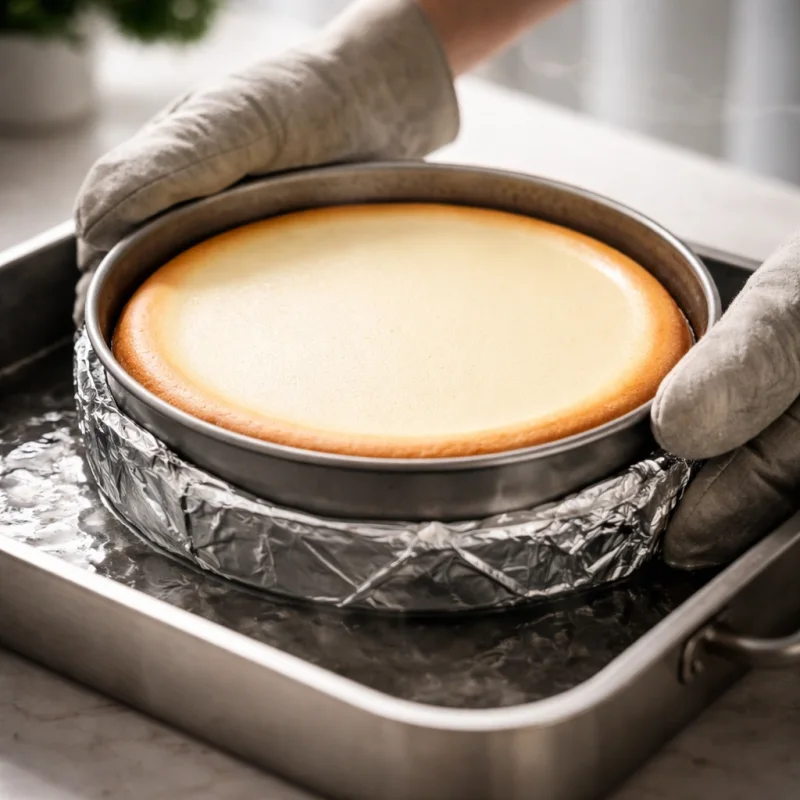
Crack-free cheesecake: the most important thing is not to overbake it
The most common cause of cracks in baked cheesecake is overbaking. Lower, more even heat, moderate mixing without excess air, a water bath when the recipe supports it, and gradual cooling all help. A cheesecake can be properly baked even when the center still has a slight wobble at the end.
A crack forms when the protein network becomes too firm during baking or when the cake contracts under too much stress as it cools. That is why there is no single “trick.” You need to control both doneness and the temperature transition.
1. Do not wait for the center to become completely firm
Egg proteins coagulate as they heat and create structure. If you bake the cheesecake until it is already dry and firm in the oven, that network will be less flexible after cooling and more prone to cracking.
For many classic cheesecakes, a useful visual cue is a stable outer edge with a center that still wobbles as one cohesive mass when the pan is moved gently, rather than sloshing like liquid. The exact cue always depends on the recipe and the diameter and depth of the pan.
If the recipe gives a target internal temperature, use a thermometer and follow that value. Do not transfer one recipe’s temperature to every cheesecake formula.
2. A water bath reduces the temperature gradient
A hot water bath around the pan buffers direct oven heat and helps keep the edges from baking far ahead of the center. For classic tall cheesecakes, it is one of the more reliable ways to promote even baking.
The pan must be suitable for the method. If you use a springform pan, protect it from water intrusion or use a setup in which the cheesecake pan is not directly submerged if that is what the recipe specifies.
3. Do not whip in unnecessary air after adding the eggs
Aggressive beating incorporates air. The bubbles expand during baking, the cheesecake rises more, and then it settles more strongly as it cools. Mix only until the batter is homogeneous.
Ingredients at similar temperatures combine more easily without prolonged beating. The cream cheese should be soft enough to make a smooth batter, and the eggs should be added gradually.
4. Gradual cooling helps, but it cannot undo overbaking
A sudden temperature drop increases contraction and can contribute to cracking. In many recipes, it helps to switch off the oven, prop the door open, and let the cheesecake cool gradually according to the recipe.
That is not permission for an extra hour of intense residual heat. If the cheesecake is already overbaked, slow cooling will not restore a creamy texture.
Once it has cooled sufficiently at room temperature, refrigerate it and chill it thoroughly before slicing. For the broader structural difference between regular cake layers and delicate desserts, remember that cheesecake follows different cooling rules.
5. Diagnose cracks by the pattern
| Sign | Likely cause | Correction |
|---|---|---|
| browned, dry edges + crack | overbaking | lower/more even heat, stop earlier |
| cheesecake puffs dramatically and then sinks | too much air, often also overbaking | mix more slowly, incorporate less air |
| crack appears during rapid cooling | temperature transition is too fast | cool more gradually |
| edge is baked while the center lags far behind | large temperature gradient | water bath or lower temperature as directed by the recipe |
Does a crack mean the cheesecake is inedible?
No. If the cheesecake was baked safely and cooled properly, a crack is mainly a quality and appearance defect. You can cover it with fruit topping, sour cream, or another garnish. For the next bake, however, identifying the cause matters more than hiding the result.
Diagnostics
Common problems and solutions
The cheesecake cracks and has a dry, browned edge.
Cause: It was most likely overbaked.
Solution: Next time stop baking earlier or check the oven’s actual temperature.
The batter puffs dramatically and then collapses.
Cause: Too much air was incorporated, possibly together with overbaking.
Solution: After adding the eggs, mix more slowly and only until homogeneous.
A crack forms during rapid cooling.
Cause: The temperature change is too abrupt.
Solution: Cool more gradually according to the recipe.
Frequently asked questions
Answers to common questions
How can I reduce the risk of cracks if I do not use a water bath?
First prevent overbaking: bake at a moderate temperature, monitor actual doneness, and stop when the outer area is stable while the center still gives a gentle unified wobble. A pan of hot water on another rack can add humidity, but it is not equivalent to a water bath, which also buffers and evens out the heat around the cheesecake pan.
Why does cheesecake puff up and then sink?
Too much incorporated air and baking that is too hot or too long can cause a strong rise followed by contraction during cooling. Mix only until the batter is smooth and avoid overbaking. A gently mobile center near the end of baking is normal for many recipes, but always follow the recipe and pan size.
Is sour cream or heavy cream better?
Neither is universally better. Sour cream adds acidity, fat and water, while heavy cream mainly adds fat and liquid; both change flavor and texture according to the full formula. Use the ingredient specified by the recipe rather than assuming that combining both is automatically more stable.
When is cheesecake properly baked?
For a classic baked cheesecake, the edges are generally stable while the center still gives a gentle unified wobble when the pan is moved slightly. Overbaking is the greatest crack risk, so judge the complete doneness cues instead of waiting for the center to become completely firm.
Why is it helpful if the ingredients are not ice-cold?
Softened cream cheese and other suitably tempered ingredients combine more easily without lumps, so less aggressive mixing is needed and less air is incorporated. That is the practical reason; it is not a universal rule that cold ingredients cause uneven coagulation.
Is convection suitable for cheesecake?
Convection is not automatically wrong, but it usually increases heat transfer and surface drying. If the recipe was not written for a fan oven, still air is often easier to control. When using convection, adjust temperature and time to the recipe and focus on avoiding overbaking.