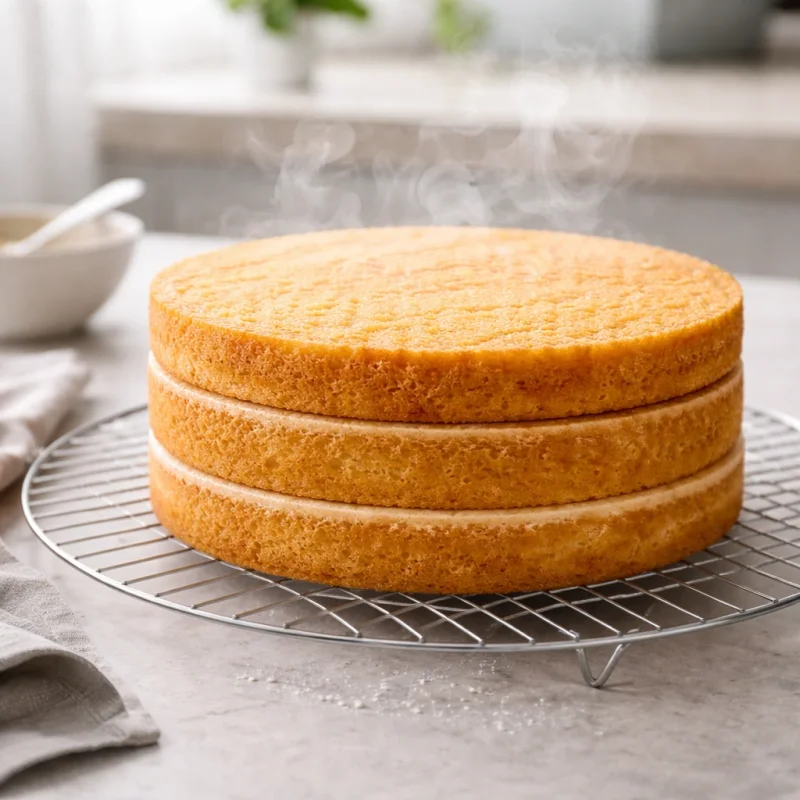
How to cool cake layers before slicing and filling
For most standard cake or sponge layers, allow a short rest in the tin after baking, then transfer them to a wire rack and let them cool completely before splitting or filling. There is no rule that every cake must cool slowly. Gentle cooling matters more for baked cheesecakes and some delicate custard-based desserts, where sudden temperature changes can contribute to cracking.
The aim is to let steam escape while the crumb becomes firm enough to handle. A hot layer left too long in its tin, or tightly wrapped immediately, can develop a damp, sticky surface as moisture condenses. Turn it out too early and the fragile layer may break.
1. Give the cake a short rest in its tin
The right interval depends on the recipe, size and type of tin. For many conventional cake layers, roughly 10–20 minutes is a useful guide before carefully turning the layer onto a rack. Always follow recipe-specific instructions for chiffon cake, angel food cake and other exceptionally airy bakes, which may need a different cooling position.
Look for a cake that has set enough to be moved without tearing rather than treating the clock as an absolute rule. Equally, avoid leaving an ordinary layer trapped in the tin for so long that steam collects around its edges.
2. Use a wire rack to release heat and steam
A solid worktop prevents air from circulating beneath the cake. A rack allows airflow underneath as well as around the sides, so heat and moisture can dissipate more evenly.
For ordinary sponge and layer cakes, efficient, even cooling is not inherently a harmful “temperature shock”. Deliberately slow cooling is more relevant to cheesecake and similar delicate baked fillings.
3. Do not slice while the middle is still warm
Warm crumb remains soft, with moisture still moving through the centre. Splitting the layer too early can crush it, scatter crumbs and leave uneven heights.
Wait until the centre is fully cool. If you need especially neat layers, you may wrap the cooled cake well and chill it briefly before slicing, provided this suits the recipe. A firmer crumb is easier to level with a long serrated knife or cake leveller.
4. Match the cake temperature to the filling
A warm layer can soften buttercream, whipped cream, ganache or mousse, allowing the filling and upper layers to slide. A surface that feels almost cool is no guarantee that a thick cake is cool at its centre.
Check the middle before assembling, especially with deeper cakes. For the wider principles of stacking cakes and supporting fillings, see stable cake layers and clean slices.
5. When to wrap a baked layer
Do not tightly wrap a warm cake in plastic: the trapped steam may create condensation and a sticky crust. Cool it thoroughly first, then wrap it to protect it from drying out and absorbing odours.
If you plan to fill the cake the next day, properly protecting a fully cooled layer is usually more useful than leaving it exposed for hours. Storage conditions still depend on the recipe and any perishable fillings.
6. Cheesecake needs a different approach
Baked cheesecake has a delicate egg-protein structure that can become stressed by overbaking and contraction. Letting it cool gradually in a switched-off oven may help limit cracks, alongside the other precautions in its recipe. This is not a universal rule for conventional cake layers.
For the underlying causes and practical remedies, read how to bake cheesecake without cracks.
Troubleshooting
| Symptom | What to check |
|---|---|
| A layer breaks as it comes out of the tin | It may have been too soft or inadequately supported. |
| The underside is wet or tacky | Steam may have been trapped by the tin or a solid surface. |
| The cake crumbles badly when sliced | The centre may still be warm, the cake too dry or the crumb structure weak. |
| Filling slips during assembly | The layers or filling may be too warm, or the filling insufficiently stable. |
| Cheesecake cracks as it cools | Review doneness, baking method and how quickly it was cooled. |
Diagnostics
Common problems and solutions
A cake layer breaks when turned out.
Cause: It was released too soon or without adequate support.
Solution: Allow a little more time in the tin and support the layer when turning it out.
The underside is damp and sticky.
Cause: Steam and condensation were trapped against the tin or a solid surface.
Solution: Move the layer to a wire rack after the initial rest and avoid wrapping it warm.
Filling slides when the cake is stacked.
Cause: The cake or filling is too warm, or the filling lacks firmness.
Solution: Cool the layers right through and check the working temperature of the frosting.
Frequently asked questions
Answers to common questions
Why does my cake sink in the middle after baking?
Check doneness and recipe balance first. A centre that has not set, excess liquid or raising agent, or baking cut short can all cause sinking. Moving a properly baked layer to a rack is not, by itself, a sound diagnosis of “temperature shock”.
Can I put a warm cake straight in the fridge to cool it faster?
For conventional layers, a brief recipe-guided rest in the tin followed by complete cooling on a rack is more predictable. The fridge does not automatically ruin cake layers, but it can encourage condensation on an unprotected warm cake.
How do I get even layers when slicing a cake?
Use the right size tin and wait until the cake is fully cool. You can chill it further if the recipe permits, then use a long serrated knife or cake leveller without pressing down hard. Level a domed top only once cooled.
Why is the bottom of my cake damp or tacky?
Warm cake releases steam. If it sits in its tin too long or on an impermeable surface, moisture may collect underneath. Once the recipe allows removal, a cooling rack improves airflow beneath the cake.
When can I add buttercream or another filling?
Only once the cake is cool at its centre. Residual warmth can soften buttercream, whipped cream, ganache or mousse and let the layers slide. Extra chilling for neat slicing is a separate step.
How do I keep cake layers from drying out as they cool?
Let the steam escape during initial cooling. Once fully cool, protect the layer with suitable wrapping or a closed container. Avoid leaving it exposed for hours; storage requirements also depend on the recipe and perishable fillings.