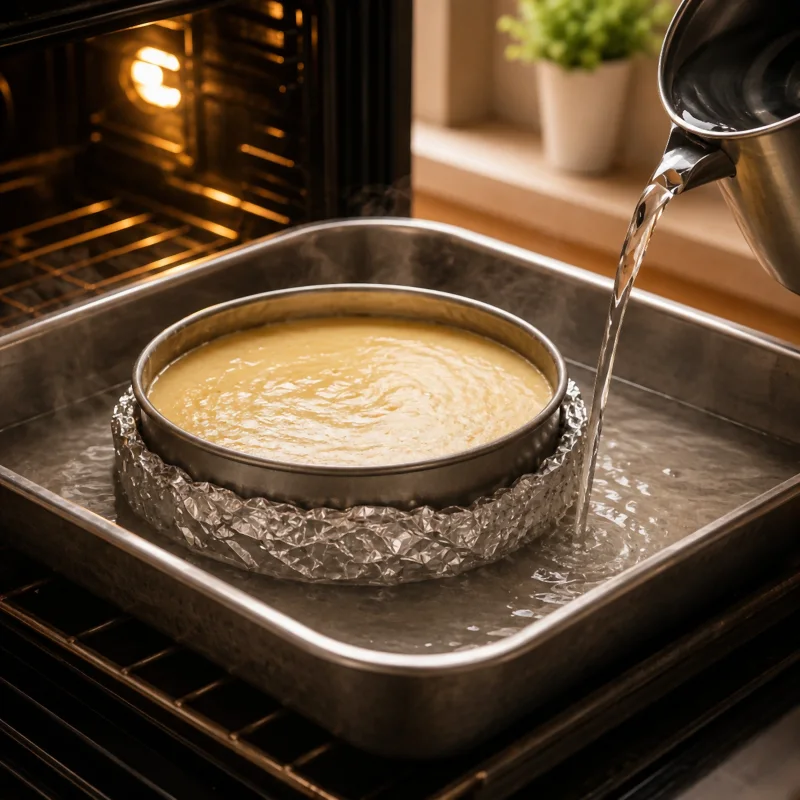
Water-bath baking: gentle heat for smoother, more even set
A water bath, also called a bain-marie, places the baking pan or ramekins inside a larger pan of hot water. The water acts as a thermal buffer around the lower sides of the vessel, while the extra moisture slows surface drying. That combination is useful for mixtures that set largely through egg proteins and can turn grainy, dry or cracked when they heat too quickly.
It is commonly used for classic baked cheesecake, crème brûlée, flan, pots de crème and some terrines. It is not a universal cheesecake rule, though. Basque-style cheesecake deliberately uses high heat and browning, so its method is different. The specific recipe always takes priority.
What a water bath actually changes
Without a water bath, hot oven air and the metal pan can heat the edges much faster than the center. With a true water bath, hot water surrounds the outer vessel and moderates how quickly the sides heat. At normal atmospheric pressure, boiling water stays near its boiling point, so the pan is protected from the most aggressive dry oven heat around its lower sides.
The second effect is humidity. A more humid oven slows the formation of a dry skin on cheesecake and custards. That can reduce surface tension and cracking, but it cannot compensate for an oven that is too hot, a batter full of air or abrupt cooling.
When to use it
Use a water bath when the target is a smooth, gently set interior:
- classic baked cheesecake with a pale, creamy filling,
- crème brûlée, flan and other baked custards,
- some sweet or savory terrines when the recipe calls for gentle heating,
- other delicate egg-set mixtures whose edges overcook before the center sets.
Do not add a water bath automatically. If a recipe depends on strong browning, a dry crust or very high heat, the bath may move the result away from the intended style.
How to set up the bath
Place the baking vessel inside a larger, deep roasting pan. Use hot water so the first part of the bake is not spent heating a large mass of cold water. A useful starting point for ramekins and many cheesecake setups is water reaching roughly halfway up the sides; follow the recipe when it specifies a different level.
The safest method is to place the roasting pan on a pulled-out oven rack first, then pour in the hot water. This reduces the chance of carrying a heavy pan full of near-boiling water across the kitchen.
The water should be hot, but vigorous boiling is not the goal. Hard bubbling can jostle ramekins and splash water where it does not belong.
Keeping water out of a springform pan
A springform pan is not designed to be watertight. Heavy-duty foil can reduce leaks, but folds and tiny tears can still let water reach the crust.
A more robust setup is to place the springform pan inside a slightly larger solid cake pan, then set that solid pan in the water bath. The springform seam never touches the water directly.
A separate pan of hot water on a lower oven rack is useful for steam, but it is not equivalent to a true water bath. It increases humidity without surrounding the cheesecake pan with water, so it provides less thermal buffering at the edges.
How to judge cheesecake doneness
For a classic baked cheesecake, the outer ring should look set while the center still gives a gentle, cohesive wobble when the pan is nudged. The center should not slosh like liquid, but it does not need to be rigid in the oven. It continues to set as it cools.
A cheesecake that puffs strongly, browns aggressively or becomes firm all the way through may be receiving too much heat. Cracking can also come from overbaking, too much incorporated air, sticking to the pan wall or cooling too quickly.
For baked custards, watch movement rather than color
Crème brûlée, flan and similar custards should be set around the edges and still move slightly in the center. Bubbling, puffing or a coarse curdled surface points to excessive heat.
The goal is controlled protein coagulation: a fine network that traps liquid without squeezing it out. That is why gentle heating matters so much more than simply “getting it firm fast.”
Terrines need an extra check
For sweet terrines, texture cues can be similar to baked custards. For meat or other food-safety-sensitive terrines, appearance is not enough: use the internal-temperature and safety target specified for that recipe and ingredient. A water bath controls heat transfer; it does not replace safe cooking verification.
Common water-bath mistakes
Starting with cold water: the first stage becomes less predictable because the oven must heat the bath itself. Start with hot water.
Overfilling the roasting pan: extra depth is not automatically better and makes spills more likely.
Trusting a springform seam: protect it properly or nest it in a solid pan.
Using too much oven heat: the water bath softens the heat load but cannot fix an unsuitable oven setting.
Cooling too fast: cheesecake contracts as it cools. A gradual transition from oven to room temperature and then refrigeration reduces thermal stress.
PEK practical rule
Use a water bath when the result you want is smooth, gently set and evenly cooked. Start with hot water, use a stable outer pan, keep water out of the cheesecake, and do not wait for the center to become rock-solid in the oven. The technique works best when you understand what it controls.
Frequently asked questions
Answers to common questions
When should I use a water bath for baking?
Use it for delicate egg-set mixtures that benefit from slow, even cooking, including classic baked cheesecake, crème brûlée, flan and some terrines. It is not required for every cheesecake style.
How deep should the water be?
A practical starting point is about halfway up the sides of the pan or ramekins unless the recipe says otherwise. Enough water is needed for stable buffering, but excess water only makes spilling more likely.
Should the water be hot before baking?
Yes. Starting with hot water reduces the warm-up lag and makes the early stage of baking more consistent.
Why can cheesecake still crack in a water bath?
Cracking can also come from excessive oven heat, overbaking, too much air in the batter, sticking to the pan wall or cooling too quickly. A water bath lowers the risk but cannot eliminate those causes.
Is a pan of water on the lower rack the same thing?
No. It adds humidity and may help keep the surface from drying, but it does not surround the baking pan with water, so the edge-heating buffer is weaker.
How do I keep water out of a springform pan?
Heavy foil can help but is not foolproof. A robust option is to place the springform pan inside a slightly larger solid cake pan, then set that pan in the water bath.
How do I know when cheesecake is done?
For a classic baked cheesecake, the edges should look set while the center still gives a gentle, cohesive wobble when the pan is nudged. A liquid center needs more time; a completely rigid center in the oven may already be overbaked.