The refrigerator slows fermentation; it does not switch it off
Cold fermentation is not one recipe with a mandatory eight, twelve, or sixteen hours. It is a way of controlling dough by lowering temperature and widening the useful fermentation window. How far dough continues to develop in the refrigerator depends on its temperature when chilled, the amount and type of yeast or starter, the formula, flour strength, and the refrigerator's actual temperature.
The more useful question is therefore what state is the dough in when it goes cold? rather than only how many hours it will stay there.
Cold bulk fermentation and a cold final proof are different tools
With cold bulk fermentation, the unshaped dough is refrigerated. The next day it is usually divided or shaped and then allowed to finish proofing. This works well when you want to shape in the morning or divide one larger batch into several loaves.
With a cold final proof, the loaf is shaped before chilling. If it reaches the right proof in the refrigerator, it may be ready to score and bake straight from cold. Chilled dough is firmer and often easier to score, but firmness by itself does not prove that the loaf is correctly fermented.
When should dough go into the refrigerator?
There is no universal rule that every dough must spend 45, 60, or 90 minutes at room temperature first. Some formulas need a clear start to fermentation before chilling; others are designed around cool dough, a small yeast dose, and early refrigeration. The recipe and fermentation target decide.
Before chilling, check whether fermentation has started, whether the dough has enough structure for the next stage, and how warm it is. Warm dough does not cool instantly after entering the fridge, so it can continue fermenting relatively quickly for some time. A large bulk mass cools more slowly than a small shaped loaf.
Measure refrigerator temperature if consistency matters. Different shelves and an overloaded or frequently opened refrigerator can create a very different overnight result.
How to judge the dough the next morning
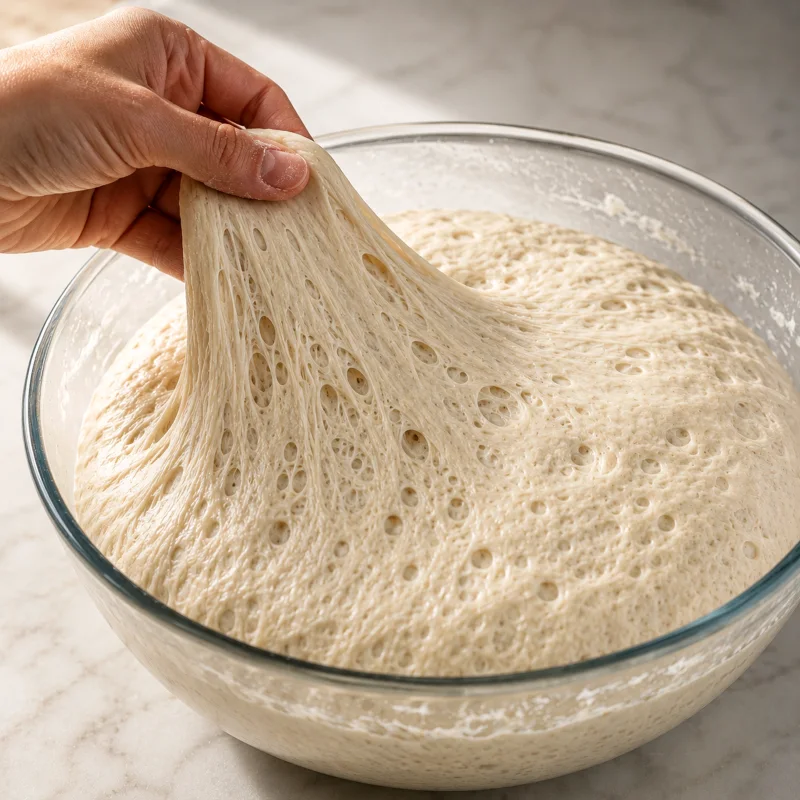
For bulk dough, look at volume increase, the distribution of bubbles, and what happens when you lift an edge. Well-developed dough feels aerated but can still regain some tension. Dough that has become very slack, sticky, and unable to tighten after movement may have gone too far.
For a shaped loaf, look at shape retention, surface tension, and gas beneath the surface. The poke test can be one extra clue, but it is not a universal meter; flour, hydration, temperature, and surface tension all change the response.
A shaped loaf that is properly proofed often does not need to warm to room temperature. It can be scored and baked cold. If it is clearly underproofed, allow additional proofing before baking.
If the dough is under- or over-fermented
Dense dough with little visible activity should first be allowed to continue fermenting at a suitable temperature. If the problem repeats, check yeast activity, dosage, salt, and the formula. When dough consistently doesn't rise and stays dense, extra refrigerator time may not fix the underlying cause.
Very puffy, weak, sticky dough calls for the opposite correction next time: chill earlier, reduce the fermentation load, or use a colder environment. Refrigeration cannot rebuild structure that has already been lost.
For lean bread dough, added sugar is not required simply to “feed” the yeast. See does yeast need sugar? for the distinction between fermentable sugars and added table sugar.
Overnight is a schedule, not a target number
An overnight refrigerator stage is convenient, but “overnight” is only a planning window. For a few bakes, record dough temperature when chilled, refrigerator temperature, cold-fermentation time, and the dough's condition the next morning. That gives you a useful reference for the same flour, formula, and yeast or starter level.
Change the flour, hydration, inoculation, dough size, or temperature and the pace will change too. Cold fermentation becomes reliable when time is read together with temperature and the dough's actual signals.
Diagnostics
Common problems and solutions
Problem
Problem
Technical terms
Terms worth understanding
- Bulk fermentation
- The first fermentation stage after mixing and before dividing or shaping.
- Final proof
- The fermentation stage of a shaped dough piece before baking.
- Cold fermentation
- Controlled fermentation at a lower temperature that strongly slows the process.
- Gas retention
- The dough structure's ability to retain fermentation gas while maintaining shape.
Frequently asked questions
Answers to common questions
Must dough always rise at room temperature before refrigeration?
No. Some methods use a warm start; others chill early. Follow the formula and the dough's actual state.
How many hours should dough stay in the refrigerator?
There is no universal number. Useful time depends on refrigerator temperature, formula, yeast or starter level, and development before chilling.
Can bread be baked straight from the refrigerator?
Yes, if a shaped loaf is already properly proofed. If it is underproofed, give it more time before baking.
How do I recognize over-fermented dough after a cold phase?
Common signs include major loss of tension, very soft sticky structure, and poor shape retention.
Does cold fermentation always improve flavor?
It can create a more complex profile, but excessive fermentation can damage both structure and flavor.