When a cake fails, read the symptom first
A cake does not sink, dry out or crack for no reason. In many sponge and butter cakes, the problem comes down to ingredient balance, the amount of air held in the batter, the oven’s real temperature, or whether the structure had time to set. That makes the failure pattern more useful than changing the recipe at random.
The cake sinks in the middle
If the crumb under the dip is wet, gummy or sticky, the centre was probably not set when the cake came out. Too much baking powder or baking soda, an oven that runs hotter or cooler than its setting, and opening the door too early can produce a similar collapse.
On the next bake, use the same pan, weigh the ingredients and measure leavening precisely. Do not open the oven simply to check whether the cake is rising. Near the end of the bake, test the centre with the doneness cue required by the recipe. Wet batter on a skewer means the structure is not ready yet.
The cake is dry and crumbly
Dry cake does not automatically mean the recipe needs more liquid. Too much flour and too much oven time are common causes. Weighing flour removes much of the uncertainty of cup measurements. Pan size matters too: the same batter in a wider pan forms a thinner layer and usually bakes faster.
If only the edges are dry while the centre is fine, check the pan material and the oven temperature. Dark pans can brown and heat the outer batter more aggressively than light-coloured metal pans.
The crumb is dense or rubbery
In cakes leavened partly by whipped eggs or creamed butter and sugar, trapped air is part of the recipe. Rough folding can knock that air out, while prolonged mixing after flour is added can create a firmer texture. Mix only until the flour is incorporated unless the recipe specifically calls for another technique.
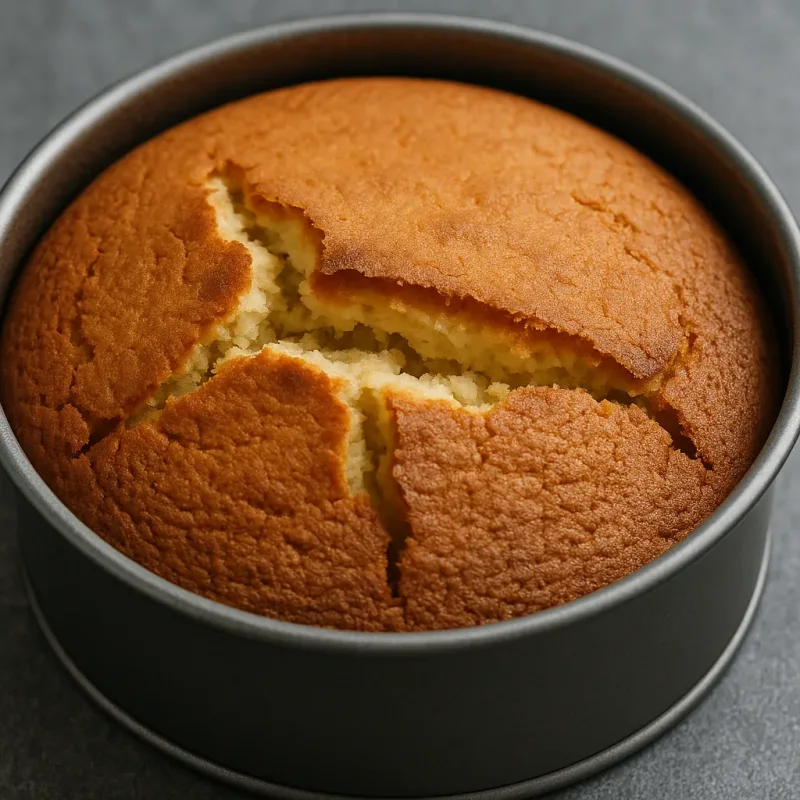
The top domes or cracks badly
In a typical layer cake, a strong dome or crack often means the outside set before the centre finished expanding. Check the actual oven temperature, the pan size and the rack position. Do not automatically lower the temperature for every crack; some loaf-style cakes naturally split on top.
One side rises higher
If several different cakes repeatedly rise higher on the same side, uneven oven heat or the pan position is more likely than the batter itself. Place the pan on a stable rack with clearance around it. Rotate only late in the bake, after the structure has had time to set.
Filling or frosting slides between the layers
A warm cake softens butter- and chocolate-based creams. A very soft filling may also lack the load-bearing strength required by a tall cake. Cool the layers completely and choose a filling whose structure matches the cake height, room temperature and transport conditions.
A fast troubleshooting order
For a sunken centre, check doneness first, then oven temperature, leavening and early door opening. For a dry cake, check flour weight, baking time and pan size. For a dense cake, check aeration and mixing. For a large dome or crack, check temperature, pan size and rack position.
Change one variable at a time. That is what turns a failed cake into useful evidence instead of another round of guesswork.