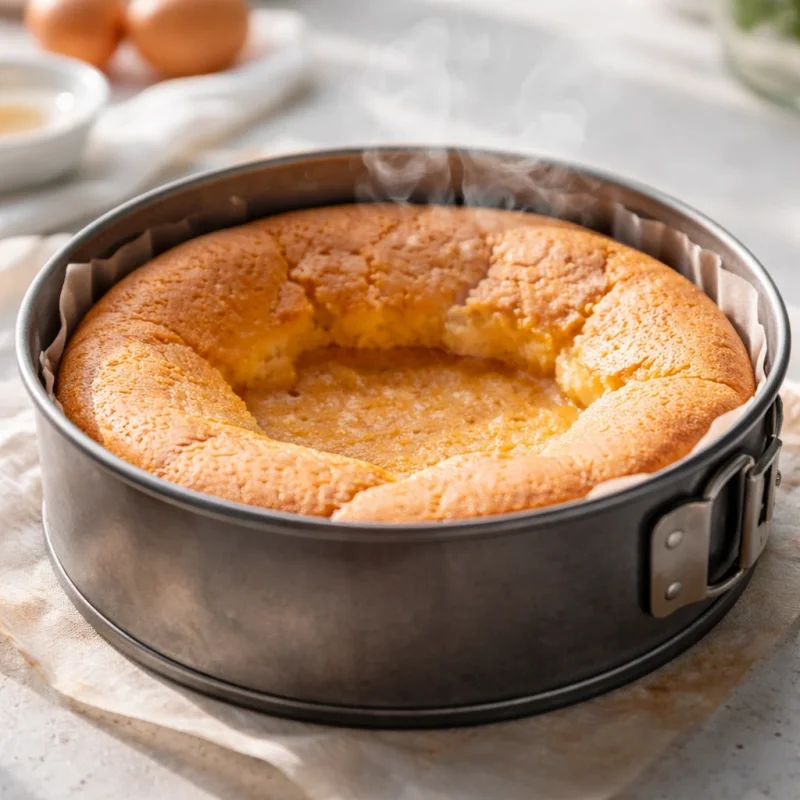
Why sponge cake sinks after baking
A sponge cake sinks when it expands faster in the oven than its internal structure can set. As the cake cools, the air and steam inside the bubbles contract. At that point the network built by egg proteins, starch and other solids has to support the height on its own. If the centre is still weak or the foam lost stability during mixing, the cake collapses.
The most common practical causes are an underbaked centre, an oven that is too hot or unstable, opening the door too early, too much chemical leavener in recipes that use it, or knocking too much air out during mixing. A small, even amount of shrinkage is normal in a very airy sponge; a deep crater, a wet dense band or a major loss of height is not.
First separate normal shrinkage from a true collapse
Airy cakes often contract slightly after leaving the oven because the gases in the crumb cool and some steam escapes. That alone is not a fault.
A structural failure is more likely when:
- the centre drops well below the edges,
- a wet or dense band develops below the top,
- the centre does not spring back after a light touch,
- the middle still looks loose or wobbly while the edges are already set,
- the cut crumb shows large voids above a heavy compressed centre.
What has to become strong enough during baking
Volume comes from air in the foam and, in some recipes, from chemical leavening. Air and water vapour expand as the batter heats. At the same time egg proteins must set, starch must absorb water and gelatinise, and the solid ingredients must form a load-bearing crumb.
Sugar helps stabilise egg foam and keeps the crumb tender, but it can also delay the setting of proteins and starch. If gas expansion outruns structure formation, the cake can look impressively high in the oven and still sink as it cools.
Diagnose by the moment the cake starts to fall
If it falls while still in the oven: check whether the door was opened too early, whether oven temperature is unstable, and whether the recipe contains too much leavener. With egg-foam sponge, also check whether the foam was stable and whether much of its volume was lost when the flour was folded in.
If it rises very high and sinks immediately after baking: the centre is often not set enough. The outside may already be browned while the middle is still behind. An oven that is too hot can make this contrast worse by setting the top and edges first.
If it never rises enough: the problem is more likely to be foam development or mixing than cooling. For a classic whole-egg sponge, look for a thick pale foam that falls from the whisk in ribbons. See how to whip eggs and sugar to ribbon stage.
If you see a wet, dense layer in the cut crumb: check centre doneness and liquid balance first. It is not automatic proof that the oven itself was “too humid”.
Oven temperature: colour is not proof of doneness
The surface and edges receive heat before the centre. If the true oven temperature is too high, the outside can brown and firm quickly while the middle still lacks enough structure.
If the same pattern appears across several recipes, measure the actual oven temperature. Do not change flour, sugar and baking time all at once or you will lose the ability to identify the real cause.
Sugar and flour both affect when the crumb sets
Sugar does more than sweeten. It helps stabilise foam, retains water and tenderises the crumb, while also delaying protein coagulation and starch gelatinisation. Large changes in sugar therefore change the timing of the bake as well as sweetness.
Flour also needs balance. Too little structural material can leave the crumb weak, while too much flour usually makes it denser, drier and less airy. “Add more flour” is not a universal fix for a sinking cake.
How to tell whether the centre is actually set
Use several signals together. The centre should no longer look liquid or loose, the surface should spring back after a gentle touch, and the edges should feel stable. Where a skewer test is appropriate, it should not come out coated in wet batter.
Recipe time is a guide, not a measurement of state. Pan size, batter depth and actual oven temperature all change when the centre becomes ready.
Cooling cannot rescue an unset centre
Some shrinkage during cooling is normal. A cold draught or rough handling can make a delicate sponge settle more, but slow cooling cannot rescue a centre that never set properly in the oven.
Follow the cooling method for the specific sponge you are baking. Some cakes rest briefly in the tin; others are turned out sooner. There is no single cooling rule for every sponge formula.
How to test the next correction: change one main variable at a time
When a sponge repeatedly collapses, first identify the phase where it begins to go wrong: whipping, folding, baking, the end of the bake, or cooling. Then change only the most likely main factor and compare the result.
The shortest answer
To stop sponge cake sinking after baking, combine stable egg foam, gentle folding, balanced ingredient ratios, reliable oven temperature and enough baking time for the centre to set fully. The moment the problem first appears is usually the best clue to its cause.
Diagnostics
Common problems and solutions
The sponge rises very high in the oven, then forms a deep crater after baking.
Cause: The centre is not set enough; excessive oven temperature or too much leavener may also contribute.
Solution: Check actual oven temperature and bake until the centre is stable and springy, not merely browned.
The batter loses a large amount of volume as soon as the flour is added.
Cause: The egg foam is weak or the flour was folded in too aggressively.
Solution: Whip to a stable ribbon stage and fold with the minimum movement needed to incorporate the flour.
The edges are dry while the centre is wet and dense.
Cause: The outside finished before the centre because of excessive heat, a deep batter layer or insufficient baking time.
Solution: Check pan size, actual oven temperature and centre stability before removing the cake.
The sponge shrinks slightly and evenly but the crumb stays dry and resilient.
Cause: Normal contraction of gases and loss of some steam during cooling.
Solution: Do not change the formula solely because of a small, even reduction in height.
Technical terms
Terms worth understanding
- Protein coagulation
- Heat-driven setting of egg proteins that helps build the sponge’s load-bearing structure.
- Starch gelatinisation
- The process in which starch absorbs water as it heats and helps the crumb become set.
- Egg foam
- A network of fine air bubbles in whipped eggs that provides much of the initial volume in foam-based sponge.
- Centre collapse
- A major loss of height when the internal structure can no longer support itself as the cake cools.
Frequently asked questions
Answers to common questions
Why does sponge cake sink in the middle after baking?
Most often the centre has not set enough by the end of baking. Short baking time, excessive or unstable oven temperature, loss of air from the foam, or too much leavener can all contribute.
Is every amount of sinking a baking failure?
No. A very airy sponge may shrink slightly and evenly as it cools. A deep crater, wet dense band, major loss of height or a centre that does not spring back are more meaningful warning signs.
Can opening the oven too early make sponge cake collapse?
Yes, especially before the centre has set. Opening the door drops temperature and contracts gases inside a structure that may still be weak. Check the cake only toward the end of baking.
How do I know when sponge cake is fully baked?
Use several signs together: a stable springy centre with no loose movement, firm edges, and—where appropriate—a skewer that is not coated in wet batter. Colour alone is not enough.
Will adding more flour stop a sponge cake sinking?
Not as a universal rule. Too little structural material can weaken the crumb, but too much flour makes it denser and drier. Check the proven formula, centre doneness and oven temperature first.