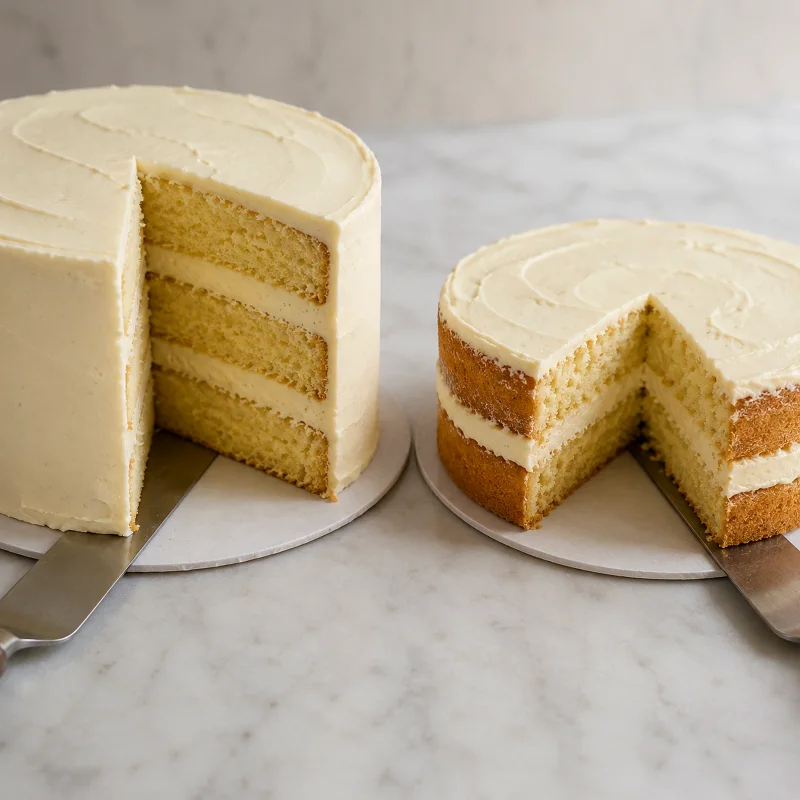
The first mistake happens before the cake reaches the oven
Changing pan size changes more than ingredient quantity. It changes batter depth, the distance heat travels to the center, edge-to-center balance, and the load on fillings. A reliable conversion therefore has two stages: scale the batter correctly, then evaluate baking and assembly separately.
For a quick calculation, use the cake pan converter.
1. Scaling by diameter instead of area
For two round pans where you want roughly the same batter depth, use (new diameter ÷ original diameter)². Moving from 18 cm to 24 cm gives about 1.78×, not one-third more batter.
See the worked 18 cm to 24 cm example and the general guide to scaling a cake recipe for a different pan size.
Area scaling assumes you want a similar depth. If the target cake should be taller or shorter, the desired depth must become part of the calculation.
2. Ignoring raw batter depth
The formula is the first check; the batter in the pan is the second. If the tested version sits about 4 cm deep, a similar depth in the new pan is a useful practical reference.
A shallower layer normally reaches doneness sooner and can dry if you keep the original time. A deeper layer makes the center slower to set.
Use the guide to how much cake batter you need for pan size and depth.
3. Multiplying bake time by the ingredient factor
A 1.78× ingredient factor does not mean 1.78× baking time. Time depends much more on actual batter depth, the cake formula, pan material and color, and real oven temperature.
If the depth remains similar, begin with the tested oven setting and judge the center. If the layer is thinner, start checking earlier. If it is deeper and the outside races ahead, then consider gentler heat and additional time.
See how to adjust cake baking time for a larger pan.
4. Rounding eggs and small ingredients carelessly
Flour and sugar are easy to scale by weight. Eggs, baking powder, baking soda, salt and gelatin need more care because small changes can have a large structural effect.
Beat and weigh eggs without the shell, then use the mass you need. Do not add extra leavener as insurance. More leavener does not replace missing batter and can weaken the crumb.
If a larger pan produces a short layer, first diagnose why cake is shorter in a larger pan.
5. Treating filling as an exact copy of the cake factor
For the same number of layers and similar filling thickness, the area ratio is a sensible starting point. It is not the final answer. Ganache, whipped cream, mascarpone filling and buttercream carry weight differently.
Check layer thickness, temperature at assembly and the extra amount required for the outside. A soft filling is not made more stable by simply making more of it.
Use the guide to scaling cake filling and frosting.
6. Comparing round and square pans by the printed centimetres
A 24 cm round pan and a 24 × 24 cm square pan do not have the same base area. Compare actual base areas first, then check batter depth.
Square pans also have corners, so edges and corners may set differently from the center. That is a reason to monitor the bake, not to apply an automatic temperature change.
Use the measured round-to-square pan conversion guide.
7. Changing five variables after one failed bake
If the scaled cake is short, dry or unstable, record the original pan, new pan, scale factor, raw batter depth and bake time. Then change one thing.
A useful order is:
- verify the geometric scale factor,
- verify raw batter depth,
- verify eggs and small ingredients,
- adjust baking only after those are correct,
- assess filling separately.
This makes cake scaling repeatable. The biggest errors happen when one number is expected to solve quantity, baking time and cake construction at the same time.
Frequently asked questions
Answers to common questions
Why shouldn’t I scale a cake recipe by pan diameter alone?
Because similar layer height depends on base area. The area of a round pan grows with the square of its diameter.
How can I check whether the scaled batter amount makes sense?
Compare raw batter depth with the tested recipe. If you want similar layer height, the depth should be roughly comparable while leaving enough room for expansion.
Does a larger pan always need a longer bake?
No. A shallower layer can finish sooner. Similar depth may keep bake time closer to the original, but formula, pan and oven still matter.
How do I scale part of an egg?
Beat the egg, weigh it without the shell and use the required mass instead of rounding to a whole egg.
Should filling use the same scaling factor as the cake?
Area ratio is a useful starting point for similar layer thickness, but account for layer count, filling stability and the amount needed for the outside.