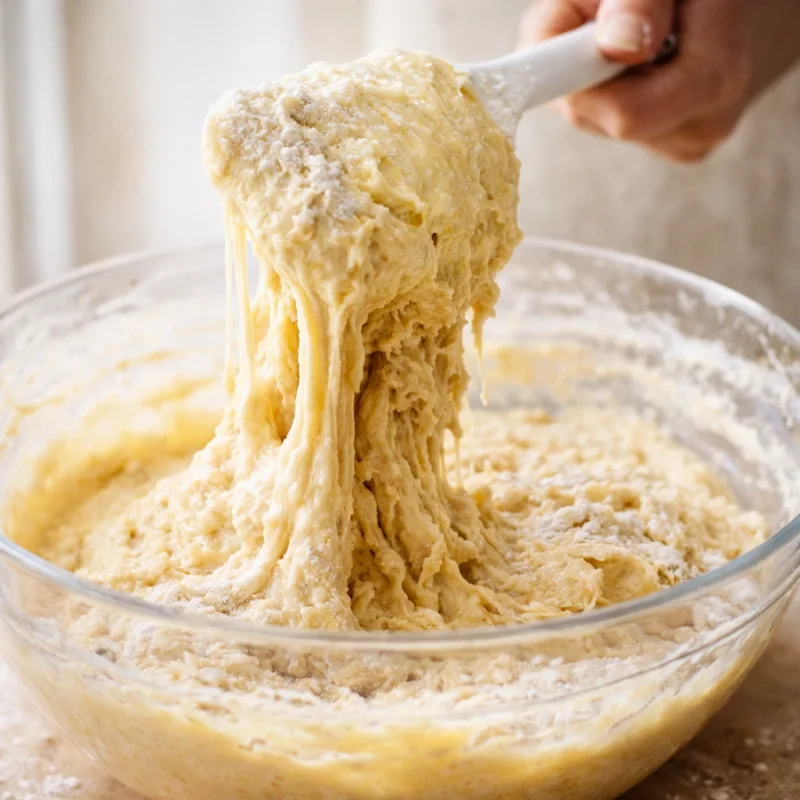
Too much flour is not the same as overmixing
If a sponge cake contains too much flour relative to the eggs, sugar and other liquid, the formula is out of balance. There is more dry matter in the batter, less water available per unit of flour, and the baked crumb can become drier, firmer and denser.
But the same-looking failure can happen with the correct amount of flour. In an egg-foam sponge, much of the starting volume comes from air trapped in the whipped eggs. If that air is lost while the flour is folded in, the cake can be low and dense even though the flour quantity was accurate.
That distinction matters: excess flour is a formula error; excessive or aggressive folding is a process error.
What excess flour actually changes
Flour contributes starch, proteins and other components that affect water binding, batter viscosity and the strength of the baked crumb. If you increase flour without proportionally changing the rest of the recipe:
- less water is available relative to total solids,
- the batter will usually become more viscous,
- the finished crumb can become firmer and less resilient,
- a heavier foam batter can also be easier to deflate while folding.
Flour quality matters as well as flour quantity. Sponge-cake research links volume and crumb softness with flour protein, damaged starch and water/solvent retention characteristics. That is why a simple rule such as “finer flour absorbs more water” is not a reliable diagnosis.
Check the scale before judging batter thickness
Weighing flour in grams is the most repeatable control. Cup measurements can change substantially depending on how the flour is scooped, settled or packed. With a proven formula, do not add an extra spoonful just because the batter looks thinner than you expected.
Batter flow also changes with egg-foam development, temperature, sugar, starch, fat and holding time. A scale is a better reference than trying to force every sponge batter to one visual thickness.
How to tell the causes apart
The batter loses obvious volume immediately after the flour goes in
Foam loss during folding is more likely. Fold only until there are no dry flour pockets, while scraping through the bottom and sides of the bowl.
The flour was measured by volume or extra flour was added “by feel”
A true flour excess becomes more plausible. Compare the actual ingredient weights with the original formula.
The cake reaches normal height but the edges are dry
Check bake time, actual oven temperature and pan size before changing the flour. Dryness alone does not prove that the formula contained too much flour.
The crumb is rubbery or tough rather than simply dry
Also review the mixing method and flour type. Prolonged mixing after wheat flour is added can deflate an aerated batter and, depending on the formula, develop more gluten.
Can you rescue the raw batter with milk or butter?
Not as a universal fix.
If you do not know how much extra flour was added, adding milk, water or melted butter by eye does not restore the original formula. It changes several ratios at once, and the extra mixing may further damage the foam.
If the exact error is known and the recipe is written in weights, you can in principle scale the whole formula to the new flour quantity and add the other ingredients proportionally. That is very different from adding liquid until the batter “looks right”.
For a delicate egg-foam sponge, making a fresh batch is often the more repeatable professional choice when the error is unknown.
Fold in the flour without unnecessary volume loss
Weigh the flour before whipping the eggs. Sift if needed to break up lumps and distribute it more evenly. Fold with a spatula, reach the bottom and sides of the bowl, and stop as soon as no dry pockets remain.
Sifting does not correct too much flour. Gentle folding does not correct a bad ingredient ratio. Each control solves a different problem.
Flour type also changes the result
Two flours of the same weight can behave differently in sponge cake. Protein level, damaged starch and water-binding characteristics all influence batter and crumb. Lower-protein cake flour is often useful for a tender sponge, but protein percentage or particle size alone does not describe the whole system.
Treat a flour substitution as a formula change and test it deliberately.
Diagnose the cooled crumb
Low, finely compact sponge: check flour quantity and how much volume was lost during folding.
Normal height but dry crumb: check flour, but also bake time, actual oven temperature and pan geometry.
Rubbery or tough crumb: review mixing and flour strength.
Visible white flour pockets: the flour was incorporated unevenly; that is not the same as using too much flour.
Dense band near the bottom: check whether heavier batter remained unmixed at the base of the bowl, whether the foam collapsed during folding, or whether the batter stood too long before baking.
Professional conclusion
A dry or dense sponge is not proof of excess flour. Diagnose three separate controls first: formula balance, retained air in the egg foam, and moisture loss during baking. Fix the ratio when the ratio is wrong, fix the folding when volume is lost, and fix the bake when height is good but the crumb is dry. That is far more repeatable than adding flour or liquid by eye.
Frequently asked questions
Answers to common questions
Can too much flour really make sponge cake dry?
Yes. Too much flour relative to the rest of the formula can produce a drier, firmer or more crumbly crumb. But overbaking and excessive oven heat can create similar dryness.
How can I tell too much flour from overmixing?
Check the weights first. If the formula is correct but the batter visibly loses volume after the flour is added, foam loss during folding is more likely.
Can I fix too much flour by adding milk?
Not by eye. If the exact error is known, the whole formula can be scaled proportionally. If it is unknown, random liquid additions change several ratios at once.
Should I always sift flour for sponge cake?
Sifting is useful for breaking up lumps and distributing flour more evenly, but it does not fix the wrong quantity. Fold only until no dry pockets remain.
Why is my sponge low if I weighed the flour correctly?
Common causes include losing air during folding, underdeveloped egg foam and baking problems. Correct flour weight alone does not guarantee volume.
Is cake flour always better for sponge cake?
Lower-protein flour is often useful for a tender crumb, but damaged starch, water binding and other flour properties also affect the result.