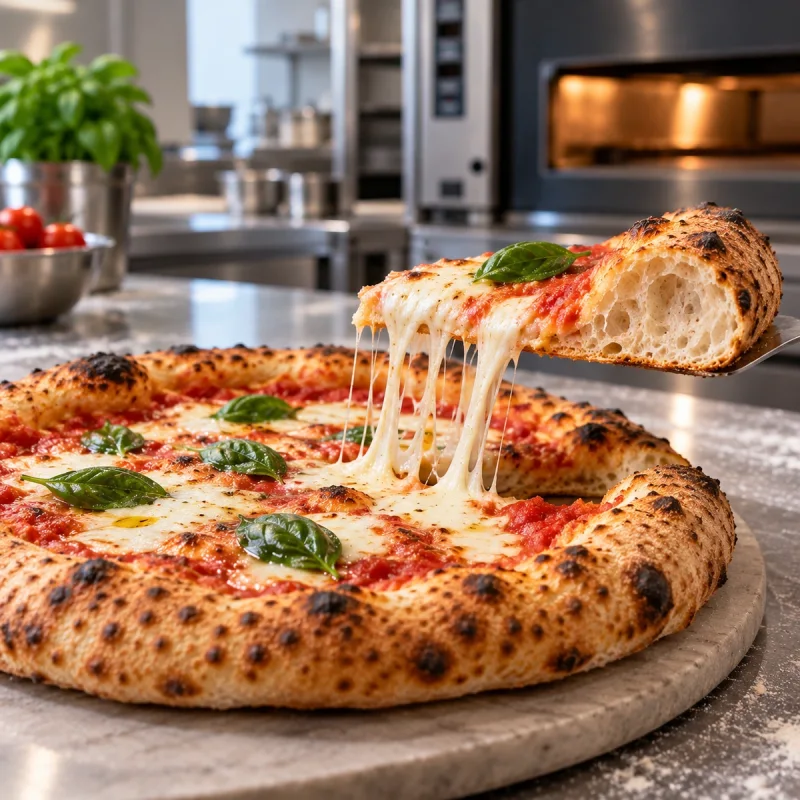
A crisp bottom and a soft, airy rim are not opposites
Pizza dough can be crisp underneath while staying soft, open and flexible at the rim. The result depends on four controls working together: dough hydration, fermentation, heat transfer into the base, and moisture released by the toppings.
A common home-oven mistake is to keep baking simply because the bottom is still pale. That often dries the rim while leaving the real problem — insufficient heat at the baking surface — unchanged.
Hydration: more water is not automatically better
Hydration is the weight of water expressed as a percentage of the flour weight. For example, 650 g water with 1,000 g flour is 65% hydration.
More water can support a softer crumb and a more open internal structure, but only when the flour can handle it and the oven can bake the dough efficiently. In a domestic oven, very wet dough often needs a longer bake. If the baking surface is not hot enough, the base may stay pale while the rim dries out.
There is therefore no single “best” hydration for every pizza. Start with a dough you can shape confidently and change only one variable at a time. If the rim is dry, a small increase in water may help. If the centre stays gummy or the dough loses structure, check flour strength, gluten development, fermentation and bottom heat before adding more water.
Fermentation builds gas, flavour and extensibility
Yeast produces gas and a developed gluten network retains it. Fermentation also changes flavour and how easily the dough stretches.
Cold fermentation can improve flavour and handling, but 24, 48 or 72 hours are not universal targets. Yeast quantity, fridge temperature, flour strength and final dough temperature all change the rate.
Use the dough as the final signal. A well-prepared ball stretches without aggressively snapping back, shows small gas bubbles and still has enough tension to hold its shape. If it constantly shrinks, it often needs more rest. If it is extremely slack, sticky and weak, it may be over-fermented or underdeveloped.
Flour: “00” does not automatically mean strong flour
Tipo 00 describes an Italian flour classification; it does not by itself tell you how long the flour can ferment or how much water it can absorb while retaining structure.
Choose flour for the fermentation schedule and hydration you actually intend to use. Protein content, W strength where available, and the producer’s recommended use can be more informative than the 00 label alone.
Very strong flour is not automatically an advantage for a short fermentation, while weaker flour may struggle during a long cold ferment with a high water load.
A crisp bottom is mainly a heat-transfer problem
Oven air temperature and the temperature of the baking surface are not the same thing.
A thin tray loses heat quickly when raw dough lands on it. A properly preheated pizza stone or steel stores more energy and transfers it into the underside of the pizza. This is why the surface needs a thorough preheat, not merely the few minutes until the oven says it has reached temperature.
Steel transfers heat more aggressively than stone. That can be excellent in a lower-powered home oven, but it can also darken a thin base before the top is ready. Stone is slower and often more forgiving. The right choice depends on your oven, dough thickness and pizza style.
Convection cannot compensate for a cold baking surface
A fan moves hot air more efficiently and can speed surface drying, but it does not replace strong heat transfer from underneath.
If the cheese and rim brown before the base is crisp, the first things to examine are the baking surface, rack position and preheat. If your oven has a dedicated pizza setting, follow the manufacturer’s instructions because different models combine top heat, bottom heat and convection in different ways.
The goal is simple: the top and bottom should finish at roughly the same time.
Wet toppings can undo good dough
Tomato sauce, fresh mozzarella, mushrooms and vegetables release water as they heat. If the oven cannot remove that moisture fast enough, the centre steams instead of baking dry.
Drain fresh mozzarella and other wet ingredients well. Use a restrained layer of sauce and avoid piling toppings heavily over the centre. If the bottom is already nicely browned but the middle is wet, do not automatically extend the bake — reduce topping moisture first.
Oil, sugar and salt change the style
Oil can make the crust feel more tender and can support browning in a domestic oven, but it is not required in every pizza dough.
Added sugar is not necessary for yeast to function. In a lower-temperature oven, a small amount can accelerate browning; at very high temperatures it may make the crust darken too quickly.
Salt improves flavour and affects gluten behaviour and fermentation speed. Reducing it purely to make the dough rise faster also changes taste and structure.
Diagnostics
Common problems and solutions
Pale bottom, rim already dry
Cause: Too little stored heat in the baking surface or the top of the oven is finishing much faster than the base.
Solution: Preheat the stone or steel more thoroughly and adjust rack position or heating mode.
Dark bottom, top still unfinished
Cause: The baking surface is transferring too much heat relative to the top of the oven.
Solution: Move the pizza higher, reduce bottom heat or use a less conductive surface.
Soft or wet centre
Cause: Too much water from sauce, cheese or vegetables, or too much topping overall.
Solution: Drain wet ingredients and reduce sauce and topping load.
Hard, dense rim
Cause: Excessive bake time, hydration too low for the setup, insufficient fermentation or gas pressed out during shaping.
Solution: Change only one variable on the next bake.
Technical terms
Terms worth understanding
- Hydration
- Water weight expressed as a percentage of flour weight.
- Thermal mass
- A material’s ability to store heat and release it into the dough during baking.
- Fermentation
- The process in which yeast activity and enzymatic changes affect gas, flavour and dough behaviour.
Frequently asked questions
Answers to common questions
Is convection or conventional heat better for pizza?
Neither is universally best. Convection moves hot air efficiently but cannot replace a hot baking surface. Choose the mode that lets the top and bottom finish at similar times.
Is more water always better for a soft crust?
No. Higher hydration can help softness, but in a lower-powered oven it can also extend the bake. Match hydration to the flour and heat available.
Is tipo 00 the best flour for every pizza?
No. The 00 label does not by itself tell you flour strength, water absorption or how it will behave during a long ferment.
Why is my pizza soft underneath even when the oven is very hot?
Because hot oven air is not the same as a hot baking surface. A thin or underheated tray cools rapidly when raw dough lands on it.