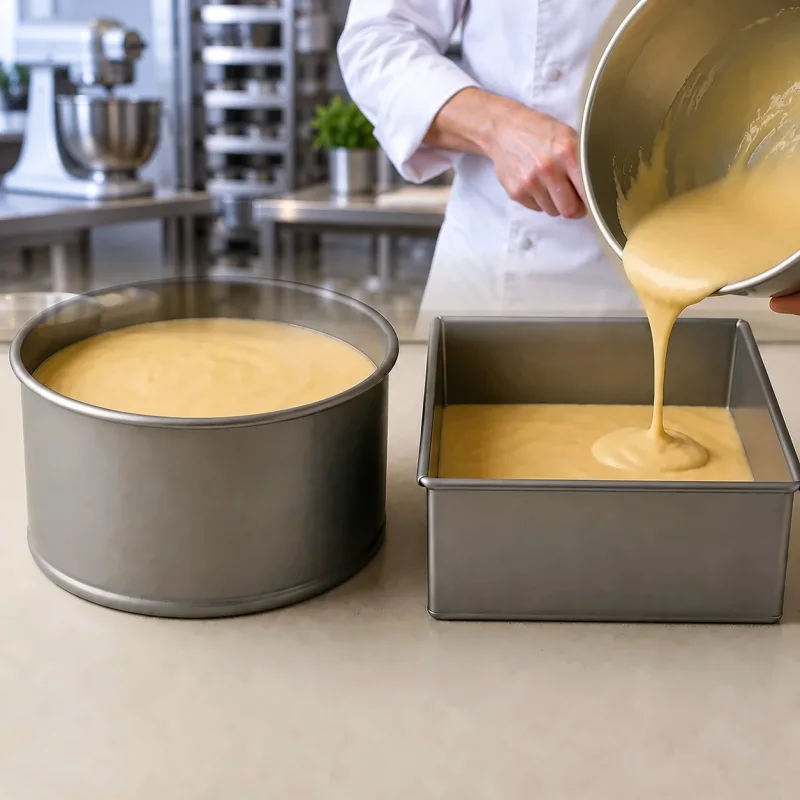
A round and square pan with the same number are not the same size
A recipe written for a 24 cm round pan does not transfer directly to a 24 × 24 cm square pan. The round pan has about 452 cm² of base area; the square has 576 cm². That makes the square about 27% larger by area.
Pour the same batter into both and the square layer will be shallower. The depth is roughly 452 ÷ 576 = 0.79 of the original—about 21% thinner.
The core formula is:
recipe factor = area of new pan ÷ area of original pan
Calculate the two areas
Round pan:
area = π × r²
For a 24 cm pan, radius = 12 cm:
3.1416 × 12² ≈ 452.4 cm²
Square pan:
area = side²
For 24 × 24 cm:
24² = 576 cm²
So the conversion factor is:
576 ÷ 452.4 ≈ 1.27
A recipe with 300 g flour becomes about 381 g. 240 g sugar becomes about 305 g. 200 g egg without shell becomes about 254 g.
Scale the full formula, not just flour or sugar.
The equal-area square shortcut
If you want to use the same recipe amount and keep approximately the same batter depth, choose a square pan with the same base area.
A useful shortcut is:
square side ≈ round diameter × 0.886
Examples:
- 18 cm round ≈ 16.0 cm square
- 20 cm round ≈ 17.7 cm square
- 24 cm round ≈ 21.3 cm square
- 26 cm round ≈ 23.0 cm square
- 28 cm round ≈ 24.8 cm square
Real pans come in standard sizes. A 21 cm square is about 2.5% smaller in area than a 24 cm round; a 22 cm square is about 7% larger. Those differences are usually manageable for a conventional sponge if you understand that batter depth changes slightly and you watch the bake accordingly.
When area is not enough
Area scaling assumes you want roughly the same raw-batter depth.
If you also want a different depth, compare volume:
batter volume = base area × target batter depth
A 24 cm round pan with 4 cm of batter contains roughly:
452.4 × 4 ≈ 1,810 cm³
A 22 × 22 cm square at the same 4 cm depth needs:
484 × 4 = 1,936 cm³
Factor ≈ 1.07.
But if you want 5 cm of batter in that same square:
484 × 5 = 2,420 cm³
Now the factor relative to the original 1,810 cm³ is about 1.34.
That is why pan wall height alone is not the target. The meaningful number is the actual batter depth you plan to bake.
For tapered or irregular moulds, use manufacturer-stated capacity or measure usable capacity with water.
Weigh eggs instead of rounding by count
A multiplier like 1.27 can produce awkward results such as 5.08 eggs. Rounding up or down changes water, protein and fat together.
For precise baking:
- crack the eggs,
- lightly mix if needed,
- weigh them without shells,
- multiply the mass by the pan factor.
If the original formula has 200 g egg, factor 1.27 gives about 254 g.
Square does not automatically mean a lower oven temperature
A square pan has corners and different edge geometry, so edges and corners may colour differently. That does not create a universal rule to lower the oven by 5 or 10 °C.
If correct scaling keeps batter depth similar, the safer starting point is the tested temperature from the original recipe.
Then monitor:
- whether the centre is set and springs back,
- how quickly corners and edges brown,
- the pan material,
- whether the actual batter depth matches the original.
Dark metal often browns more aggressively than light aluminium. That is a material effect, not proof that square pans always need a lower temperature.
Do not multiply baking time by the recipe factor either. Similar batter depth may give a broadly similar bake, but start checking early enough and judge the centre rather than the clock.
Filling and exterior frosting use different geometry
Filling between layers mainly covers horizontal area, so equal-thickness filling can generally follow the area factor.
Exterior frosting covers the top and the sides. A fixed rule such as “add 50–100 g for the corners” is not reliable.
Vertical side area is:
- circle: π × diameter × height
- square: 4 × side × height
An equal-area square has about 13% more vertical side area than the equivalent circle at the same height. That is why a square cake can need somewhat more exterior frosting for the same coating thickness, especially when the cake is tall.
Decide what you are trying to preserve
Before calculating, define the target:
- same batter depth → compare base areas;
- different batter depth → compare volumes;
- same recipe amount → choose a pan with similar base area;
- same exterior finish → include perimeter and cake height.
That one decision prevents most pan-conversion errors.
PEK recommends recording four values whenever you change pans: old shape and size, new shape and size, the scaling factor, and the actual batter depth after filling. Once those are known, the conversion becomes repeatable instead of guesswork.
Frequently asked questions
Answers to common questions
Is a 24 cm round pan equivalent to a 24 × 24 cm square pan?
No. A 24 cm round pan has about 452 cm² of base area, while a 24 × 24 cm square has 576 cm². For the same batter depth, the square needs about 1.27× the recipe.
What square pan is equivalent to a 24 cm round pan?
Mathematically, about 21.3 × 21.3 cm. A 21 cm square is about 2.5% smaller in area and a 22 cm square about 7% larger.
Should I lower the oven temperature for a square pan?
Not automatically. If batter depth is similar, start from the tested temperature in the original recipe and monitor the centre, edges and pan material. Dark metal can brown faster than light aluminium.
How should I scale eggs?
Crack and weigh the eggs without shells, then multiply that mass by the same recipe factor. This is more precise than rounding to whole eggs.
Is area scaling enough if the new pan is deeper?
Only if you want the same raw-batter depth. If the target depth changes, compare volume: base area × target batter depth.
How do I scale exterior frosting?
Layer filling can usually follow the area ratio. Exterior frosting covers the top and sides, so perimeter and cake height matter too. An equal-area square has about 13% more vertical side area than the equivalent circle at the same height.