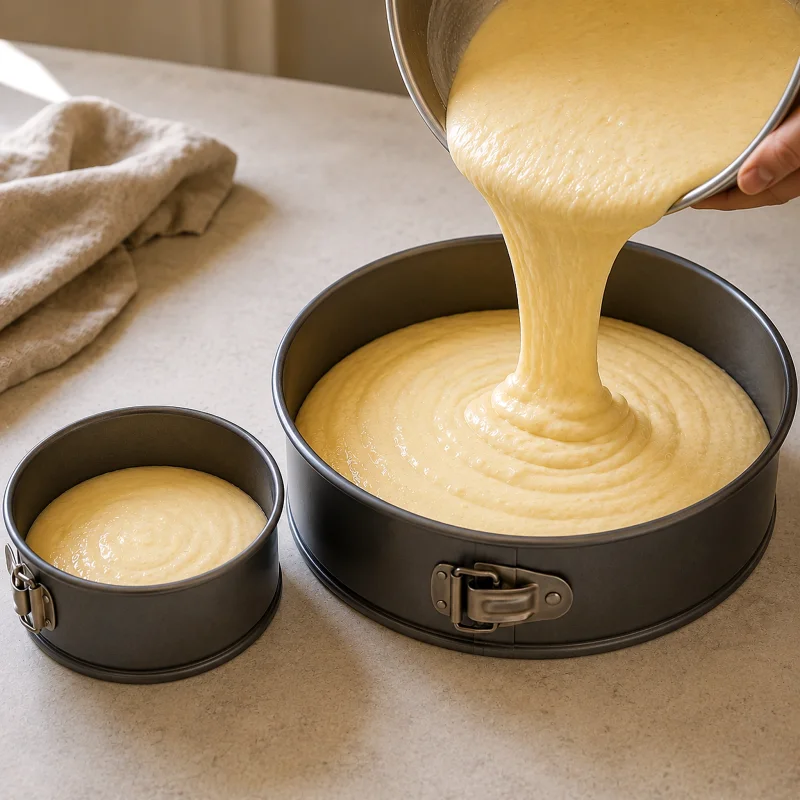
A bigger cake pan does not need “a little more” batter
A recipe is written for an 18 cm round pan, but you have a 24 cm pan. Increasing the ingredients by one third sounds reasonable—and gives the wrong result. The area of a round pan increases with the square of its diameter, not in a straight line.
If you want to keep roughly the same batter depth, use:
scaling factor = new diameter² ÷ original diameter²
Multiply the main ingredients by that factor. The same equation works in centimetres or inches as long as both diameters use the same unit.
Worked example: 18 cm to 24 cm
24² ÷ 18² = 576 ÷ 324 = 1.78. The recipe therefore needs about 1.78 times the original quantities.
250 g flour becomes about 445 g. 180 g sugar becomes about 320 g. 80 g butter becomes about 142 g.
The diameter only increased by a third, but the required batter increased by almost 78%. That is why scaling by the difference in centimetres or inches fails.
Weigh eggs instead of forcing the result to a whole number
Flour, sugar and butter are easy to scale. Eggs are awkward because the factor often gives a fraction of an egg. Beat the eggs together and weigh the amount you actually need.
As a practical reference, a medium egg without its shell is around 50 g. Four eggs are therefore roughly 200 g of egg mass; at a factor of 1.78 the target is about 356 g.
This matters especially in sponge cakes, where eggs contribute water, protein, fat and trapped air. Rounding too aggressively changes more than the total weight—it changes the structure of the batter.
Use batter depth as your reality check
The formula gives you the number. The pan tells you whether the number makes sense.
If the original batter sat about 3 cm deep and the scaled batter is only 2 cm deep in the new pan, recheck the pan diameter, the factor and your weighed quantities. A correctly scaled recipe should put the batter at a similar depth when the goal is the same cake height.
Many conventional cake batters fill a pan somewhere around one-half to two-thirds full, but that is not a universal rule. The best reference is the proven fill level of the original recipe and how much that particular batter rises.
If you also change the intended batter depth or pan height, diameter alone is no longer enough. That becomes a volume calculation.
Scale small ingredients carefully
Baking powder, baking soda, salt and strong flavourings are small in weight but powerful in effect. If the original recipe contains 8 g baking powder, 8 × 1.78 gives 14.2 g. About 14 g is sensible; 16 g “just to make sure it rises” is not.
Too much leavener can inflate the batter faster than the structure can set, giving a coarse crumb or a cake that sinks as it cools.
Scale salt and concentrated flavourings too, but use sensory judgment with vanilla, citrus zest, alcohol and strong spices. Mathematical proportion preserves concentration; it does not guarantee that a flavour will remain balanced to your taste.
A larger diameter does not automatically mean a lower oven temperature
This is the part most conversion guides oversimplify. If you have scaled the ingredients by area and kept batter depth roughly the same, start with the oven temperature specified in the original recipe. A wider pan alone is not a reason to automatically drop the temperature by 10 or 15 degrees.
Do not multiply baking time by the scaling factor either. With similar depth, bake time may stay in the same general range. Start checking at the appropriate point and use physical cues: the centre should be set and springy, and a tester should come out without liquid batter.
A different situation arises when the new batter layer is deeper. Heat then has farther to travel to the centre, so the cake is more likely to need additional time; some recipes may also benefit from gentler heat. That is a depth problem, not simply a diameter problem.
Frosting and filling: use the area factor as a starting point
If the cake has the same number of layers and you want similar filling thickness, the same area factor is a sensible first estimate for frosting or filling.
Then judge the actual product. Whipped cream, ganache, buttercream and fruit gel do not carry weight in the same way. Too little filling leaves a skimpy layer; too much soft filling can make the cake slide when cut.
When the diameter formula is not enough
The equation new diameter² ÷ original diameter² is for two round pans when the target batter depth is similar.
For round-to-square or round-to-rectangular conversions, compare the actual base areas. If the target depth changes as well, compare volume. For tiered cakes, calculate each tier separately.
PEKI recommend writing down four values whenever a conversion works: original diameter, new diameter, scaling factor and actual batter depth before baking. That turns one successful bake into a repeatable production standard.
Frequently asked questions
Answers to common questions
How do I scale a recipe from a 20 cm pan to a 26 cm pan?
Use 26² ÷ 20² = 1.69. Multiply the main ingredients by 1.69, then check that the batter sits at roughly the same depth as it did in the original pan.
Should baking powder be scaled too?
Usually yes. Apply the same factor, but weigh the small amount accurately rather than adding extra “for insurance”. Too much leavener can produce a coarse or unstable crumb.
Does a larger pan always need a longer bake?
No. If scaling keeps batter depth similar, start with the original oven temperature and judge doneness by the cake itself. A deeper layer is much more likely to need extra time.
Can I scale filling or frosting with the same factor?
For the same number of layers and a similar filling thickness, the area factor is a useful starting point. Then adjust for the stability and desired thickness of the specific filling.