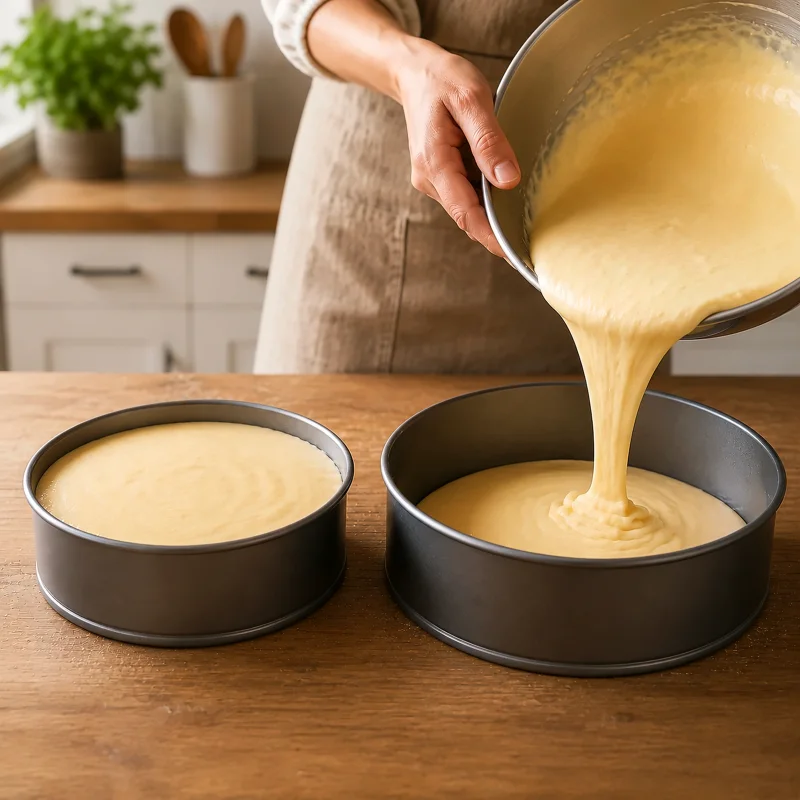
The 18 cm to 24 cm conversion factor is 1.78
To bake a recipe written for an 18 cm round pan in a 24 cm round pan while keeping roughly the same batter depth, multiply the recipe by 1.78.
The calculation uses pan area:
scale factor = (new diameter ÷ original diameter)²
For 18 → 24 cm:
(24 ÷ 18)² = 1.777… ≈ 1.78
That means you need about 78% more batter, not 33% more. Diameter grows linearly; the circular base area grows with the square of the diameter.
Scale the whole formula
If the original recipe is balanced and proven, scale the full formula: flour, sugar, fat, liquid, cocoa, chocolate, nuts, salt and leavening. Scaling only one part changes the recipe rather than simply changing the pan size.
Example:
| Ingredient | 18 cm | 24 cm |
|---|---|---|
| flour | 160 g | about 285 g |
| sugar | 160 g | about 285 g |
| butter | 40 g | about 71 g |
| milk | 40 g/ml | about 71 g/ml |
Most gram amounts can be rounded sensibly. Eggs deserve more care.
Weigh eggs instead of replacing a fraction with milk
Four eggs × 1.78 equals 7.1 eggs on paper. Using seven eggs and then adding a splash of milk to “make up the difference” is not equivalent. Egg contributes water, but also proteins, yolk fat and emulsifiers that affect structure and texture.
A more reliable method is to weigh eggs without the shells. If the four eggs in your original recipe weigh 200 g in total:
200 g × 1.78 = 356 g egg
Whisk the eggs together and weigh out about 356 g. This keeps the functional ratio much closer to the original formula.
Batter depth is the physical check on your math
Area scaling works because it keeps the batter at a similar depth. If your successful 18 cm version had 3.2 cm of batter before baking, the correctly scaled 24 cm version should be close to that depth too.
There is no single correct pre-bake depth for every sponge or butter cake. Recipes are designed for different heights. Compare with the proven original recipe rather than applying a universal “fill the pan to X” rule.
For a recipe you scale often, record both the total batter weight and the batter depth in the pan. Those two numbers make future scaling much more repeatable.
Do not change oven temperature just because the pan is wider
If you have scaled by 1.78 and kept batter depth similar, start with the temperature in the tested original recipe. A 24 cm diameter by itself is not a reason to automatically lower or raise the oven temperature.
Pan material and colour, actual batter depth, recipe composition, convection and oven calibration can all change how the cake bakes. If you also make the batter much deeper or shallower, the thermal situation changes and the baking plan may need to change — but that is a depth and heat-transfer issue, not simply “24 cm”.
Do not multiply baking time by 1.78
The ingredient scale factor is not a time factor. With a comparable batter depth, baking time may remain near the original, but doneness must decide.
Start checking around the time you know from the original recipe. For a conventional sponge or butter cake, the centre should no longer be raw, the surface should spring back gently, and a tester should not come out coated in wet batter. For intentionally fudgy or very moist cakes, a completely dry tester may mean overbaking.
What about baking powder or baking soda?
When you are simply scaling a tested recipe for a different pan, preserve the formula. That means chemical leaveners normally scale with the rest of the ingredients. Changing them independently “because the number looks high” turns a pan conversion into a recipe reformulation.
Layer filling can use 1.78; exterior frosting is different
If the 24 cm cake has the same number of layers and you want the same filling thickness between them, 1.78 is a useful starting point. Each circular layer has 78% more area.
Exterior frosting has different geometry. The top still scales by area, but the side surface of a cake with the same height scales mainly with circumference:
24 ÷ 18 = 1.33
So the sides have about 33% more surface area at the same cake height, not 78% more. Total buttercream or ganache for coating depends on the cake height and how thickly you apply it.
When the 1.78 factor is not enough
Area scaling is excellent for two round pans of similar height when you want the same batter depth. It is not the whole answer for very deep pans, tall layer cakes, cheesecakes, foam cakes with special structural needs, tube pans, water baths, or a change to a different pan shape. In those cases you may also need to consider volume, heat path, support and the limits of the recipe.
Quick 18 cm → 24 cm checklist
- Confirm both pans are round and you want a similar batter depth.
- Multiply the recipe by 1.78.
- Scale eggs by weight without shells.
- Compare batter depth with the successful original.
- Start with the original tested oven temperature.
- Do not multiply bake time by 1.78; judge doneness.
- Layer filling can follow 1.78 at the same thickness; calculate exterior frosting separately.
That turns pan conversion from guesswork into a controlled process: geometry sets the batter quantity, while batter depth and doneness confirm that the scaled cake is actually behaving like the original.
Frequently asked questions
Answers to common questions
What is the 18 cm to 24 cm factor?
For two round pans, (24 ÷ 18)² = 1.777… or 1.78 in practice. That is about 78% more batter for a similar depth.
How should I scale eggs?
Weigh them without shells. If the original egg mass is 200 g, the target is about 356 g. Do not replace a fraction of egg with milk.
Should I lower the temperature for a 24 cm pan?
Not automatically. With similar batter depth, start with the tested original temperature and change it only if depth, pan material or the specific recipe requires it.
Do I multiply baking time by 1.78?
No. 1.78 scales batter quantity, not minutes. Centre doneness is the deciding check.
Should frosting also be multiplied by 1.78?
For the same number of layers and filling thickness, it is a good starting point. Exterior frosting should be planned separately because side area depends on circumference and cake height.