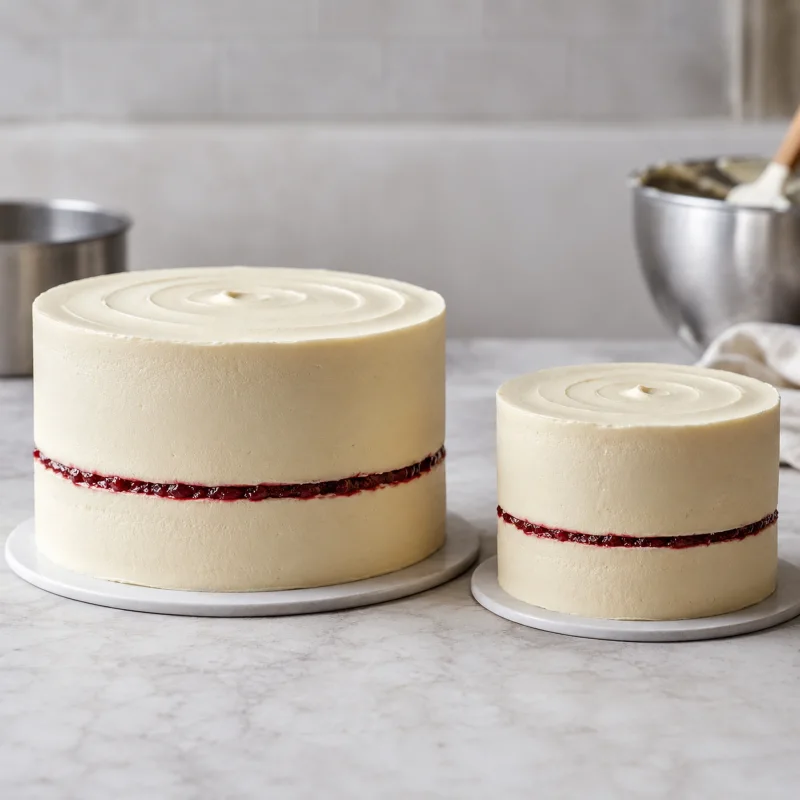
Cake pan conversion is about the pan, not just the diameter
Short answer: when you change cake size, compare the space the batter occupies in the original pan with the space available in the target pan. This converter uses shape, dimensions and pan depth to calculate a recipe multiplier, then applies it to ingredient quantities and approximate servings. That is much more reliable than scaling “by feel” or comparing diameters alone.
Round pans are a classic trap. If depth stays the same, moving from 18 cm to 24 cm does not mean 33% more batter. Area changes with the square of the diameter, so the geometric multiplier is about 1.78. If pan depth or shape also changes, volume is the better comparison.
For a worked example, see how to scale a cake recipe from an 18 cm to a 24 cm pan. For the simpler same-depth diameter relationship, use how to scale a cake recipe for a different pan size.
How to use the cake pan converter
1. Enter the actual inside dimensions of the original pan
Choose round, square or rectangular and enter the dimensions the recipe was written for. Use the usable inside measurement rather than an outside measurement if the difference is meaningful. Pan depth matters for tall cakes: the same diameter at 5 cm and 10 cm deep does not represent the same volume.
If you are unsure how much batter a pan should hold, use how much cake batter you need by pan diameter and layer depth.
2. Enter the target pan
Choose the target shape and enter its real dimensions. The converter can therefore compare different shapes too. A 24 cm round pan and a 24 cm square pan do not have the same area or capacity.
For that specific conversion, see how to convert a round cake pan to a square pan.
3. Add ingredients and read the recipe multiplier
The multiplier tells you how much more or less of the base recipe the target pan needs. For flour, sugar, butter and similar ingredients it is a strong starting point. Eggs, gelatin, yeast, baking powder, salt, fillings and decoration may need sensible rounding or recipe-specific judgment rather than blind linear multiplication.
This matters especially for fillings. A bigger cake does not simply need “more frosting”; it needs the right layer thickness and enough structural stability. Use how to scale cake filling and frosting amounts correctly for that part.
Pan diameter does not tell you the number of servings
Two cakes with the same diameter can give very different numbers of useful portions if their heights differ or if the serving size changes. The converter therefore treats pan dimensions, cake type and portion size as separate inputs.
When you are planning an event, calculate the pan and batter first, then plan the final serving size. Check how many servings a 20, 24, 26 or 28 cm cake makes. For tiered cakes, calculate each tier separately with how to calculate quantities for a tiered cake.
Do not multiply bake time or temperature by the recipe multiplier
If the converter returns 1.78, that does not mean the bake time should also be multiplied by 1.78. A larger mass changes the path heat must travel to the centre, while the outer edge remains directly exposed to oven heat. Time and temperature are therefore separate baking decisions.
Treat the original recipe’s temperature and time as a starting point. Confirm doneness from the cake itself: the outer edge should not be drying out while the centre is still unstable. A cake that becomes too short in a larger pan may not have a leavening problem at all; it may simply start with a batter layer that is too shallow. See why cake is shorter in a larger pan and how to choose cake height for pan diameter.
The most common cake-scaling mistakes
Most errors happen when several variables change at once but only one is considered. A larger diameter, different depth, different shape and a higher serving target are four separate changes.
Use a fixed order: original pan, target pan, recipe multiplier, ingredients, then servings. Only after that should you adjust the bake. If the maths looks right but the batter sits at a very different depth in the new pan, stop and recheck the inputs before baking. Common conversion mistakes include comparing diameter directly, entering outside pan measurements, forgetting pan depth and treating bake time as if it scaled with ingredient weight.
When the converter is not enough
The tool is intended for round, square and rectangular pans that can be described well by basic geometry. Very irregular moulds, strongly tapered sides, tube pans and other specialist shapes may not be represented accurately by simple dimensions. In those cases, measure or compare the actual usable capacity and scale from that.
The cake pan converter is not a replacement for observing the bake. It is the best first step for removing guesswork from quantity calculations, so the next decisions can focus on batter structure, filling stability and an evenly baked centre.