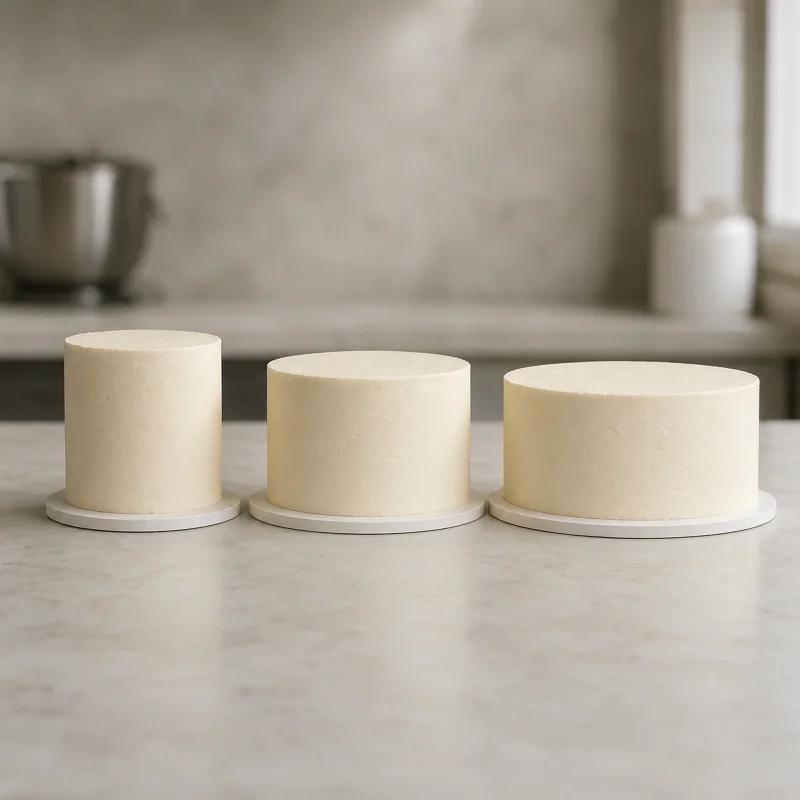
Pan diameter does not come with one correct cake height
A rule such as “a 24 cm cake should be 8 cm tall” sounds convenient, but it mixes up two different variables. Diameter controls base area; it does not automatically determine finished cake height. Finished height should match the amount of cake you need, your cutting method, the number of layers, filling stability and the look you are trying to achieve.
For many classic layer cakes, a finished height around 8–10 cm is a useful planning range. It is not a diameter rule. A small cake can be tall and a wide cake can be tall too; the quantity and structural demands simply change dramatically.
First decide what you are trying to keep constant
If you move to a wider pan and want to keep the same finished height, quantity scales with area:
quantity factor = (new diameter ÷ old diameter)²
Going from 20 cm to 24 cm gives 1.44, so the same-height cake has about 44% more geometric volume.
If instead you want roughly the same total cake volume, height must change:
new height = old height × (old diameter ÷ new diameter)²
A 20 cm cake that is 9 cm tall becomes about 6.25 cm tall at 24 cm diameter for similar geometric volume.
That distinction is the core of the problem. “Bigger pan” can mean a bigger cake, or it can mean the same amount of cake spread across a wider footprint.
Same height can mean almost twice as much cake
For an ideal cylinder 9 cm tall:
| Diameter | Geometric volume at 9 cm | Factor vs 20 cm |
|---|---|---|
| 16 cm | about 1.81 L | 0.64 |
| 20 cm | about 2.83 L | 1.00 |
| 24 cm | about 4.07 L | 1.44 |
| 28 cm | about 5.54 L | 1.96 |
| 32 cm | about 7.24 L | 2.56 |
This is not a serving chart. Real cakes are not perfect cylinders and slice size matters. The table simply shows why diameter and height must be planned together: a 28 cm × 9 cm cake is almost twice the geometric volume of a 20 cm × 9 cm cake.
Build finished height from layers, not from pan-wall height
A 10 cm-deep pan does not mean you should bake one 10 cm-tall sponge. The finished cake is assembled from levelled cake layers, filling and the final finish.
For a roughly 9 cm finished cake, one workable example is three 22 mm cake layers, two 10 mm filling layers and about 4 mm for the top finish. That totals 90 mm. Those numbers are an example, not a universal filling specification. Mousse, whipped cream, ganache and buttercream have very different structural behaviour.
Batter depth is the baking variable to watch
Pan-wall height is capacity. Raw batter depth is what strongly changes the distance heat must travel to the centre.
Pour the same batter into a wider pan and the layer becomes shallower, so it will usually bake faster. Make the batter layer much deeper and the centre takes longer to set while the edges keep receiving heat.
Do not lower oven temperature automatically just because the diameter is larger. If batter depth and recipe remain similar, start from the tested temperature of the original recipe and judge actual doneness. Bake time is not multiplied by the area ratio.
When you need a very tall finished cake, multiple controlled layers are often more predictable than one extremely deep sponge unless the recipe was specifically designed for deep baking.
Extra-tall cakes become a structural problem
At greater finished heights, lateral movement, filling softness, overall mass and transport matter as much as the sponge recipe. There is no single universal centimetre threshold for every cake.
Extra-tall or tiered cakes should use boards and dowels according to actual load. Established cake-construction systems split very tall tiers into supported sections rather than asking filling and sponge alone to carry the entire stack. This is especially important when the cake will be moved after assembly.
A reliable planning order
- Decide servings and cutting method.
- Choose diameter.
- Decide whether you are keeping height or total volume.
- Calculate the geometry.
- Allocate finished height across cake layers, filling and finish.
- Scale batter quantity to the required area and batter depth.
- Check baking behaviour, filling stability and structural support.
- Plan chilling, box clearance and transport before final assembly.
The right cake height is not a lookup-table number. It is a controlled design decision that connects geometry, baking and construction.
Frequently asked questions
Answers to common questions
Does a larger cake have to be shorter?
No. A larger diameter simply creates more area and volume at the same height. Choose a shorter profile only when you want less total cake or a different design.
How do I calculate height if I want the same cake volume?
Use h₂ = h₁ × (d₁ ÷ d₂)². A 20 cm cake that is 9 cm high becomes about 6.25 cm high at 24 cm diameter for similar geometric volume.
Is pan height the same as finished cake height?
No. The pan is the baking vessel. Finished height is built from levelled cake layers, filling and the final top coating.
When does a tall cake need boards and dowels?
There is no single threshold for every recipe. Extra-tall or tiered cakes should be supported according to actual height, weight, filling and transport; established tier systems split very tall cakes into supported sections.