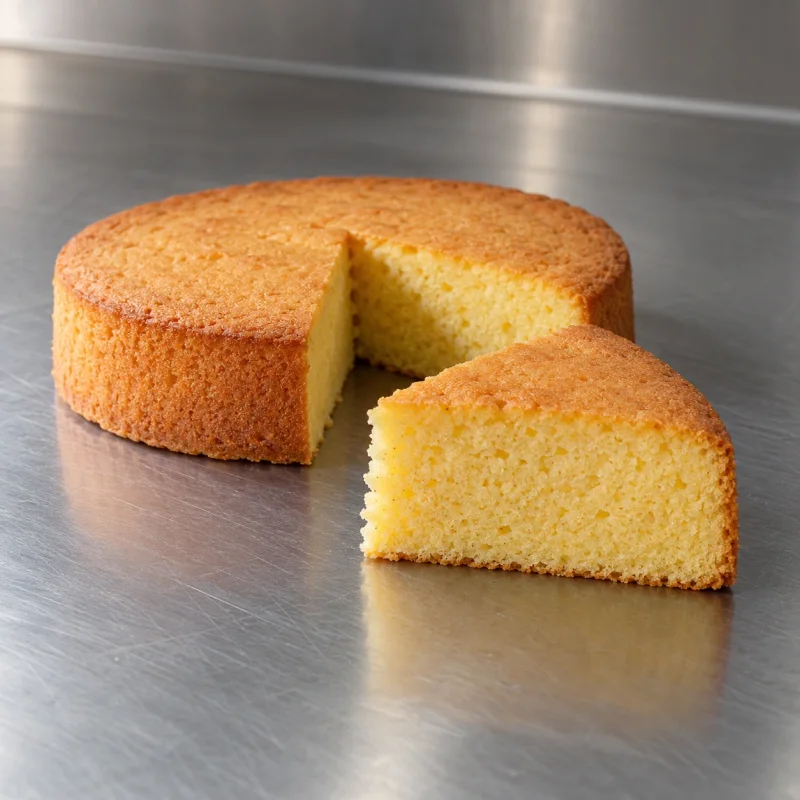
Corn flour cake without a dry, crumbling centre
Check the ingredient before adding more liquid. A corn flour cake can crumble because it was overbaked, the grind does not suit the recipe or the batter cannot support its liquid. Adding milk to a weak batter can leave a heavy, gummy centre instead of a soft crumb.
A well-made cake may be more delicate than a wheat-based version, but a cooled slice should hold together. Look for an even crumb without a floury feel, rather than treating every slightly rustic texture as a fault.
Fine maize flour, cornmeal and cornstarch
These names do not always mean the same thing across English-speaking countries:
- Fine maize flour is ground corn. A fine grind does not tell you whether it is wholegrain or refined.
- Cornmeal, including products sold for polenta, has larger particles and a more noticeable grainy texture.
- Cornstarch is the extracted starch. In the UK it is commonly called cornflour; that is not the fine maize flour discussed here.
Check the packet and the recipe. Do not exchange these ingredients one for one and expect the same cake. A coarser ingredient needs a recipe designed for its hydration; starch needs a formula that uses it deliberately. Neither the name nor the yellow colour establishes the right substitution.
What holds the crumb together?
As the cake bakes, proteins set and starch gelatinizes around the air cells. Gluten is not the only possible source of structure, but a recipe without wheat flour needs a suitable balance of ingredients and mixing.
Crumbling can follow an unsuitable coarse grind, insufficient binding, too little fat, excessive water loss, very thick batter or overbaking. Cutting while the cake is warm can also make it seem more fragile than its finished texture.
The broader relationship is explained in the guide to moisture and stable cake texture.
More moisture is not always the right correction
Extra liquid changes batter consistency and the way the centre sets. If the structure cannot support it, the cake can become heavy or sink. Increasing sugar or fat without checking the recipe changes other features too, including browning and the setting process.
With an existing recipe, check the weights, the actual flour and the baking result first. Make ingredient adjustments in the next batch, one at a time. Adding flour or liquid to a baked cake does not rebuild its internal structure.
Mix evenly and preserve the air
The batter should have no dry pockets of flour. With a finer product it should look uniform; a recipe designed for larger particles may retain some graininess. Do not beat longer merely to make coarse particles disappear.
If the method relies on whipped eggs or egg whites, fold and mix as directed so that the air is retained. The guide to a light, stable sponge cake explains the basic foam-based method. Extra vigorous mixing can lose the volume you have already built.
Check the centre, not just the colour
Yellow crumb and browned edges do not prove that the centre is done. Use several checks together: the middle should spring back under gentle pressure, and a skewer should show no raw or sticky batter. Follow the chosen recipe’s testing instructions and check that the edges are not becoming hard and dry.
A tester alone is not conclusive. Do not extend baking simply to obtain darker edges; equally, a sunken or unset centre is not solved by taking the cake out early to preserve moisture. Assess the inside again when a cooled slice is available.
Let cooling finish before judging the cake
Warm cake has not reached its final cutting texture. Let it become firm enough to unmould according to the recipe, then cool it on a rack. Once fully cool, protect it from drying out. Prolonged exposure to air makes it harder to distinguish a recipe problem from a storage problem.
Record the flour product, grind, tin and baking time. Your target is a deliberately tender maize cake that holds together, with corrections that you can repeat rather than a series of unmeasured additions.
Diagnostics
Common problems and solutions
Dry, crumbly cake
Cause: Overbaking, an unsuitable coarse grind, too little fat or an unbalanced formula.
Solution: Compare the edges with the centre and inspect a cooled slice. Check the flour and doneness first; adjust liquid or fat only afterwards, in the next batch.
Wet or gummy centre
Cause: Too much free liquid, insufficient structure or an underbaked centre.
Solution: Look for a smear on the knife and a centre that stays indented. Check weighing and doneness. Do not add flour blindly; test formula changes in a new batch.
Low, dense cake
Cause: Very thick batter, loss of incorporated air or insufficient structure for the liquid.
Solution: Review whether the batter was heavy or lost volume during mixing. Check the ingredient and method for the next batch; more baking powder is not an automatic fix.
Frequently asked questions
Answers to common questions
Is corn flour the same as cornstarch?
Not necessarily: in the US, corn flour commonly means finely ground maize; in the UK, cornflour commonly means cornstarch. Check the ingredient label and the recipe’s intended product rather than substituting by name.
Why is the cake dry despite plenty of liquid?
Water alone does not ensure a soft, stable crumb. Overbaking, an unsuitable coarse flour or weak structure can still produce a dry result.
Is a corn flour cake automatically gluten-free?
No. Maize is naturally gluten-free, but every ingredient, its label and possible cross-contact during preparation must also be checked.